How much is it to cut trees down depends on several factors, but here’s a quick answer if you need a number fast:
| Tree Size | Typical Height | Estimated Cost Range* |
|---|---|---|
| Small | Up to 30 ft | $150 – $500 |
| Medium | 30 – 60 ft | $450 – $1,200 |
| Large | 60 – 80 ft | $800 – $1,500 |
| Very Large | 80+ ft | $1,000 – $3,000+ |
| Emergency Removal | Any size | $1,475 – $5,000+ |
*These are general national averages based on internet research. Actual costs vary significantly based on your property, site conditions, access, and job complexity. Always request a free on-site estimate for accurate pricing.
That tree leaning over your yard after last week’s storm isn’t going anywhere on its own. And if you’ve got storm damage, multiple trees to deal with, or debris piling up, the cost question is usually the first one on your mind.
The honest answer? Tree removal pricing has a wide range. Most homeowners pay somewhere between $400 and $1,200 per tree for a standard removal. But a large, difficult tree near your house or power lines can push that number to $3,000 or more. Complex emergency jobs can go even higher.
The reason for that range isn’t random. Size, species, condition, and access are the four biggest variables. A 30-foot maple in an open backyard is a very different job from a 90-foot oak wedged between your house and your fence.
This guide breaks down exactly what drives those costs — so you can budget accurately, ask the right questions, and avoid surprises.
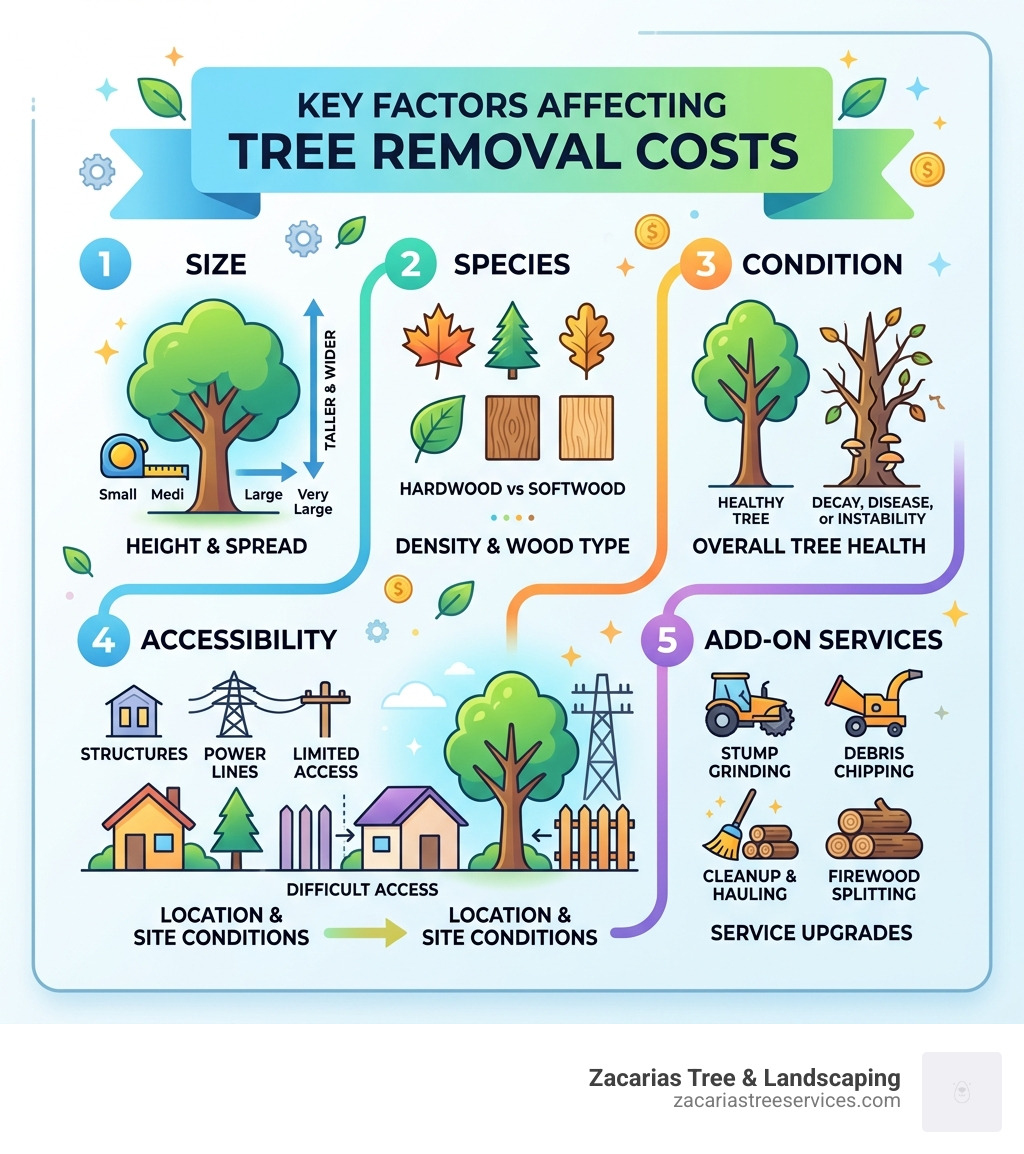
When we talk about tree removal, we have to look at the big picture. According to Tree Removal Cost [2026 Data] | Angi, the national average for tree removal is roughly $750, with most projects falling between $200 and $2,000. However, in our neck of the woods—across Massachusetts from Arlington to Woburn—local factors like labor rates and property density can shift those numbers.
At Zacarias Tree & Landscaping, we know that every yard in Cambridge or Newton is unique. A tree in a wide-open field is one thing; a tree towering over a historic home with narrow lot lines is another entirely. We often point customers to our detailed breakdown on How Much Does It Cost To Cut Down A Tree to help them understand that complexity.
Size is the primary “accelerant” for tree removal costs. The taller the tree, the more equipment, labor, and safety protocols we have to deploy.
It isn’t just about how high the tree reaches toward the clouds; it’s also about how much “meat” is on the bone. Trunk diameter—specifically what pros call Diameter at Breast Height (DBH)—is a major factor.
A tree with a massive, thick trunk represents a huge volume of wood. That wood is heavy, requires more chainsaw work (bucking), and takes more time to haul away. A 100-foot tree with a four-foot-wide trunk is a massive logistical undertaking. If you’re dealing with a giant, you’ll want to read 100 Foot Tree Removal A Tall Order For Your Wallet to see how volume impacts the final bill.
Beyond the tape measure, several “invisible” factors can make a quote go up or down.

Not all wood is created equal. Hardwoods like Oak and Hickory are dense and heavy, which puts more wear and tear on our equipment and takes longer to cut. Softwoods like Pine are generally easier to handle, but they often grow taller and have more “sticky” sap to contend with.
For those with towering hardwoods, our guide on Large Oak Tree Removal Costs That Wont Leave You Broke offers specific insights. Conversely, if you’re looking at a pine, you might find The Average Cost Of Cutting Down A Pine Tree Without Getting Needled helpful for budgeting.
We also have species-specific pricing guides for those who know exactly what’s in their yard:
In Massachusetts, “location” usually means one of two things: power lines or tight spaces. If a tree is within 10 feet of a utility line, we have to work with extreme precision, often coordinating with the utility company.
Then there are the “tight squeezes.” If a tree is sandwiched between a Victorian home in Newton and a neighbor’s prized fence, we can’t just “felling” it (cut it at the base and let it fall). We have to “top” it, removing it piece by piece and lowering those pieces with ropes (rigging).
In some cases, the only safe way to do this is with Crane-assisted tree removal. While a crane adds to the daily cost (often $500–$1,500), it can actually save you money by making the job go twice as fast and preventing property damage. For more on navigating these urban obstacles, see The Root Of The Problem Navigating Tree Removal In Newton Ma.
When you ask, “how much is it to cut trees down,” you’re usually getting a quote for “felling and bucking”—basically, getting the tree on the ground and cutting it into manageable logs. But the job rarely ends there.
Unless you want a wooden “monument” left in your yard, you’ll likely want stump grinding. This is almost always a separate charge.
We provide comprehensive Tree removal services that can include everything from the first cut to the final rake-up. You can find more about our Stump grinding and removal options to ensure your lawn is ready for replanting.

Mother Nature doesn’t always work 9-to-5. If a tree falls on your roof in the middle of a Nor’easter, you need help now. Emergency removals are significantly more expensive because they require us to mobilize crews and equipment instantly, often in dangerous conditions.
According to research, emergency tree removal can range from $1,475 to over $5,000. The cost is high because of the risk and the urgency. If you find yourself in this situation, our 24/7 emergency tree service is designed for rapid response to keep your family safe. You can also read more about national trends in What Is the Average Cost of Cutting Down a Tree?.
Once the tree is gone, your yard might need a little TLC. Heavy equipment can sometimes leave ruts in the grass (though we do our best to prevent this). We offer Seasonal cleanups and full Landscaping services to restore your property to its former glory—or even improve it!
One of the most overlooked costs of tree removal is the paperwork. In many Massachusetts towns like Arlington, Cambridge, or Lexington, you can’t just start cutting.
Navigating these rules can be a headache, which is why we wrote How To Handle Residential Tree Removal Without Losing Your Mind.
If the tree isn’t an immediate hazard, timing your removal can save you a bundle.
We get it—renting a chainsaw seems cheaper than hiring a crew. But tree removal is one of the most dangerous home maintenance tasks there is.
Before you grab the ladder, read our Step By Step Guide To Tree Removal Quotes to see what a professional evaluation looks like.
In many cases, yes. Towns like Cambridge and Newton have strict “Public Shade Tree” laws and ordinances regarding trees on private property that exceed a specific diameter. Always check with your local Department of Public Works (DPW) or Town Hall. We can often help you determine if a permit is needed during our estimate.
Insurance typically only pays if the tree falls due to a “covered peril” (like a windstorm) and hits a “covered structure” (like your house or garage). They generally do not pay for preventative removal of a dying tree, even if it’s leaning toward your house. It’s always best to check your specific policy.
For a small tree, we might be in and out in two hours. A medium-sized tree usually takes 4 to 8 hours. A massive, complex removal involving a crane and extensive rigging can take one to two full working days. Setup and cleanup usually account for about 20-30% of the total time.
At Zacarias Tree & Landscaping, we pride ourselves on being the go-to experts for homeowners from Beverly to Framingham. We understand that how much is it to cut trees down is a significant question for your family budget. That’s why we focus on rapid response, quick estimates, and a thorough cleanup that leaves your property looking better than we found it.
Whether you’re in the tight streets of Lynn or the sprawling yards of Weston, we have the specialized equipment and the local knowledge to handle your tree needs safely and efficiently. Don’t wait for the next big storm to turn a “leaning tree” into an “emergency.”
Ready to find out exactly what your project will cost? Get Your Instant Tree Removal Quote Today and let us take the weight off your shoulders (and your roof!).
Need a pro? Zacarias Tree & Landscaping provides licensed, insured, and expert care across Lynn, Essex, and Middlesex Counties.
We live by a simple promise: Clear scope. Clear plan. Clean finish.
From emergency removals to seasonal landscaping, we’ve been Lynn’s trusted choice since 2002. Safety-first standards. Total site cleanup. Every time.