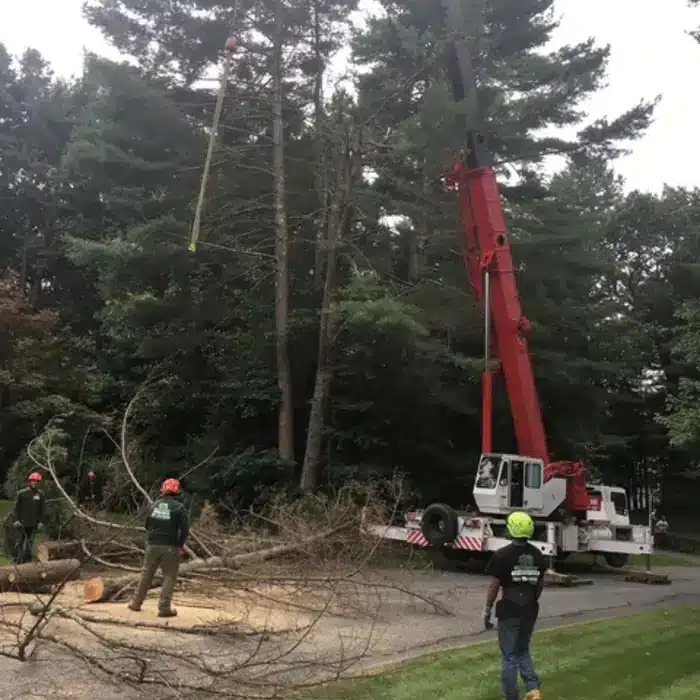
The cost to cut down 80 foot tree typically falls between $1,000 and $2,000 for most homeowners — but complex jobs can push that number to $3,500 or more, depending on your location, the tree’s condition, and how difficult it is to access.
Here’s a quick snapshot of what to expect:
| Tree Height | Typical Cost Range |
|---|---|
| Up to 30 ft | $150 – $500 |
| 30 – 60 ft | $450 – $1,200 |
| 60 – 80 ft | $800 – $1,500 |
| 80 ft and over | $1,000 – $3,500+ |
Note: These figures are based on national averages from general internet research. Actual costs vary significantly based on site conditions, access, tree species, and local labor rates. Always request a free on-site estimate for accurate pricing.
A tree that size isn’t just tall — it’s heavy, wide, and often deeply rooted near things that matter: your home, power lines, fences, and neighbors’ property.
If you’re dealing with a storm-damaged tree in your Massachusetts backyard right now, that urgency is real. A leaning or partially fallen 80-foot tree is a serious hazard. Getting an accurate estimate fast — from a licensed, insured professional — is the smartest first move.
This guide breaks down exactly what drives the cost, what extra fees to watch for, and how to make sure you’re getting a fair price.
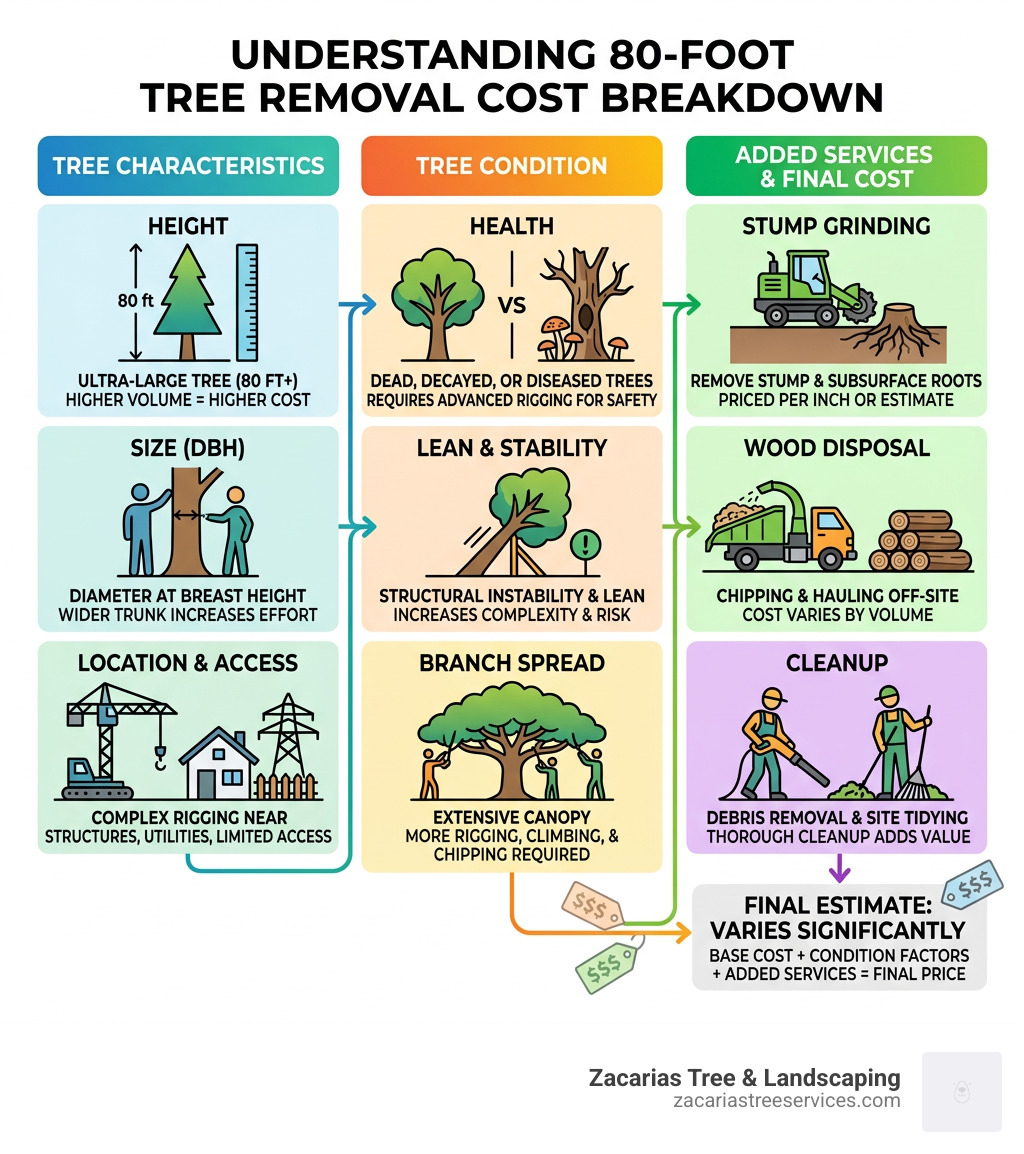
When we talk about an 80-foot tree, we are discussing a massive biological structure. These “extra-large” trees require a level of precision and heavy machinery that smaller ornamental trees simply do not. Based on broad industry data, the cost to cut down 80 foot tree usually starts around $1,000 but can quickly scale upward.
The height-to-cost ratio isn’t linear; as a tree doubles in height, the volume of wood and the complexity of the rigging often triple or quadruple. For a detailed look at how these baseline prices are formed, you can explore our Beginner’s Guide to Tree Service Removal Cost.
While a 30-foot birch might be felled in a single afternoon with a small crew, an 80-foot pine or oak often requires multiple days, specialized climbers, or even crane assistance. Because of this, pricing variability is high. In the Massachusetts area, you might see quotes ranging from $1,160 to well over $3,500 for the most complex removals involving obstacles or high-risk environments.
The taller the tree, the higher the stakes. An 80-foot tree possesses immense potential energy. If it falls the wrong way, the damage to a home or power line can be catastrophic.
If you live in Massachusetts towns like Lexington, Concord, or Cambridge, you know that local factors play a huge role in service pricing.
Not all 80-foot trees are created equal. The species and physical characteristics of the tree are major price drivers. For instance, a tall, slender palm tree (rare in our neck of the woods!) is much easier to handle than a sprawling, multi-trunked White Oak.
Our Tree Removal experts look at several specific traits:
You might think a dead tree would be cheaper to remove because the wood is lighter. In reality, the opposite is often true. Dead or diseased trees are structurally unstable. Brittle wood can snap unexpectedly under the weight of a climber, and the “fall unpredictability” increases significantly.
Research on diseased or infested pests shows that internal rot can hide behind healthy-looking bark. If a tree is infested with emerald ash borer or has significant fungal growth, it may require a crane because it is too dangerous for a human to climb. If you suspect your tree is failing, check out our Emergency Tree Removal: The Homeowner’s 24-Hour Survival Guide to assess the level of risk.
This is often the “make or break” factor for an estimate. If we can’t get a truck near the tree, the crew has to carry every heavy log out by hand or use expensive specialized equipment.
When you see a quote for the cost to cut down 80 foot tree, make sure you know exactly what is included. Some companies provide a “felling only” price, which leaves you with a massive trunk sitting in your yard.

Common add-ons include:
To get a full picture of the possibilities, you can read more info about tree services on our main service page.
In many Massachusetts towns, you can’t just cut down a large tree because you feel like it.
Ignoring these regulations can lead to heavy fines, so we always recommend checking with your town hall in places like Andover, Newton, or Framingham before the saws start buzzing.
We love a good DIY project as much as the next person, but an 80-foot tree removal is not the time for a “weekend warrior” approach. The risks are simply too high.
If you find yourself in a bind, our Emergency Tree Service is designed to handle these high-stakes situations safely and efficiently.
This is a common question. Generally, insurance covers tree removal only if the tree has already fallen and caused damage to a covered structure (like your house or garage) during a covered event (like a windstorm).
Most policies will not pay for “preventative” removal of a healthy or even a dying tree. That is considered routine maintenance. However, if a neighbor’s tree falls on your house, your insurance usually handles your repairs and then seeks reimbursement from the neighbor’s insurance.
For an 80-foot tree:
You should call for emergency service if the tree is:
Budgeting for the cost to cut down 80 foot tree doesn’t have to be a guessing game. While the price range of $1,000 to $3,500+ reflects the massive scale of the job, the investment protects your home’s value and your family’s safety.
At Zacarias Tree & Landscaping, we pride ourselves on our rapid response and thorough cleanup. We understand the local regulations across Massachusetts — from Acton to Woburn — and we bring the professional equipment needed to handle even the most challenging “big ones.”
Don’t wait for the next big Nor’easter to turn a “maintenance” project into an “emergency” disaster. Request a professional tree removal quote today, and let us provide you with a quick, accurate estimate for your property.
Need a pro? Zacarias Tree & Landscaping provides licensed, insured, and expert care across Lynn, Essex, and Middlesex Counties.
We live by a simple promise: Clear scope. Clear plan. Clean finish.
From emergency removals to seasonal landscaping, we’ve been Lynn’s trusted choice since 2002. Safety-first standards. Total site cleanup. Every time.