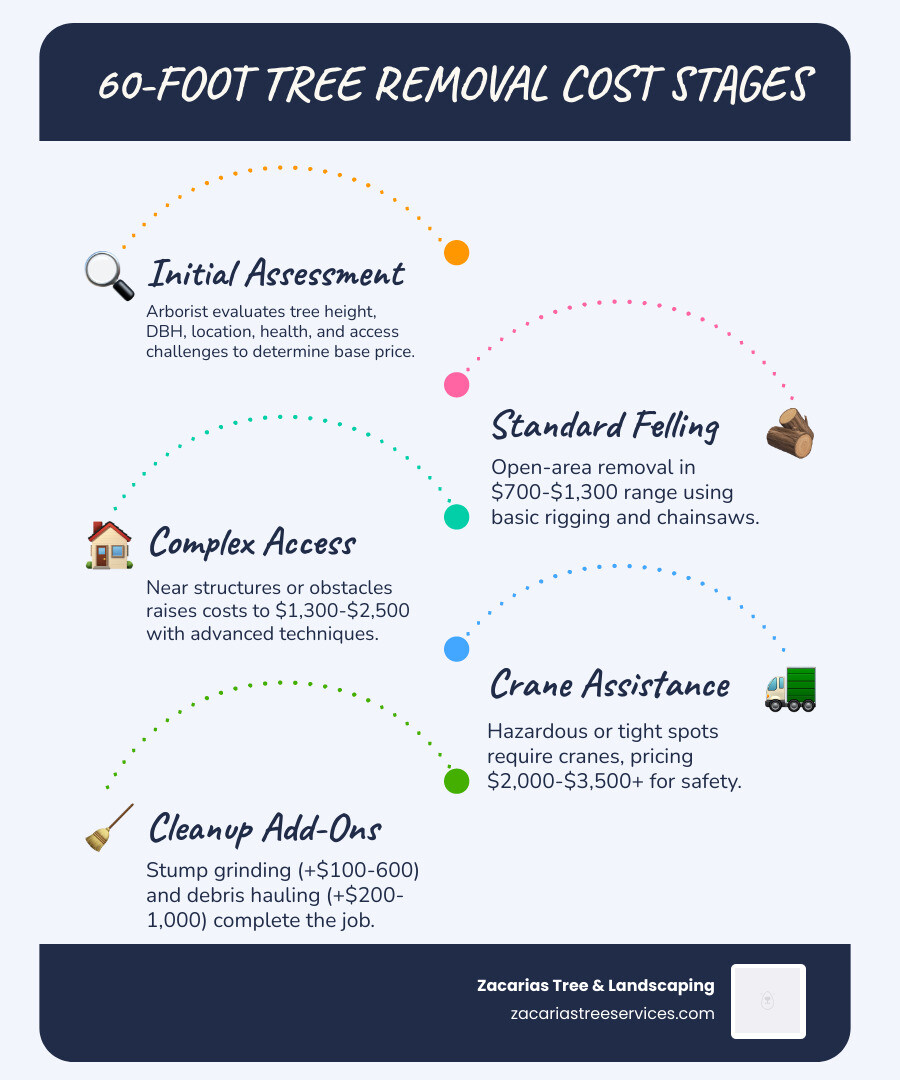
The cost to cut down 60 foot tree typically ranges from $700 to $3,500+, depending on location, tree condition, accessibility, and the services included. Based on general national averages and industry data, here’s a quick breakdown:
| Scenario | Estimated Cost Range |
|---|---|
| Standard removal, open area | $700 – $1,300 |
| Complex removal, near structures | $1,300 – $2,500 |
| Crane-assisted or emergency removal | $2,000 – $3,500+ |
| Add stump grinding | +$100 – $600 |
| Add debris hauling and cleanup | +$200 – $1,000 |
Prices above reflect general internet research and national averages. Actual costs vary based on your property’s conditions, site access, and project scope. Always get an on-site estimate for accurate pricing.
A 60-foot tree is no small job. That’s roughly the height of a six-story building standing in your backyard. When a tree that size gets storm-damaged, starts leaning, or simply needs to come down, the stakes — and the costs — are serious.
Getting a clear picture of what you’ll pay before the chainsaw starts matters. The wrong assumptions can leave you surprised by a bill that’s two or three times what you expected.
This guide breaks down every cost factor so you know exactly what to budget for.
When we assess a tree that reaches 60 feet into the Massachusetts sky, we aren’t just looking at the height. Several physical characteristics of the tree dictate how much labor, equipment, and time will be required.
The first major factor is the trunk diameter, often measured as Diameter at Breast Height (DBH). A 60-foot tree with a narrow trunk is significantly easier to manage than one with a massive, multi-stemmed base. Generally, the wider the trunk, the heavier the wood sections, which requires more intensive rigging and hauling. For more details on the logistics involved, you can explore tree removal services.
Species complexity also plays a massive role. For instance, a 60-foot White Pine is often “straight up and down” with relatively light wood. Conversely, a 60-foot Oak or Sugar Maple—common sights in towns like Lexington or Concord—features dense, heavy hardwood and a sprawling canopy. Hardwoods are tougher on equipment and much heavier to move, often pushing the cost to cut down 60 foot tree toward the higher end of the spectrum.

Location is perhaps the biggest “X-factor” in pricing. A tree in the middle of a five-acre field in Ashby is a straightforward felling job. However, most of our work in places like Cambridge, Somerville, or Newton involves tight quarters.
If a tree is squeezed between two houses, hanging over a swimming pool, or entangled in power lines, we cannot simply “drop” it. We must use specialized techniques like crane assisted tree removal to lift sections of the tree safely over obstacles.
Accessibility obstacles include:
You might think a dead tree would be cheaper to remove because the wood is lighter. In reality, the opposite is often true. Dead or diseased trees are structurally unstable. They are prone to “shattering” when they hit the ground, and it is often too dangerous for an arborist to climb them.
When a tree is leaning significantly or showing signs of internal rot, we have to take extra safety precautions. This often involves using a crane to hold the tree’s weight while it is being cut. If you are curious about how these variables change the bottom line, check out this beginner’s guide to tree service & removal cost.
While national averages for large trees (60-80 feet) often sit between $850 and $2,000, the reality in the Greater Boston area and surrounding Massachusetts suburbs can be higher due to labor rates and disposal fees. In our region, it is common to see quotes ranging from $1,500 to $3,500 for a complex 60-foot removal.
Below is a comparison of how different service levels impact the total:
| Service Level | Description | Estimated Price Range |
|---|---|---|
| Basic Felling | Tree is cut down and left in long lengths; no debris removal. | $700 – $1,200 |
| Standard Removal | Tree is cut, branches are chipped, and wood is hauled away. | $1,500 – $2,500 |
| Complex/Crane | High-risk removal near structures requiring a crane and rigging. | $2,500 – $4,500+ |
For a more exhaustive look at national pricing trends, you can refer to this tree removal cost guide.
The quote to “remove the tree” usually means taking it down to a stump. What happens to the stump and the mountain of branches is often a separate line item.
You can see a full list of these add-ons on our tree services overview page.
Timing is everything. A standard removal is a scheduled event where we have time to plan the best approach. An emergency removal usually happens after a Nor’easter or a summer thunderstorm in towns like Framingham or Worcester.
If a 60-foot tree has split and is resting on your roof, it is an emergency. These jobs often cost 50% to 100% more than standard removals because they require immediate mobilization of crews and equipment, often outside of normal business hours. For help navigating these stressful situations, see our emergency tree removal survival guide.
In many Massachusetts municipalities, you can’t just start cutting. Towns like Brookline, Cambridge, and Salem have strict “Tree Ordinances.” You may need an arborist’s report proving the tree is a hazard before a permit is issued.
To learn more about the technical side of estimating these large-scale projects, you can review large tree removal estimating resources.
We cannot stress this enough: a 60-foot tree is not a DIY project. A tree of this size can weigh between 10,000 and 30,000 pounds. One wrong cut can lead to a catastrophic fall that destroys your home or, worse, causes fatal injury.
Professional arborists bring:
Sometimes, you might not even need a full removal. Strategic tree trimming and pruning alternatives can often save a healthy tree while removing the risk to your home.
Generally, insurance does not cover preventative tree removal. If the tree is healthy but you’re just worried about it, the cost is on you. However, if the tree falls due to a “covered peril” (like a windstorm) and damages a “covered structure” (like your house or garage), insurance will typically pay for the removal of the tree from the structure and a portion of the debris removal. Always check your specific policy for exclusions.
No. Even if you are comfortable with a chainsaw, the physics of a 60-foot fall are unpredictable. Professional equipment like bucket trucks or cranes costs thousands of dollars to rent, and without the training to use them, you are taking a massive risk. The “savings” of a DIY job quickly disappear if you end up paying a $5,000 insurance deductible for a crushed roof.
The cost to cut down 60 foot tree is a significant investment in your property’s safety and value. While the price tag can seem daunting, the cost of doing nothing—or hiring an uninsured “guy with a truck”—can be much higher in the long run.
At Zacarias Tree & Landscaping, we pride ourselves on rapid response times and thorough cleanup. We serve a wide range of Massachusetts communities, from the historic streets of Salem to the wooded lots of Groton and the busy neighborhoods of Quincy. Our goal is to make the process as efficient and stress-free as possible.
Ready to clear that towering hazard from your yard? Request a tree removal estimate today, and let our experts provide you with a safe, professional solution tailored to your property.
Need a pro? Zacarias Tree & Landscaping provides licensed, insured, and expert care across Lynn, Essex, and Middlesex Counties.
We live by a simple promise: Clear scope. Clear plan. Clean finish.
From emergency removals to seasonal landscaping, we’ve been Lynn’s trusted choice since 2002. Safety-first standards. Total site cleanup. Every time.