
• Proudly Servicing Essex & Middlesex Counties and Beyond
  • 24/7 Emergency Tree Services
100-Foot Tree Removal: A Tall Order for Your Wallet
Fully Licensed & Insured
Safety-First Approach
Complete Site Cleanup
Established In 2002

Average Cost to Cut Down 100 Foot Tree


The cost to cut down 100 foot tree typically ranges from $1,500 to $9,000 or more, depending on your location, the tree’s condition, and how complex the job is.

Here’s a quick breakdown before we dive deeper:

Scenario Estimated Cost
Basic removal, clear access $1,500 – $3,000
Moderate complexity (near structures) $3,000 – $5,000
High complexity (crane, power lines, storm damage) $5,000 – $9,000+

Note: These are national averages based on general research. Actual costs vary by location, site conditions, and project scope. Always get a free on-site estimate for accurate pricing.

A 100-foot tree is a serious undertaking. We’re talking about a structure that can weigh anywhere from 10,000 to 50,000 pounds — roughly the weight of a loaded semi-truck.

When that tree is standing in your backyard, possibly leaning after a storm, close to your house or power lines, the stakes are high. One wrong cut can mean a crushed fence, a damaged roof, or worse.

This guide breaks down exactly what drives the cost, what to watch out for, and how to make a smart decision for your property.

Cost drivers for 100-foot tree removal: height, condition, access, equipment, and cleanup - cost to cut down 100 foot tree

When we talk about a 100-foot tree, we are entering the “extra-large” category of tree service. Most residential trees top out at 40 to 60 feet. Once a tree hits the triple digits, the complexity—and the price tag—scales up significantly. Based on national averages and industry data, the cost to cut down 100 foot tree can start as low as $1,500 for a straightforward felling in an open field, but quickly climbs to $5,000 or even $9,000 for complex removals in tight residential quarters.

To put this in perspective, let’s look at how tree size generally dictates the budget.

Tree Removal Cost Comparison by Size

Tree Size Height Average Price Range
Small Under 30 feet $200 – $900
Medium 30 – 60 feet $400 – $1,500
Large 60 – 80 feet $800 – $3,000
Extra-Large Over 80 feet $1,500 – $9,000+

As you can see, the jump from a “large” tree to a “100-foot extra-large” tree is substantial. This is because the equipment required changes from simple chainsaws and ladders to heavy-duty cranes, bucket trucks, and advanced rigging systems. If you’re looking for a quick way to get a rough idea for your specific tree, you can use a Tree removal cost calculator to see how various factors might tip the scales.

Regional Variations in the Cost to Cut Down 100 Foot Tree

In our corner of the country—Massachusetts—costs tend to lean toward the higher end of the national average. Why? It comes down to the local economy and our unique environment. Labor rates in the Northeast, particularly in areas like Cambridge, Lexington, and Newton, reflect a higher cost of living and the high demand for specialized, insured professionals.

Furthermore, our climate plays a huge role. We deal with heavy snow, ice storms, and high winds that can weaken these giants over decades. A 100-foot White Pine in a suburb like Concord or Sudbury requires a different approach than a similar tree in a rural, flat landscape. The density of homes in Massachusetts means we often have to navigate tight property lines, overhead power cables, and historical “heritage” regulations. You can learn more about how we handle these specific challenges on our Tree Services page.

Estimating the Total Cost to Cut Down 100 Foot Tree

While height is the headline, it isn’t the only measurement that matters. When we provide an estimate, we look at several physical dimensions:

  • Trunk Diameter: A 100-foot tree with a 20-inch diameter is much easier to handle than one with a 50-inch “Diameter at Breast Height” (DBH). Thicker trunks mean more weight, more cuts, and more debris to haul away.
  • Canopy Spread: A tree with a massive, sprawling canopy requires more “limbing” (removing branches) before the main trunk can be addressed.
  • Site Accessibility: Can we get a crane or a bucket truck into your backyard? If we have to remove a section of fence or if the tree is positioned on a steep slope, the labor hours will increase.

Industry professionals often use a specific pricing methodology and data to ensure quotes are fair and reflect the actual risk and effort involved.

Key Factors Influencing Large Tree Removal Prices

A crane lifting a massive tree section over a house during removal - cost to cut down 100 foot tree

Removing a 100-foot tree isn’t just about “chopping it down.” It’s a surgical operation. Several factors can swing the price by thousands of dollars.

Tree Species and Wood Density

Not all 100-footers are created equal. For example, a 100-foot Pine tree is a softwood. While tall, its wood is lighter and often easier to cut through. However, Pines are prone to “snapping” rather than bending, which makes them unpredictable if they are diseased. On the other hand, a 100-foot Oak is a dense hardwood. Oak is incredibly heavy and puts more wear and tear on equipment. Because of the sheer weight of hardwood sections, more advanced rigging and larger cranes are often mandatory, driving the price toward that $5,000–$9,000+ range.

Tree Health and Structural Integrity

You might think a dead tree would be cheaper to remove because the wood is lighter. In reality, the opposite is often true. Dead or diseased trees are brittle and unstable. They are dangerous for climbers because branches can snap without warning. If a tree has been hollowed out by rot or damaged by a Nor’easter, we have to take extreme safety precautions. This often means bringing in a crane even if the tree is in an open area, just to ensure no one has to climb the unstable structure. If you’re dealing with a tree that looks like it might go at any second, check out our emergency tree service for immediate assistance.

Equipment Needs and Crane Assistance

For a tree of this magnitude, standard ladders don’t cut it. We often utilize:

  • Bucket Trucks: These allow our technicians to reach heights of 60-70 feet safely.
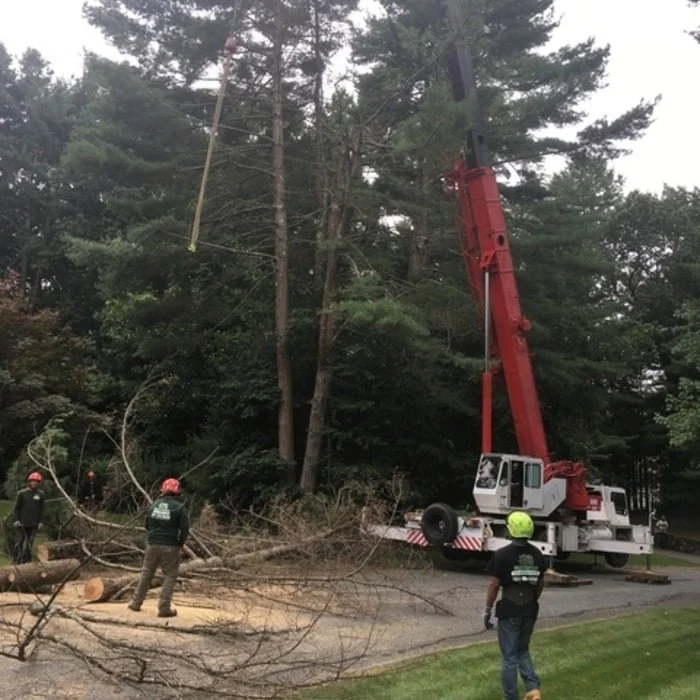
  • Cranes: A crane is often the safest way to remove a 100-foot tree. It allows us to “pick” sections of the tree and lift them directly over your house or fence, landing them safely in a designated drop zone. Crane rentals can add $500 to $1,500 or more to the daily cost, but they significantly reduce the risk of property damage.
  • Specialized Rigging: High-tension ropes, pulleys, and “port-a-wraps” are used to slowly lower heavy limbs so they don’t crash into your lawn.

For more details on why this equipment is a game-changer, visit our page on crane assisted tree removal.

Essential Add-Ons and Hidden Expenses

The quote for “removal” usually covers the act of getting the tree on the ground. However, a 100-foot tree produces a mountain of wood and debris. You need to consider what happens next.

Stump Grinding and Removal

Once the tree is gone, you’re left with a stump that could be four or five feet wide.

  • Stump Grinding: This involves a machine that chews the wood down to several inches below the soil line. For a massive tree, this can cost anywhere from $300 to $1,000 depending on the diameter and depth.
  • Full Stump Removal: This is much more intensive, involving digging out the entire root ball. It’s rarely recommended unless you are planning to put a foundation or a pool in that exact spot.

If you’re feeling adventurous, there are DIY stump removal tactics, but for a 100-foot tree’s stump, you might find yourself in over your head quite literally!

In many Massachusetts towns, you can’t just cut down a massive tree because you want to.

  • Local Ordinances: Towns like Salem or Marblehead may have “Heritage Tree” protections. If your tree is of a certain age or species, you may need a permit from the town forest warden.
  • Utility Line Clearance: If the tree is within a certain distance of power lines, we must coordinate with the utility company.
  • Traffic Control: If your 100-foot tree is near a busy street in Somerville or Cambridge, we might need to hire a police detail or set up traffic cones, which adds to the project cost.

We handle the heavy lifting of figuring out these tree removal logistics for our clients.

Post-Removal Cleanup and Landscaping

What do you want to do with the wood?

  1. Hauling Fees: Taking away several tons of logs and branches costs money in fuel and disposal fees at the dump.
  2. Wood Chipping: We can turn the smaller branches into mulch for your garden on-site.
  3. Log Splitting: If you have a fireplace, we can buck the trunk into 16-inch rounds for you to split later.

A crane and heavy trucks can be tough on a lawn. Part of a comprehensive service includes repairing any divots or ruts left behind. For more on maintaining the rest of your canopy, see our guide on tree trimming and pruning.

Professional vs. DIY: Why 100-Foot Trees Require Experts

We love a good DIY project as much as the next person. Painting a room? Great. Fixing a leaky faucet? Go for it. Cutting down a 100-foot tree? Please, do not attempt this.

The physics of a falling 100-foot tree are terrifying. A tree of that height has a “fall zone” that is essentially a 100-foot radius in every direction until it is secured. If it leans the wrong way, it can destroy your home, your neighbor’s home, or worse.

The Risks of Improper Felling

  • Power Line Hazards: Electricity can “arc” from a wire to a wet branch or a metal ladder. You don’t even have to touch the wire to be electrocuted.
  • Barber-Chairing: This is when a tree splits vertically up the trunk during a cut, kicking the butt of the tree backward with enough force to level a garage—or a person.
  • Insurance Liability: Most homeowners’ insurance policies have a “negligence” clause. If you cause damage while trying to remove a tree yourself without a license, they may deny your claim.

Hiring a professional ensures that you are protected by workers’ compensation and general liability insurance. You can read more in our Beginner’s guide to tree service removal cost.

When to Call the Pros

If you notice any of the following, it is time to stop searching for DIY videos and call us:

  1. The tree is leaning toward a structure.
  2. There are large, dead “hangers” (branches) caught in the upper canopy.
  3. The ground is heaving at the base of the tree (a sign the roots are failing).
  4. There is fungus or “conks” growing on the trunk, indicating internal rot.

For a deeper dive into what to do in a crisis, see our emergency survival guide.

Frequently Asked Questions about 100-Foot Tree Removal

Does homeowners insurance cover the cost of removing a 100-foot tree?

In most cases, insurance only pays for tree removal after it has fallen and caused damage to a covered structure (like your house or fence). They rarely pay for “preventative” removal of a healthy tree. However, if a storm knocks a 100-foot tree onto your roof, your policy will likely cover the removal and the repairs, minus your deductible.

Is it cheaper to remove a large tree during the winter off-season?

Yes! Many homeowners wait until the leaves are out to notice a problem. In Massachusetts, the “peak season” is typically spring through autumn. Scheduling your removal in the late winter (January or February) can sometimes save you 15% to 25% because demand is lower. Plus, the frozen ground is actually better for our heavy equipment—it prevents those deep ruts in your lawn!

How long does it typically take to safely remove a 100-foot tree?

A professional crew can usually dismantle a 100-foot tree in one to two full workdays. Day one is usually spent “limbing” and taking down the top sections. Day two is for the heavy trunk sections and the final cleanup. If a crane is used, the process is often much faster but requires more setup time.

Conclusion

Removing a 100-foot tree is a major investment in your property’s safety and value. While the cost to cut down 100 foot tree—ranging from $1,500 to $9,000+—might seem steep, it pales in comparison to the cost of repairing a home after a catastrophic tree failure.

At Zacarias Tree & Landscaping, we specialize in these “tall orders.” Whether you are in Acton, Framingham, or right in the heart of Cambridge, we provide the rapid response and efficient work you need to protect your home. We pride ourselves on thorough cleanup; when we leave, the only thing missing will be the hazard that was keeping you up at night.

Don’t leave it to chance. Contact us today for a free on-site estimate. We’ll take a look at your giant, assess the risks, and give you a fair, transparent price to take it down safely.

Ready to clear the air? Visit our Tree Removal Services page to get started.

Get Your Free Estimate Today

Need a pro? Zacarias Tree & Landscaping provides licensed, insured, and expert care across Lynn, Essex, and Middlesex Counties.

We live by a simple promise: Clear scope. Clear plan. Clean finish.

From emergency removals to seasonal landscaping, we’ve been Lynn’s trusted choice since 2002. Safety-first standards. Total site cleanup. Every time.

cost to cut down 100 foot tree
You Can Trust The Experts At Zacarias Tree & Landscaping
Three gold badges labeled Licensed, Insured, Bonded with green icons and ribbons.
Contact Us for Tree Service Assistance or a Free Estimate.
Our Services
We accept MasterCard, Visa, American Express, and Discover for your convenience.
MasterCard logo with interlocking red and yellow circles and the word "MasterCard" in white text over the circles. Visa logo on a blue background with yellow accent on the "V". Blue American Express card with "AM EX" logo on the right. Discover logo with black letters and an orange circle on a light background.
Copyright © 2026 | All Rights Reserved | Zacarias Tree & Landscaping | Page List | Service Areas | Digital Marketing By AQM