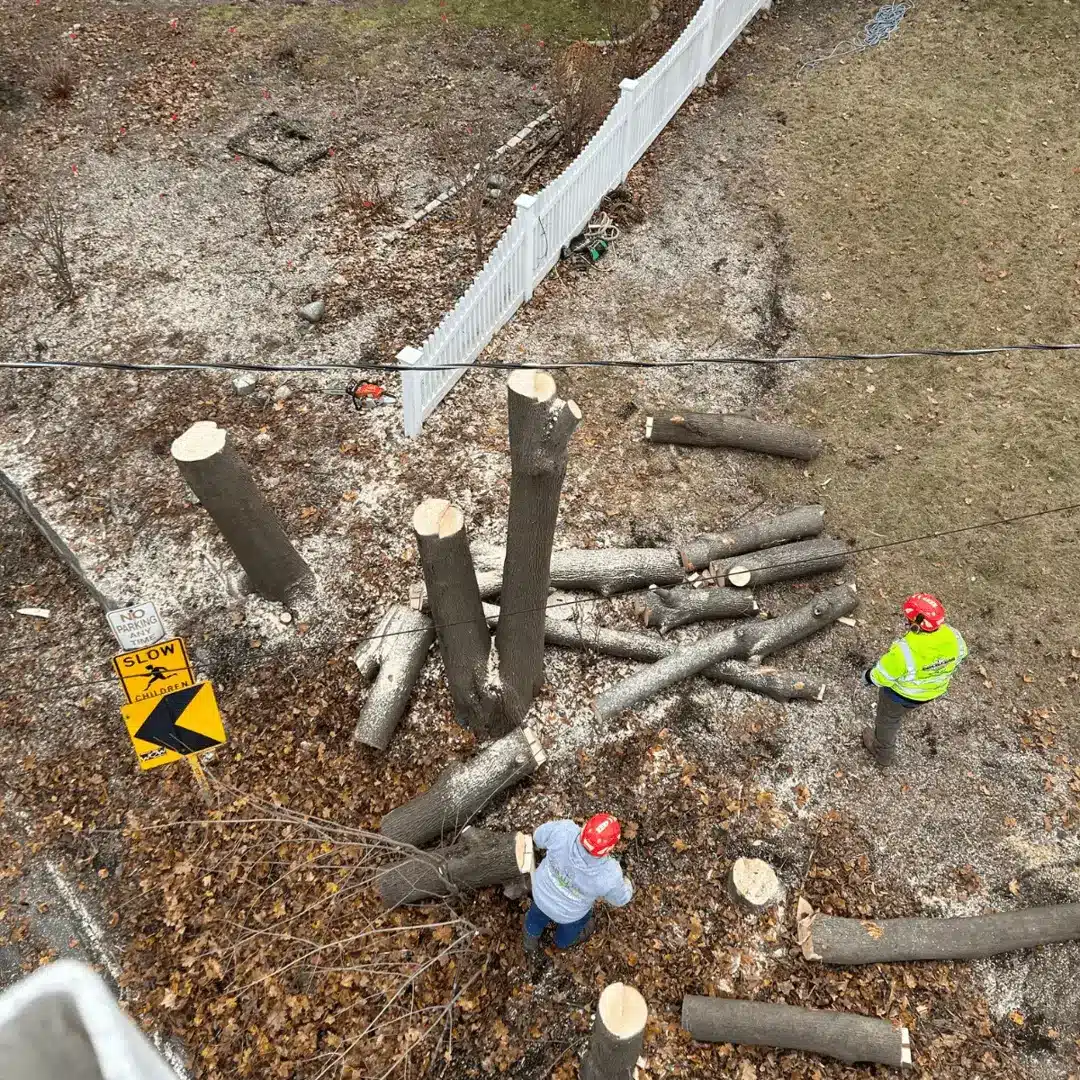
Getting a tree removal quote doesn’t have to be confusing — here’s what most Massachusetts homeowners can expect:
Quick-reference cost ranges (based on general market research and national averages; actual costs vary by property conditions, access, and scope):
| Tree Size | Estimated Cost Range |
|---|---|
| Small (under 30 ft) | $200 – $900 |
| Medium (30–60 ft) | $600 – $2,500 |
| Large (60 ft+) | $1,500 – $6,000+ |
Key factors that affect your quote:
A large tree down in your backyard after a storm isn’t just an eyesore — it’s a safety hazard that needs professional attention fast. Whether you’re dealing with storm damage, a dangerously leaning tree, or simply a tree that’s outgrown its space, understanding how tree removal quotes work puts you in a much stronger position.
The reality is that tree removal pricing can vary widely. The same-sized tree can cost very differently depending on where it’s located on your property, what’s underneath it, and what condition it’s in. That’s why knowing what goes into a quote — before you call anyone — helps you ask better questions, spot red flags, and avoid overpaying.
This guide walks you through everything you need to know, from the factors that drive costs to what a professional estimate should include.
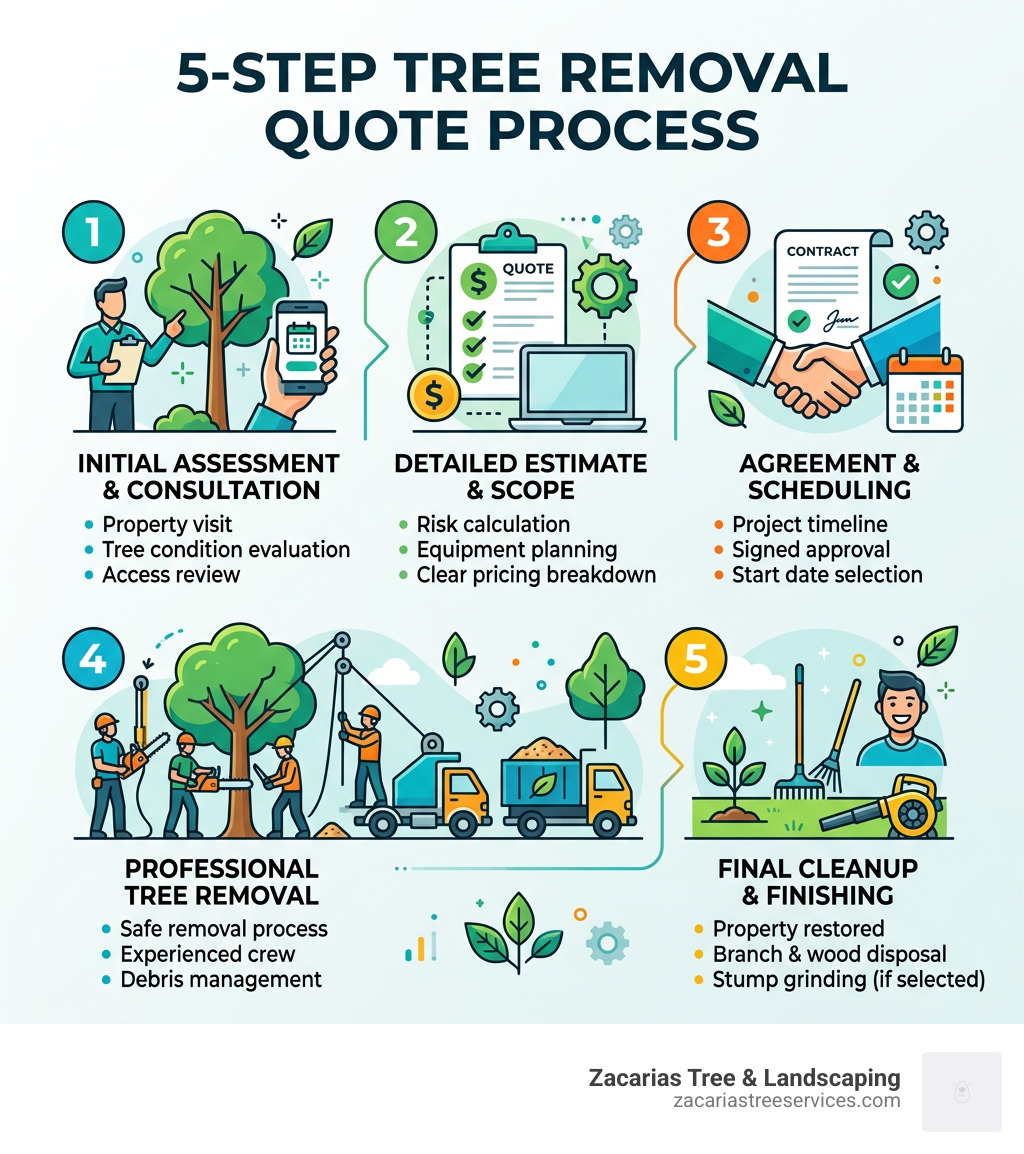
When we visit a property in Acton or Arlington to provide an estimate, we aren’t just looking at the height of the tree. A professional tree removal quote is a calculation of risk, time, and specialized equipment. In the tree service industry, the “volume” of the work often matters more than just a single measurement.

The most obvious factors are the physical dimensions of the tree. Most companies calculate a base rate of roughly $12 to $15 per foot of height. However, the trunk diameter (measured at breast height, or DBH) is equally important. A thick, wide trunk requires more chainsaw work, more heavy lifting, and more time to process into manageable pieces. A tall, skinny Pine might be simpler to remove than a shorter, massive Oak with a trunk three feet wide.
A tree with a massive, spreading canopy requires significantly more labor than one with a narrow profile. If those branches are hanging over your roof, a pool, or a delicate fence, the complexity skyrockets. We use advanced rigging techniques to “piece down” the tree, lowering sections slowly to avoid property damage. This is where Tree Removal becomes a precision operation rather than just a cutting job.
If a tree is within 10 feet of high-voltage power lines, the job requires specialized training and often coordination with the local utility company. Furthermore, accessibility plays a massive role. Can we get a bucket truck into the backyard? If we have to carry debris through a narrow gate or across a manicured lawn by hand, the labor hours increase. In some cases, Crane Assisted Tree Removal is the only safe way to lift heavy sections over a house, which is a factor that will be reflected in the final quote.
Yes, the type of tree sitting in your yard in Concord or Lexington matters. Hardwoods like Oak and Maple are much denser and heavier than softwoods like Pine. This density affects how quickly we can cut through the wood and how much the debris weighs when we haul it away.
According to Scientific data on tree removal costs, the species’ growth habit and wood density are primary drivers of professional labor rates.
It might seem counterintuitive, but a dead or dying tree is often more expensive to remove than a healthy one. Why? Because dead wood is unpredictable.
When a tree is rotting or infested with pests, its structural integrity is compromised. Our climbers cannot safely move through the canopy of a brittle, dead tree, which often necessitates the use of a bucket truck or a crane. If a tree is leaning dangerously or has “V-shaped” weak branch unions, the risk of an unplanned fall is higher. For urgent situations, you can refer to our Emergency Tree Removal: The Homeowner’s 24-Hour Survival Guide to understand how we stabilize these hazards.
To help you budget for your project in places like Framingham or Newton, we’ve gathered general market research data to illustrate how pricing tiers usually break down.
| Tree Complexity | Estimated Price Range | Description |
|---|---|---|
| Low Complexity | $200 – $600 | Small trees, easy access, no nearby structures. |
| Medium Complexity | $600 – $1,600 | Medium trees, some rigging required, standard suburban yard. |
| High Complexity | $1,600 – $5,000+ | Large/Extra-large trees, near power lines or over roofs. |
These figures are general estimates. As noted by Tree removal cost factors, the final price is always dictated by the specific “logistics” of your property.
When you receive a tree removal quote, it is vital to know exactly what is included. Some companies provide a low “cut and drop” price, leaving you with a massive pile of wood to deal with.
We always recommend that homeowners in towns like Bedford and Burlington get at least three quotes. Statistics show that users who compare three quotes save an average of 28% on their tree jobs. However, the cheapest quote isn’t always the best.
You should be wary of any company that gives you a firm price over the phone without seeing the tree. At Zacarias Tree & Landscaping, Our Process always involves a visual assessment. We need to see the “targets” (your house, shed, or power lines) and check the ground for stability.
Tree removal is one of the most dangerous professions in the country. Never hire a crew that cannot produce up-to-date liability insurance and workers’ compensation certificates. If an uninsured worker is injured on your property in Haverhill or Salem, you could be held liable.
Timing can save you money. Many companies offer “dormant season” discounts of 10% to 20% during the winter months (January through March). Not only is the demand lower, but the frozen ground is firmer, which helps prevent heavy equipment from damaging your lawn.
A professional estimate should be a written document, not a verbal “handshake” deal. It should clearly outline:
It depends on your specific municipality. Many towns in the Greater Boston area have “Tree Ordinances” that protect trees over a certain diameter (often 6 to 10 inches). If your property falls under the jurisdiction of a local Conservation Commission—especially if you are near wetlands—you will almost certainly need an arborist report and a permit. We often help clients navigate this so they can move forward with Tree Planting to replace what was lost.
Insurance typically only covers tree removal if the tree has already fallen on a “covered structure” (like your house or garage) due to a named peril like wind or lightning. If the tree is still standing but is simply “hazardous,” insurance usually considers it a maintenance issue and will not pay for the removal. Always check your policy, as some will cover up to $500–$1,000 for debris removal after a major storm.
Navigating a tree removal quote doesn’t have to be a daunting task. By understanding the factors that drive costs—from tree height and species to accessibility and health—you can make an informed decision that protects both your wallet and your property.
At Zacarias Tree & Landscaping, we pride ourselves on our rapid response, thorough cleanup, and expert knowledge of the Massachusetts landscape. Whether you are in Acton, Cambridge, or Worcester County, our goal is to provide a transparent, fair estimate and execute the job with the highest safety standards. Don’t wait for a hazardous tree to become an emergency. Request a professional tree service quote today and let us help you maintain a beautiful, safe outdoor space.
Need a pro? Zacarias Tree & Landscaping provides licensed, insured, and expert care across Lynn, Essex, and Middlesex Counties.
We live by a simple promise: Clear scope. Clear plan. Clean finish.
From emergency removals to seasonal landscaping, we’ve been Lynn’s trusted choice since 2002. Safety-first standards. Total site cleanup. Every time.