The cost to cut down 50 foot tree typically falls between $450 and $1,200, based on national averages from internet research — though your actual cost will vary depending on your specific property, access, and site conditions.
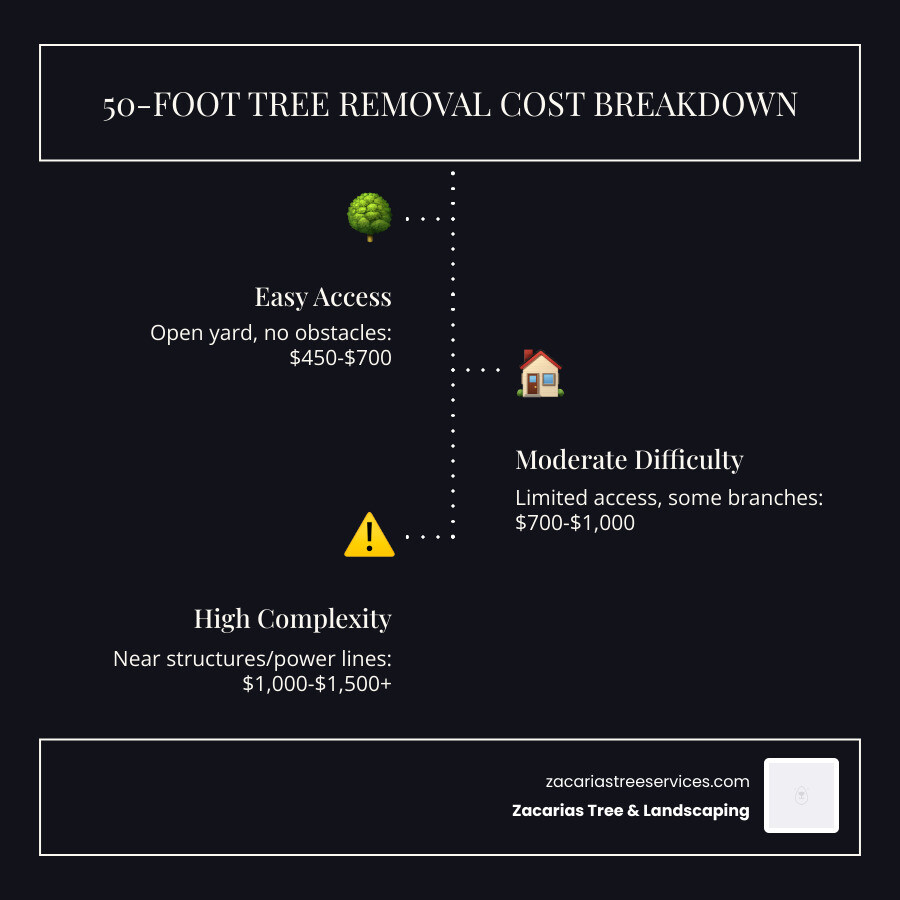
Here’s a quick snapshot of what homeowners typically pay:
| Scenario | Estimated Cost Range |
|---|---|
| 50-ft tree, easy access, open yard | $450 – $700 |
| 50-ft tree, moderate difficulty | $700 – $1,000 |
| 50-ft tree, near structures or power lines | $1,000 – $1,500+ |
| Add stump grinding | +$150 – $550 |
| Add debris hauling | +$100 – $300 |
Note: These are general national averages based on internet research. Actual prices vary widely based on property conditions, tree species, access, and local labor rates. Always request a free on-site estimate for accurate pricing.
A 50-foot tree is no small job. That’s roughly the height of a five-story building looming over your yard — and if it’s storm-damaged, leaning, or showing signs of decay, the urgency is real.
Getting the tree down safely requires specialized equipment, trained crews, and careful planning. The cost reflects all of that — not just the cutting, but the rigging, cleanup, and risk management that goes into it.
This guide breaks down exactly what drives the price, what to expect from start to finish, and how to get a fair deal from a qualified tree service in Massachusetts.
When we talk about a 50-foot tree, we are looking at the “medium-to-large” category in the tree service world. Based on extensive internet research and national averages, the cost to cut down 50 foot tree generally lands in a broad range of $450 to $1,500. However, because every tree is a unique individual (some are just more stubborn than others), complex removals can easily exceed $2,000.
In the industry, pricing is often tiered by height because taller trees require more specialized rigging and safety protocols. Here is how a 50-footer compares to its neighbors:
As you can see, a 50-foot tree sits right in that middle bracket where things start to get interesting. At this height, a simple “felling” (cutting it at the base and letting it fall) is rarely an option in residential areas like Arlington or Newton. Instead, we usually have to take it down piece by piece.
Some researchers suggest a per-foot pricing model, which averages between $9.50 and $15.00 per linear foot. For a 50-foot tree, that math checks out to roughly $475 to $750 for the basic cut. But remember, that “base model” price usually doesn’t include the “luxury features” like hauling away the massive trunk or grinding the stump into oblivion.
The variability in price isn’t just a “guess.” It comes down to site complexity. Is the tree in the middle of a wide-open field in Groton? Or is it squeezed between two Victorian homes in Cambridge? The more obstacles we have to navigate—fences, sheds, power lines, or your prized prize-winning rose bushes—the more time and equipment we need to ensure nothing gets squashed.
For more details on how we handle these projects, check out our Tree Removal services page.

If you have ever wondered why two neighbors might get two completely different quotes for the same size tree, it’s because tree removal is more of a “custom surgery” than a “flat-fee product.” Several critical factors influence the final tally.
This is a huge one. If we can get our bucket truck or crane right up to the tree, the job goes faster. If we have to climb the tree manually and carry every single branch through a narrow side gate by hand, the labor costs will naturally rise. In some urban Massachusetts locations, accessibility can increase the total bill by 25% to 50%.
You might think a dead tree is easier to cut down because the wood is lighter. In reality, dead or decaying trees are often more expensive to remove. Why? Because they are unpredictable. Brittle wood can snap unexpectedly, making it dangerous for a climber. In these cases, we often have to bring in a crane to safely lift sections of the tree away, which adds to the equipment cost.
If your 50-foot pine is leaning gracefully over your roof, we can’t just “drop it.” We have to use a complex system of ropes and pulleys (rigging) to lower each piece slowly and precisely. This “controlled removal” takes significantly more time than a standard cut.
Working near utility lines is a high-stakes game. It requires coordination and often specialized non-conductive equipment. If a tree is within ten feet of a power line, the complexity—and the price—goes up.
A 50-foot tree with a skinny trunk is one thing; a 50-foot tree with a four-foot-wide base is another. A thicker trunk means more weight, more chainsaw work, and much more debris to haul away.
If your tree isn’t quite ready for the chopping block but needs some TLC to stay safe, you might want to explore Tree Trimming & Pruning as a preventative measure.
Not all wood is created equal. The species of your 50-foot tree plays a massive role in how much effort it takes to remove it.
Pines are generally considered softwoods. A 50-foot Pine often has a single straight trunk and branches that are relatively easy to manage. According to national research, removing a 50-foot Pine might range from $325 to $1,100. However, Pines can be messy—sappy wood can gum up tools, and they often have a lot of small, spindly branches that take time to chip.
Oaks, Maples, and other hardwoods are a different story. These trees are dense, heavy, and often have wide-spreading canopies. A 50-foot Oak can weigh significantly more than a Pine of the same height.
Because of this, removing a 50-foot Oak typically starts at a higher price point, often ranging from $450 to $1,650 or more.
Before you sharpen the saw, some trees are protected by law. While Massachusetts doesn’t have the same sycamore restrictions as California, many local towns have “Tree Wardens” or specific ordinances regarding the removal of “public shade trees” or trees in historic districts. Always check your local bylaws in towns like Lexington or Concord before starting a project.
When you get a quote for the cost to cut down 50 foot tree, make sure you know exactly what is included. Often, the “base price” only covers felling the tree and cutting it into manageable sections. Here are the common “add-ons” that can sneak up on you:
Once the tree is gone, you’re left with a stump that can be a tripping hazard or a home for termites. Professional stump grinding usually costs between $150 and $550 for a tree of this size. If you want the stump completely excavated (roots and all), expect to pay significantly more.
A 50-foot tree produces a mountain of brush. Most professional services include chipping the smaller branches, but hauling away the massive trunk logs might be an extra fee, often ranging from $100 to $300.
In some Massachusetts municipalities, you need a permit to remove a tree over a certain diameter. These permits can cost anywhere from $75 to $150, depending on your town’s regulations.
Want to keep the wood for your fireplace? We can often split the logs for you on-site. This is a great way to save on hauling fees while getting a winter’s worth of firewood, but it does add to the labor cost.
If you live in a more remote area, some companies charge a travel fee or a per-mile rate if the job site is more than 30 minutes from their headquarters.
For those situations where a tree has already decided to come down on its own (usually at 2 AM during a Nor’easter), see our Emergency tree removal guide.
We get it—everyone loves a good DIY project. But when it comes to a 50-foot tree, the stakes are literally five stories high.
At 50 feet, gravity is not your friend. A falling limb from that height can accelerate to speeds that can crush a car or a roof instantly. Professional crews use specialized climbing gear, harnesses, and bucket trucks to manage these heights safely.
Removing a large tree safely requires more than just a chainsaw from the local hardware store. We use:
If a DIY attempt goes wrong and a tree falls on your neighbor’s house, your homeowners insurance might not cover the damage if they determine the work was done “negligently” by an unlicensed individual. When you hire a professional, our insurance covers the property and the workers.
If the tree is in a particularly tight spot, we might use Crane Assisted Tree Removal to lift the tree out vertically, piece by piece.
Investing in professional removal isn’t just about getting the tree down; it’s about peace of mind.
In Massachusetts, our costs are influenced by the higher cost of living and the specific challenges of our landscape.
Not sure if it’s time to say goodbye? Look for these “red flags”:
Usually, no—not for preventative removal. Insurance companies view tree maintenance as the homeowner’s responsibility. However, if a healthy tree falls due to a “covered peril” (like a windstorm or ice storm) and damages a “covered structure” (like your house or garage), they will typically pay for the removal, often up to a limit of $500 to $1,000.
For a professional crew, a standard 50-foot tree removal usually takes between 4 and 8 hours. This includes the setup, the actual cutting, the chipping of branches, and the final yard cleanup. If a crane is required, the process might actually be faster but more expensive.
Absolutely! If you have a fireplace or a wood-burning stove, asking the crew to leave the wood “in rounds” (unsplit logs) can save you money on hauling and disposal fees. Just be prepared for the fact that a 50-foot tree creates a lot of wood—make sure you have a place to stack it!
Determining the cost to cut down 50 foot tree involves balancing height, species, and the unique layout of your Massachusetts property. While the price range of $450 to $1,500 is a good starting point for your budget, the only way to get a truly accurate number is with an on-site evaluation.
At Zacarias Tree & Landscaping, we pride ourselves on our rapid response and quick estimates. Whether you are in Bedford, Billerica, or Beverly, we bring the right equipment and the right expertise to every job. We don’t just cut trees; we protect your property and ensure a thorough cleanup so you can get back to enjoying your yard.
Don’t wait for the next big storm to find out if your tree is a hazard. Get a professional estimate for tree removal today and let us handle the heavy lifting.
Need a pro? Zacarias Tree & Landscaping provides licensed, insured, and expert care across Lynn, Essex, and Middlesex Counties.
We live by a simple promise: Clear scope. Clear plan. Clean finish.
From emergency removals to seasonal landscaping, we’ve been Lynn’s trusted choice since 2002. Safety-first standards. Total site cleanup. Every time.