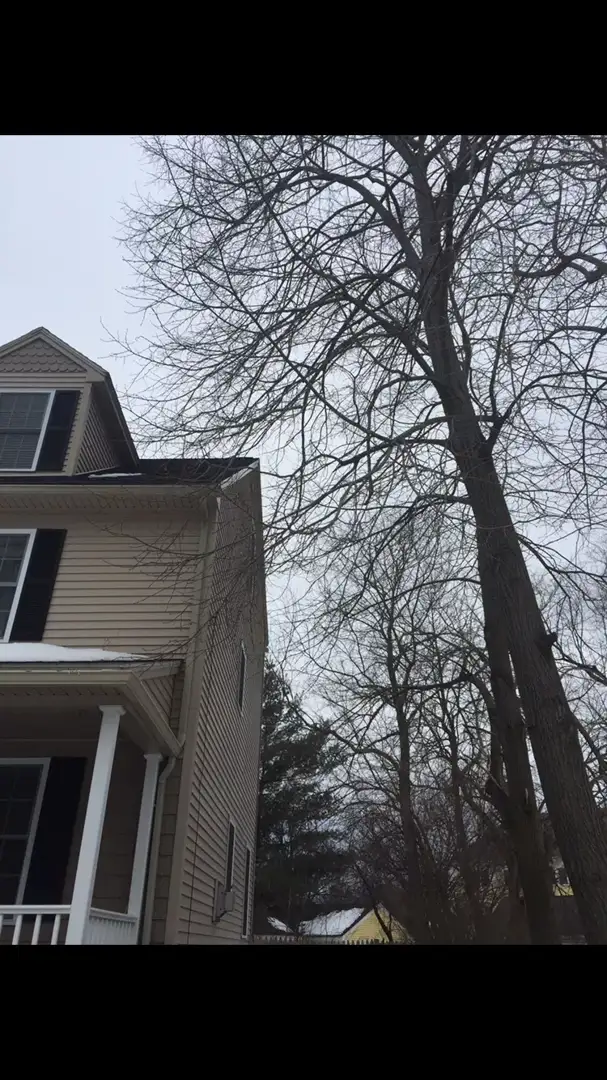
The cost to remove a large tree near a house is higher than the same tree in an open yard because it usually cannot be dropped in one piece. It has to be taken apart from the top down, with limbs and trunk sections cut, rigged, and lowered on ropes or lifted out by crane, which takes more people, more gear, and more hours. A crane or utility coordination adds more on top, so the only accurate number is a free on-site estimate that looks at the tree, the house, and the wires together.
Zacarias Tree & Landscaping has worked out of Lynn since 2002. We have ISA-Certified Arborists on staff, and our crews are licensed, bonded, and fully insured, which matters more on a tree over a roof than on almost any other job. Here is where the extra cost comes from and what to check before anyone climbs.
Why close quarters raise the price
A tree with room to fall is mostly a cutting job. A tree beside your house is a lowering job. That one difference drives most of the added cost.
- Sectional removal. A climber or lift operator works down the tree, cutting pieces small enough to control. Each cut is followed by a pause while the piece is tied off and lowered.
- Rigging. Ropes, pulleys, and a friction device at the base let the ground crew lower heavy wood slowly to a safe landing spot. The rigging is set and reset many times over the job.
- A bigger crew. Controlled lowering needs a climber plus ground workers on the ropes, clearing wood, and watching the landing zone.
- Protection. Plywood over decks and patios, padding at gutters, and mats across lawns all add setup time.
- Slower hauling. When the only way to the street is a narrow side yard, every log and branch is carried or wheeled out.
North Shore conditions that make these jobs harder
Many older neighborhoods from Lynn to Beverly have houses set close together, with Norway maples, red oaks, and white pines planted generations ago now reaching over two roofs at once. Ice storms load those limbs with weight, and a nor'easter that soaks the ground before the wind arrives can loosen the roots of a tree that has leaned toward a house for years. Coastal wind adds its own stress near the water. A tree already carrying cracked limbs or a lean after a storm is harder to climb safely, which is one reason a planned removal usually costs less than waiting for the tree to make the decision.
When a crane makes sense
For a very large tree leaning over the roof, a dead tree too brittle to climb, or a backyard tree with no room to lower wood, a crane can be the safest option and sometimes the fastest. The crane holds each section before it is cut, then lifts it over the house to the street or driveway. It adds equipment cost and needs firm ground to set up on, but it can shorten the day and take away most of the risk of wood hitting the structure. Our page on crane-assisted tree removal covers that option.
Trees near power lines: what the utility handles
This is the part homeowners most often get wrong. Tree companies do not work on or next to energized utility lines unless they are qualified line-clearance crews working for the utility. For a home removal, that usually means one of two situations:
- Main lines along the street. Branches near the primary lines on the poles are the utility's responsibility. Contact your electric company about a tree growing into those lines.
- The service line to your house. If your tree is tangled in the wire running from the pole to your home, the utility may need to disconnect it temporarily so tree work can go ahead. That appointment has to be arranged, and it can set the schedule for the whole job.
Phone, cable, and internet lines are less dangerous but still need care, since a snapped cable is its own repair. Point out every wire during the estimate. If a tree is already down on a line, call the utility and stay clear. Once the utility has made the line safe, a tree crew can take the tree off, and our emergency tree service is available 24/7 for that.
What else pushes the number up or down
| Factor | Pushes cost up when | Can lower cost when |
|---|---|---|
| Distance to the house | Limbs rest on or over the roof | There is a clear lowering zone on one side |
| Tree condition | Dead, hollow, or cracked wood limits climbing | The tree is sound and can be rigged normally |
| Species | Heavy hardwoods like red oak or sugar maple | Lighter wood like white pine |
| Wires | The service drop must be disconnected | No lines within reach |
| Access | No truck access to the backyard | The driveway reaches near the tree |
| Wood and stump | Full haul-away and grinding | Firewood left, stump left |
For height, species, and seasonal pricing across every kind of removal, see our tree removal cost guide.
Insurance and credentials: the part of the price you cannot skip
When a tree sits over a house, the difference between a careful crew and a careless one shows up as a hole in the roof. Before you hire anyone for this kind of job, ask for two certificates:
- General liability insurance, which covers damage to your home or a neighbor's property caused by the work.
- Workers' compensation, which covers the crew if someone is hurt. Without it, an injured worker may look to the property owner.
Ask for the certificates to come straight from the insurance agent, and check that the dates are current. It is also worth asking whether an ISA-Certified Arborist will be involved in planning the removal; you can confirm a name in the ISA's Find an Arborist directory. A low quote from a crew without coverage is not a savings if something goes wrong. A short call to your own homeowner's insurer also tells you how your policy treats tree work on the property.
Should it come down at all?
Not every big tree near a house needs to go. A healthy tree with one heavy limb over the roof may only need pruning or a reduction cut on that side. Removal makes sense when the tree is dead or declining, has a serious structural defect, is leaning toward the house with soil heaving at the base, or its roots are damaging a foundation. Our arborist assessments are a good first step when you are not sure, and trimming and pruning may solve the problem for less.
Frequently Asked Questions
How much does it cost to cut down a large tree next to a house?
Expect a big tree next to a home to cost noticeably more than the same tree in open space, and more again for crane work, a service-line disconnect, or a very large tree. The exact figure depends on size, condition, wires, and access, so get a written on-site estimate that names the removal method, how your roof and deck will be protected, and the cleanup.
Can I have the power company remove a tree near my house?
Utilities generally clear trees from their own lines, not whole trees on private property. They may trim or disconnect service so your tree company can work safely. Call them to ask what they will handle.
Is a crane always needed for a tree over a roof?
No. Many trees over roofs come down safely by climbing and rigging. A crane is usually chosen when the tree is too large, too decayed to climb, or has no space to lower pieces.
Who pays if the tree damages my house during removal?
That is what the contractor's general liability insurance is for. Confirm the company carries it before the job, not after.
Get a plan before anyone climbs
If a tree is leaning over your roof, deck, or driveway anywhere in Lynn or the North Shore, request a free estimate. An ISA-Certified Arborist from our team can look at the tree and the wires, the estimate is free and in writing, and it comes with our No-Surprise Pricing Guarantee. Learn more about our tree removal service.