
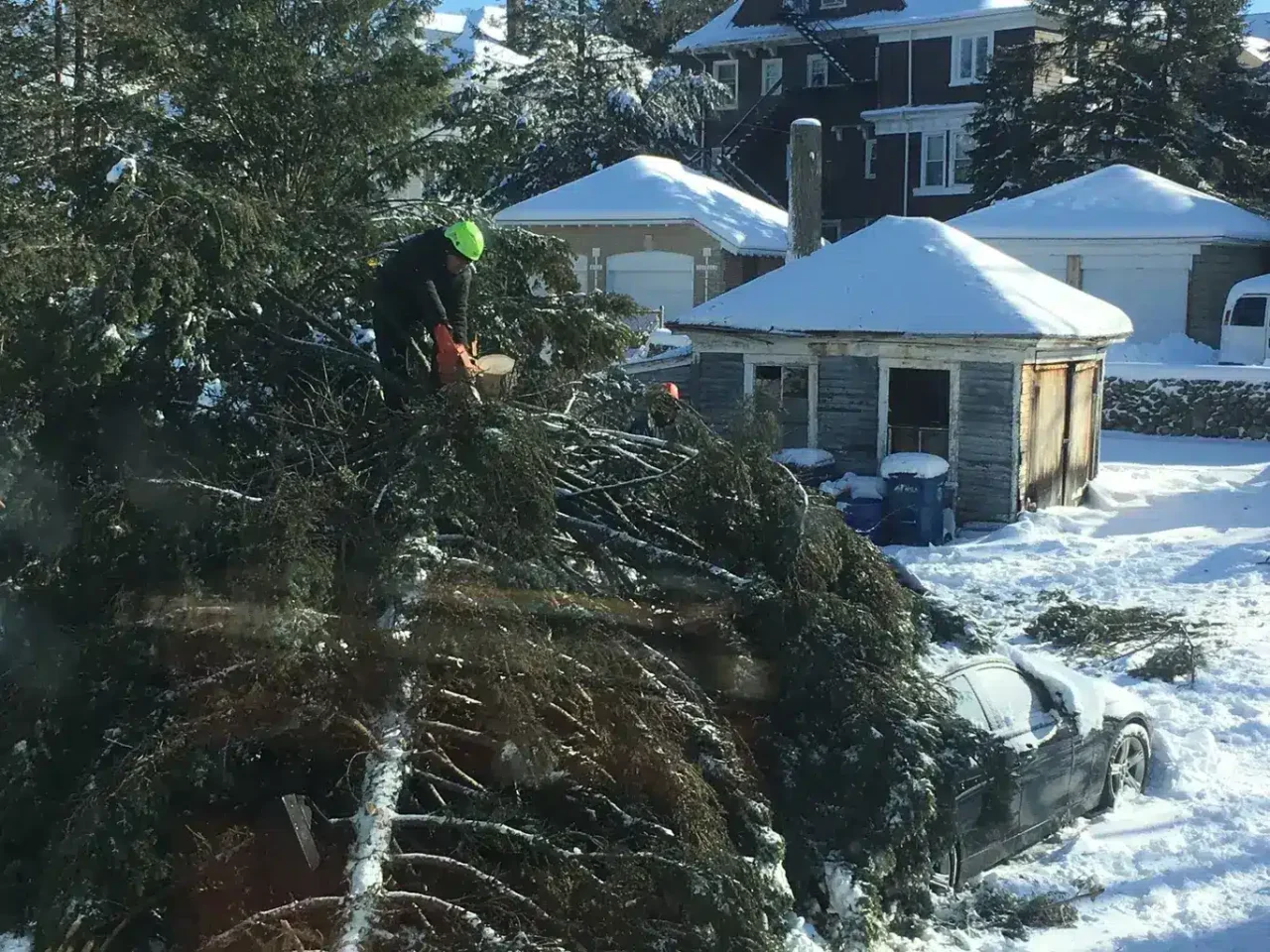
When a tree falls on your property, get everyone away from it first, stay well back from any wire it touched, and call 911 if anyone is hurt or trapped. Call your electric utility about any wire involved, then call a tree company for emergency fallen tree removal once people are safe. Removal comes after safety, never before it.
Zacarias Tree & Landscaping is a family-run company based in Lynn since 2002, and our crews answer emergency calls 24/7 across the North Shore and Essex and Middlesex Counties. This guide walks through the first hour after a tree comes down, who handles which part of the problem, and what a professional crew actually does when it arrives.
The first ten minutes: protect people, not property
A tree that has already fallen can still move. Limbs caught in other trees (crews call them hangers) drop without warning, a trunk resting on a roof can shift as the structure flexes, and a root plate that has lifted out of saturated soil can settle back or roll. Treat the whole area as a hazard zone until someone trained has looked at it.
- Move people and pets out of any room the tree struck, and out of the yard beneath it.
- If a wire is down or tangled in branches, assume it is live. Do not touch the tree, a fence, a puddle, or a vehicle in contact with it.
- If you smell gas, leave the house and call 911 from a safe distance.
- Keep children and neighbors back. People gather to look after a storm, and that is when second failures hurt someone.
- Do not start a chainsaw on a tree under tension. Bent limbs and trunks store energy and can spring back hard when cut.
Who to call for a fallen tree
Most homeowners call the wrong party first, which costs time. Each situation has a clear owner.
| Situation | Call first | Then |
|---|---|---|
| Someone is injured or trapped | 911 | Utility if wires are involved, then a tree crew |
| Tree on or touching power lines | Your electric utility (and 911 if there is sparking or fire) | A tree crew after the utility makes the lines safe |
| Tree on the house, no wires | A 24/7 tree service | Your insurance company, and a contractor for repairs |
| Tree blocking the street | Your town's DPW or police non-emergency line | A tree crew if the tree came from your yard |
| Tree across your driveway or yard only | A tree service when convenient | Insurance only if something covered was damaged |
On the North Shore, your electric company may be one of the large regional utilities or your town's municipal light department. Either way, only the utility or its line contractor can safely clear a tree from energized lines. A tree crew works around the tree once the utility has cut or cleared power.
Common fallen tree scenarios and what happens next
A tree on the roof
This is the call we treat most carefully. The tree is often holding itself up partly on the structure, so cutting the wrong piece first can drop weight through the roof. The crew studies how the load is resting, removes the canopy in controlled sections, and lifts or lowers the heavy trunk pieces off the house. On large trees or tight lots, crane-assisted tree removal lets us pick the trunk straight up instead of dragging it across shingles and gutters.
A tree on a car
Leave the car where it is unless it is blocking emergency access. Photograph it before anything moves. The tree gets cut away in sections so no extra weight shifts onto the roof or glass, and then the car can be pulled clear.
A tree across the driveway
If no wires are involved and nothing is damaged, this is usually a clearing job: cut the trunk into manageable lengths, chip the brush, and open the driveway. If you burn wood, you can ask for the rounds to be left on the property.
An uprooted tree with the root plate lifted
Uprooted trees are common after a nor'easter soaks the ground and wind finishes the job. The root plate can weigh a great deal and may tip back toward the hole once the trunk is cut free. Stay well back from it. Grinding or removing what is left of the stump is a separate step that can wait until the property is safe.
What an emergency crew does when it arrives
- Size up the scene. The lead checks for wires, gas, structural damage, hangers, and how the tree is loaded before anyone cuts.
- Make it safe. The first goal is removing the immediate danger: weight off the house, the driveway open, hanging limbs brought down.
- Remove the tree. Sections are cut, rigged, and lowered or lifted out. Brush is chipped and wood is cut to length.
- Clean up and plan what is left. Stump grinding, damaged neighboring trees, and any pruning of storm-torn limbs can be scheduled once the emergency is over.
During a widespread storm, crews usually handle the most dangerous situations first, so a tree on an occupied home comes before a tree lying across a back lawn. Being clear about your situation on the phone helps. Our emergency call checklist covers what details to have ready.
Insurance: photograph before anything is moved
Before the crew touches the tree, and only from a safe spot, take wide photos showing the whole tree and what it hit, then closer shots of the damage. Photograph the stump or root plate too, since it can show whether the tree failed from decay or was healthy and simply overwhelmed by wind. Keep receipts for emergency work.
Policies vary a lot. Many homeowner policies help with removal when a tree damages a covered structure such as the house or a garage, and many do not pay to remove a tree that fell without hitting anything. Call your insurer or agent to ask how your policy treats it, rather than assuming.
When the tree came from a neighbor's yard
In general, the owner of the property the tree lands on starts the claim with their own insurer, and the insurers sort out responsibility. If the tree was obviously dead or hazardous before it fell, that can change who pays. Talk to your insurer before you make promises to a neighbor or accept any.
Frequently asked questions
Who do I call for a fallen tree on power lines?
Call your electric utility first, and 911 if there is sparking, fire, or an injury. A regular tree crew should not touch a tree in contact with energized lines until the utility has made them safe.
Can I cut up a downed tree myself?
A small tree lying flat on open ground, with no wires nearby, is something many homeowners handle. A tree resting on a structure, a vehicle, or other trees, or any trunk bent under tension, is a job for a trained crew with rigging.
Does homeowners insurance pay for downed tree removal?
Often it does when the tree damaged a covered structure, and often it does not when the tree simply fell in the yard. Coverage limits differ by policy, so check with your insurer.
Should I worry about the other trees after a storm?
Yes. Storms that drop one tree often crack limbs or loosen roots on its neighbors. Our guide to the signs a tree is failing explains what to look for from the ground.
Get help now
If a tree is down and people are safe, request help through our emergency tree service page. We provide 24/7 emergency response with ISA-Certified Arborists and licensed, bonded, fully insured crews, and our standard tree removal team can return for the stump and cleanup once the danger has passed.