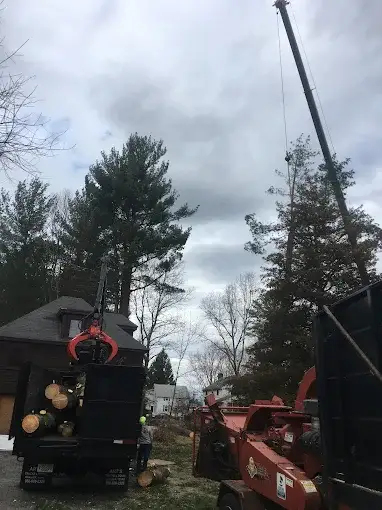
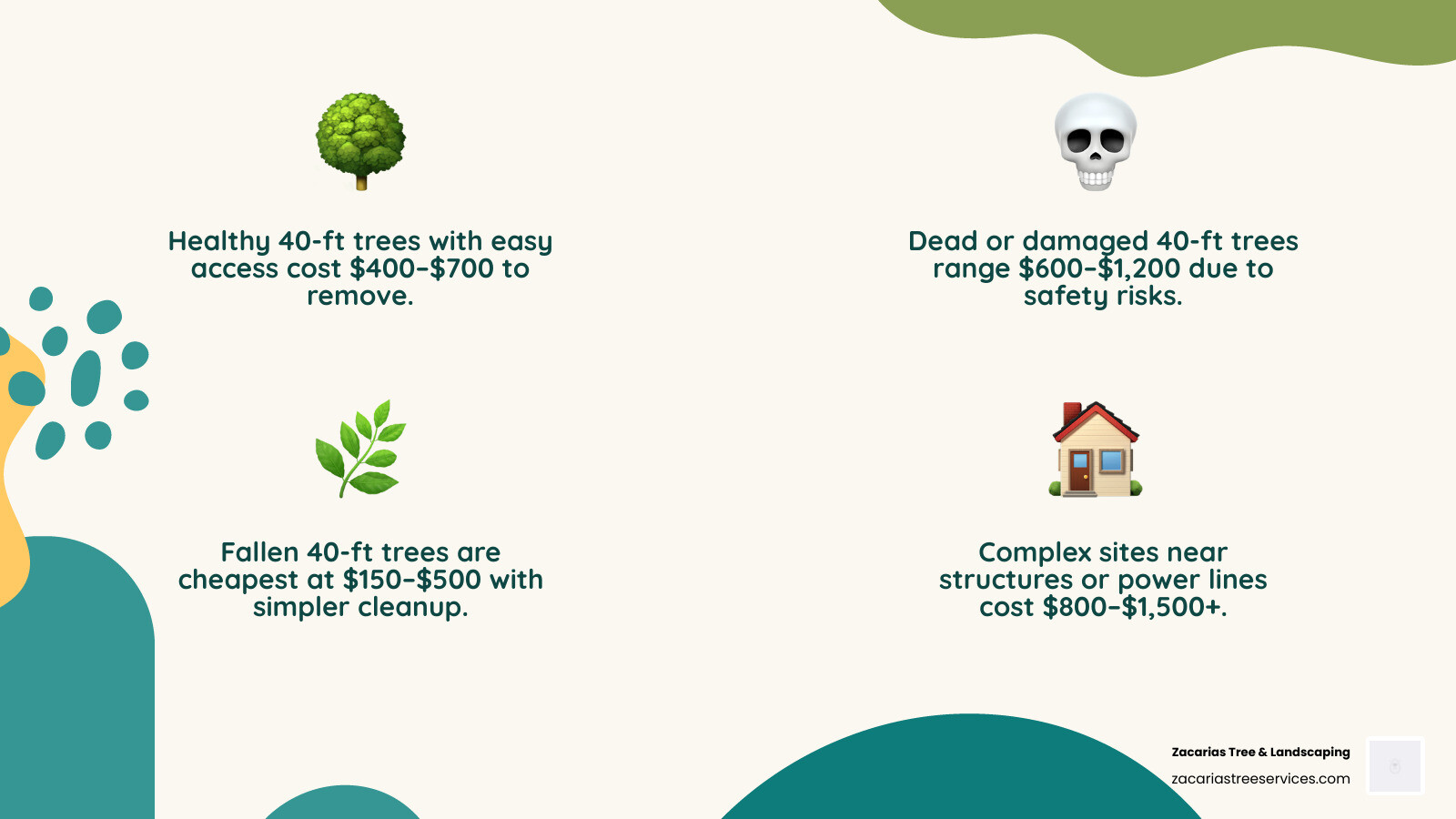
The average cost to remove a 40 foot tree falls between $400 and $1,500, depending on a handful of key factors. Most homeowners pay somewhere in the middle of that range.
| Scenario | Estimated Cost Range |
|---|---|
| Healthy 40-ft tree, easy access | $400 – $700 |
| Dead or damaged 40-ft tree | $600 – $1,200 |
| Fallen 40-ft tree | $150 – $500 |
| Complex site (near structures, power lines) | $800 – $1,500+ |
Important note: These figures are based on national averages from general internet research. Actual costs vary widely based on your specific property, site access, tree condition, and local labor rates. Always get an on-site estimate for accurate pricing.
A storm rolls through. You wake up to find a 40-foot tree leaning hard toward your fence — or worse, already down in your yard. Now you need it gone, fast, and you need to know what it’s going to cost you.
It’s a stressful situation. And the pricing you’ll find online can feel all over the place.
That range exists for good reason. A slender pine in an open backyard is a very different job than a thick oak wedged between your house and a fence. Height is just one piece of the puzzle. Tree type, condition, access, and what happens to the debris afterward all push the final number up or down.
This guide breaks it all down so you can budget with confidence and know exactly what to ask when you call for a quote.
When we talk about a 40-foot tree, we are looking at a “medium-sized” specimen. In arboriculture, this is the height where things get serious. It is too tall for a standard ladder and a hand saw, requiring professional rigging, heavy machinery, and a crew that knows how to manage gravity.
Nationally, the average cost to remove a 40 foot tree sits between $400 and $1,500. However, it is important to remember that this is a broad spectrum. A tree in an open field in a rural area will always be cheaper to fell than a tree in a tight residential lot in Cambridge or Newton.
Several variables dictate where your quote will land. Complexity is the biggest driver. If a crew can simply “drop” the tree in one piece, the labor is minimal. If they have to climb it and take it down section by section—a process called “dismantling”—the hours and the price tag go up. For more details on the process, you can explore our tree removal services.
Not all 40-footers are created equal. The species of the tree plays a massive role in the final bill because of wood density and branch structure.
The diameter of the trunk also matters. A “skinny” 40-foot tree requires less chainsaw work and generates less debris than a “fat” 40-foot tree with a massive trunk. You can find more insights in our Beginners Guide to Tree Service Removal Cost.
In Massachusetts, we often deal with tight quarters. Whether you are in the historic streets of Salem or a packed neighborhood in Somerville, accessibility is a major cost factor.

Beyond species and location, the physical state of the tree is the primary safety concern for any crew. Ironically, a dead tree isn’t always cheaper to remove than a live one.
When you receive a quote for the average cost to remove a 40 foot tree, make sure you know what is actually included. Basic “felling” usually just means getting the tree on the ground.
It is tempting to look at a 40-foot tree and think, “I have a chainsaw and a YouTube subscription; I can handle this.” Please, for the sake of your roof and your health, reconsider.
A 40-foot tree weighs several thousand pounds. When it starts to fall, you cannot “steer” it with your hands. Professional crews use physics—ropes, pulleys, and specific notch cuts—to control the descent.
For a standard crew of 2–3 people, a 40-foot tree removal usually takes between 2 and 4 hours. If the tree is in a difficult location or requires extensive rigging, it could take a full day. The “cleanup” phase—chipping branches and raking the lawn—often takes just as long as the actual cutting.
Insurance generally only covers tree removal if the tree has caused damage to a “covered structure” (like your house or garage) during a “covered peril” (like a windstorm or lightning strike). They rarely pay for “preventative” removal. If a tree falls in your yard but doesn’t hit anything, you are usually responsible for the cleanup costs.
Yes! The “dormant season” (late winter and early spring) is often the best time for removal. The trees are lighter because they have no leaves, and the frozen ground protects your lawn from heavy equipment. Many companies offer “off-season” pricing to keep their crews busy during the colder months. Conversely, summer and fall are peak seasons with higher demand. You can learn more about our year-round tree services to find the best time for your project.
Budgeting for the average cost to remove a 40 foot tree doesn’t have to be a guessing game. While the $400 to $1,500 range is the standard, your specific price will depend on whether that tree is a “straight-shot” pine or a complex, house-hugging oak.
In Massachusetts, our weather can be unpredictable. From Nor’easters to ice storms, our trees take a beating. At Zacarias Tree & Landscaping, we pride ourselves on our rapid response and efficient work across the state—from Acton to Woburn and everywhere in between. We don’t just cut and run; we ensure a thorough cleanup so your property looks better than when we arrived.
If you have a 40-foot tree that’s giving you the side-eye, don’t wait for the next big storm to make the decision for you. Contact us today for a quick estimate and let our experts handle the heavy lifting. Whether you need a simple cut or full tree removal, we are here to help keep your property safe and beautiful.
Need a pro? Zacarias Tree & Landscaping provides licensed, insured, and expert care across Lynn, Essex, and Middlesex Counties.
We live by a simple promise: Clear scope. Clear plan. Clean finish.
From emergency removals to seasonal landscaping, we’ve been Lynn’s trusted choice since 2002. Safety-first standards. Total site cleanup. Every time.