Crane tree removal techniques are specialized methods used to safely dismantle and lift large, hazardous, or hard-to-reach trees — section by section — using a crane instead of relying solely on traditional climbing and rope rigging.
Here is a quick overview of the core techniques involved:
If a massive tree is leaning over your roof, or a storm has left a 70-foot oak barely standing in your backyard, traditional removal methods may simply not be safe — or even possible.
That is exactly where crane-assisted removal earns its place. What might take a crew two full days of climbing and hand-rigging can often be completed in 5 to 6 hours with the right crane setup. The efficiency is hard to argue with.
But crane tree work is not just about speed. It is a highly technical process involving licensed operators, certified climbers, precise load calculations, and strict safety protocols. Done right, it protects your home, your yard, and everyone on the crew.
This guide walks through the full process — from initial site planning to the final cleanup — so you know exactly what professional crane tree removal looks like and what to expect.
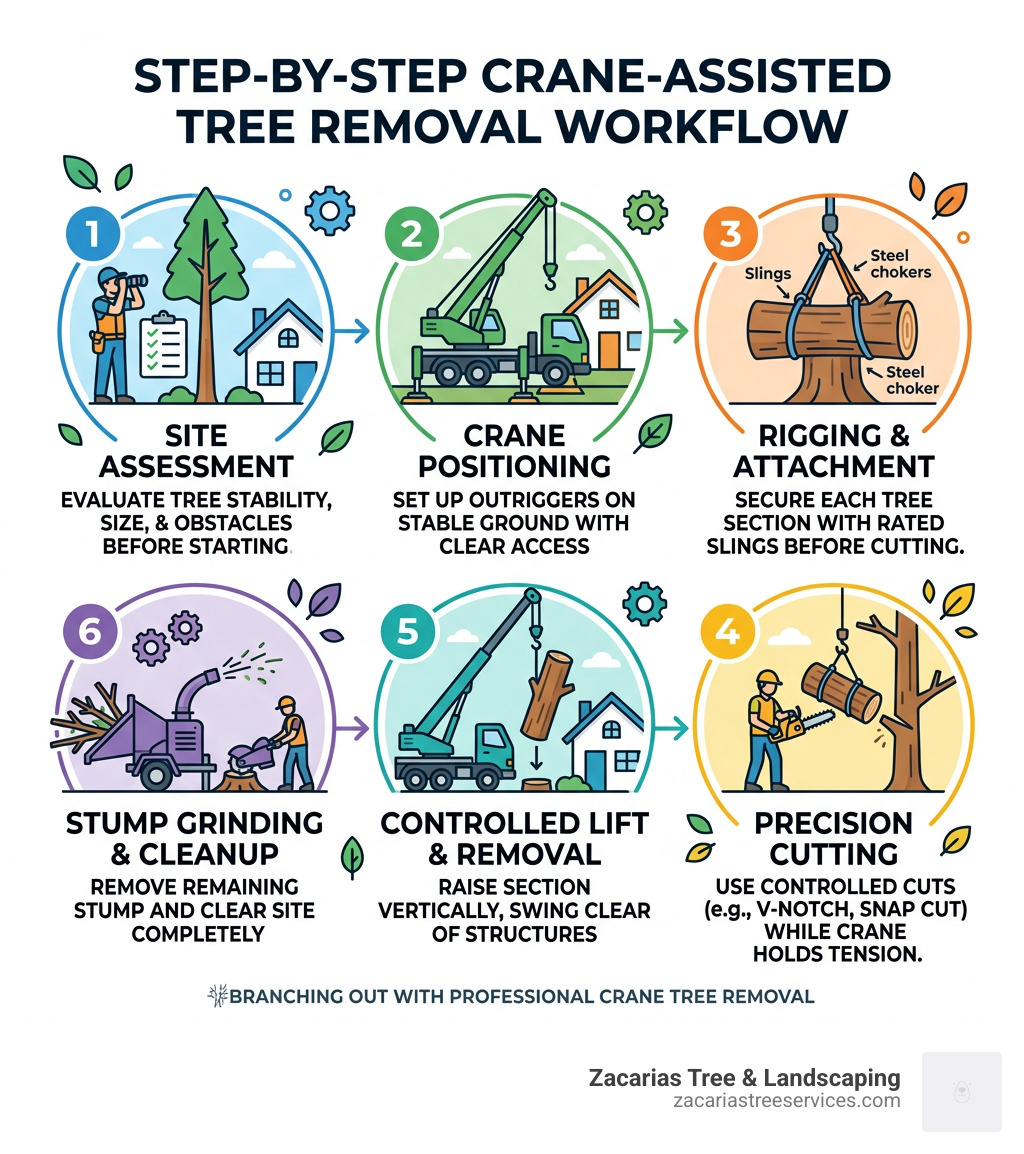
When we talk about professional crane tree removal techniques, we are describing a process that brings a level of surgical precision to urban forestry. In many Massachusetts neighborhoods—from the tight streets of Cambridge to the wooded lots of Concord—trees grow in spaces where there is simply no “drop zone.” Traditional felling is impossible because a falling trunk would crush a garage, a pool, or a neighbor’s fence.
The primary technique used is often called the “plucking” method. Instead of letting gravity do the work, a crane holds the weight of a tree section before it is even cut. Once the arborist finishes the cut, the crane simply lifts the piece vertically. This vertical extraction is the gold standard for Crane-Assisted Tree Removal: When And Why It’s Needed because it eliminates the “swing” factor that causes so much property damage in traditional rigging.
By utilizing crane-assisted tree removal, we can protect the delicate landscape below. Because the tree sections never hit the ground with force, we avoid soil compaction and damage to nearby ornamental plants.
Success in crane work happens long before the first saw is started. We begin with a rigorous site assessment. This isn’t just looking at the tree; it’s looking at the ground. A crane is only as stable as the surface it sits on. We evaluate soil stability and ensure there is clear boom access, avoiding overhead obstructions like communication lines.
Expert arborists then determine the outrigger positioning. These “legs” of the crane transfer the massive weight of the machine and its load to the ground. If the ground is soft or uneven—common in our hilly Massachusetts terrain—we use specialized pads to distribute that weight safely. This level of planning is a core part of our tree removal philosophy: measure twice, cut once, and lift safely.
Choosing the right tool for the job is about balancing safety, speed, and cost. While we love the power of a crane, we always evaluate other options first.
| Feature | Crane Access | EWP (Bucket Truck) | Traditional Climbing |
|---|---|---|---|
| Speed | Extremely High | Moderate | Low |
| Worker Fatigue | Low | Low | High |
| Obstacle Navigation | Excellent (Over-the-top) | Limited by reach | Moderate |
| Property Impact | Minimal (Vertical lift) | Moderate (Truck footprint) | Moderate (Drop zones) |
| Best For | Massive/Hazardous trees | Roadside trimming | Small/Stable trees |
As the table shows, cranes significantly reduce worker fatigue. A climber who doesn’t have to fight gravity all day is a climber who makes fewer mistakes.

Safety in the tree care industry isn’t a suggestion; it’s a legal and moral duty. We follow a strict hierarchy of risk control. Whenever possible, we try to eliminate the risk (working from the ground) or substitute the method (using an EWP). However, when a tree is structurally compromised—perhaps by an ice storm or internal decay—climbing it becomes too dangerous. In these cases, the crane is actually the safest option because it allows us to remove the tree without putting a climber’s weight on a failing structure.
In Massachusetts, certified and highly trained operators must hold specific hoisting licenses. Our crews also include “doggers” (people trained to direct crane loads) and observers who maintain a 360-degree view of the work zone. Adhering to these safety standards ensures that every person on-site knows their role. We also monitor weather closely; if wind speeds exceed safe thresholds or if lightning is in the area, we shut down immediately.
Rigging is the “art” side of the science. The goal is to attach the crane to the tree so that when the cut is made, the piece stays perfectly level or tilts exactly how we want it to.
We use high-strength nylon slings and steel chokers that “bite” into the bark to prevent slipping. To ensure we never overload the crane, we often use tools like the Log Weight Pro app, which helps us estimate the weight of green wood based on species and dimensions. This prevents the “jerking” of the crane that can happen if a piece is much heavier than expected. Proper crane maintenance of these cables and hydraulic systems is non-negotiable.
The moment of the cut is the most critical part of the operation. We use several specialized cuts:
Communication is the glue that holds this together. We don’t rely on shouting over chainsaws. We use high-tech helmet comms (Bluetooth or radio headsets) that allow the climber and operator to speak in normal voices. This builds a deep level of trust; the climber can “feel” the tree and tell the operator exactly when to put tension on the line.
To operate safely in Massachusetts, equipment must meet rigorous standards. We look to the AS 1418 standards and ANSI Z133 compliance for all our gear. This includes:
While modern cranes do the heavy lifting, we still utilize manual rigging systems as backups. Every lift is cross-referenced with load calculation charts to ensure we stay well within the crane’s Safe Working Load (SWL).
Working near power lines is one of the most dangerous aspects of our job. We strictly observe the Minimum Approach Distance (MAD). If a tree is within a certain distance of high-voltage lines, we coordinate with the local utility company before a single leaf is touched.
In the event of an emergency tree service call, we have pre-established rescue protocols. This includes training for “suspension intolerance”—a condition that can affect a climber hanging in a harness for too long. Our teams are trained in first aid and aerial rescue, ensuring that if something goes wrong, we can get our people to safety in minutes, not hours. For more information on how to handle these stressful situations, see our homeowners’ survival guide for emergency removal.
We understand that budget is a major factor for homeowners. Based on general industry research, crane-assisted removals typically range from $1,500 to $7,500 or more.
Why the wide range? It depends on:
Because every job is unique, we always recommend getting a free on-site estimate. While the daily rate for a crane is higher than a standard crew, the fact that it can turn a two-day job into a half-day job often makes it the most cost-effective choice in the long run.
A crane is often used as a last resort when all other access methods pose an unacceptable risk. This includes:
However, many professionals now argue that crane operations can be more efficient and should be considered earlier in the planning phase to maximize safety.
Don’t just hire the first person with a crane. Look for:
At Zacarias Tree & Landscaping, we pride ourselves on bringing these advanced crane tree removal techniques to our neighbors across Massachusetts. Whether you are in Acton, Billerica, or Winchester, we provide the rapid response and thorough cleanup you expect from a professional service.
Using a crane isn’t just about having the biggest machine; it’s about having the most expertise. Our goal is to make the “impossible” removal look easy, leaving your property safer and cleaner than we found it.
Ready to clear that hazardous tree with professional precision? Schedule your Crane Assisted Tree Removal with us today and let our expert team handle the heavy lifting.
Need a pro? Zacarias Tree & Landscaping provides licensed, insured, and expert care across Lynn, Essex, and Middlesex Counties.
We live by a simple promise: Clear scope. Clear plan. Clean finish.
From emergency removals to seasonal landscaping, we’ve been Lynn’s trusted choice since 2002. Safety-first standards. Total site cleanup. Every time.