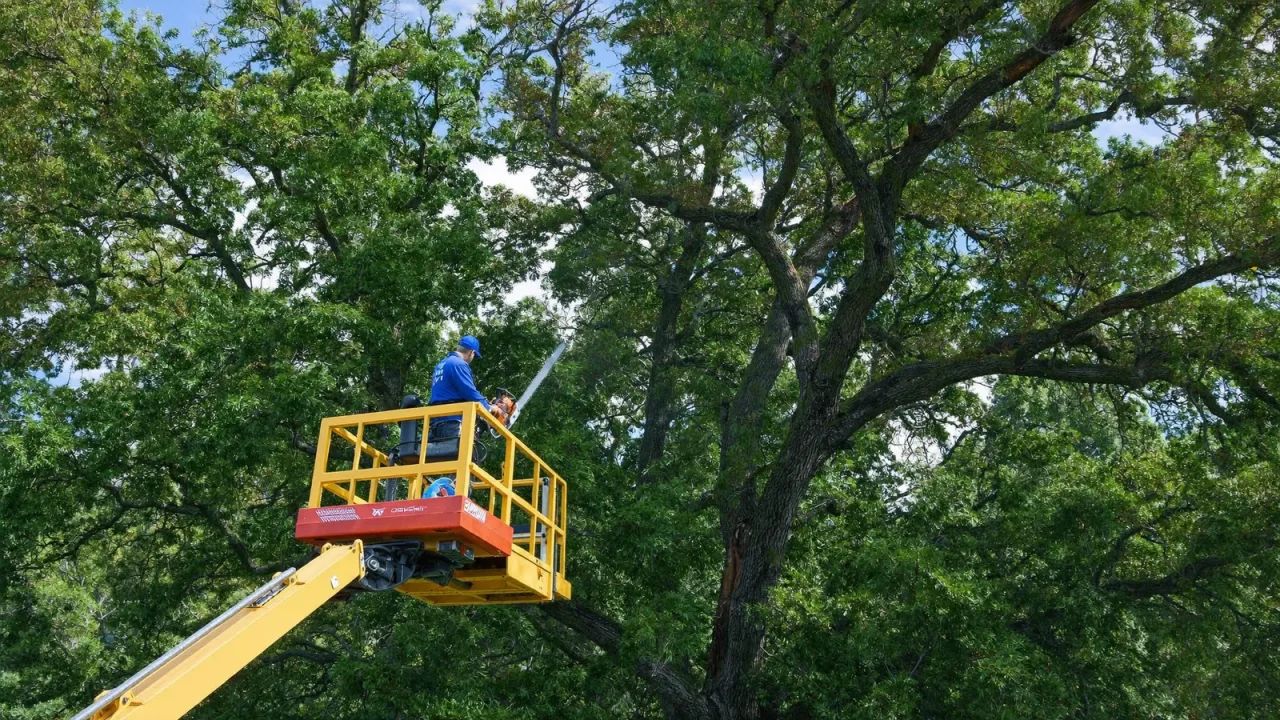
Oak tree trimming cost for a large, mature oak climbs with every complication: a very tall tree, limbs spreading over a house, or a crown carrying a lot of deadwood. What sets the price is the size of the canopy, the type of pruning, whether a climber or a lift can reach the work, and what sits under the limbs. Big sugar and Norway maples follow the same logic. The only accurate number is a free on-site estimate.
This is our main guide to pruning big shade trees. Zacarias Tree & Landscaping has cared for mature oaks and maples in Lynn and across Essex and Middlesex Counties since 2002, and the factors below are the ones our ISA-Certified Arborists weigh on site. If your trees are smaller ornamentals, see our guide to routine and small tree trimming costs instead.
Why large oaks and maples cost more to prune
A mature red or white oak can hold limbs as heavy as a small tree. Over a roof, a pool, or a driveway, those limbs cannot simply be dropped; each one is cut in sections and lowered on ropes, which takes a climber, a ground crew, and time. Oak wood is dense, so the brush and logs weigh more to move and haul. Large maples bring their own issues: Norway maples grow thick, heavy crowns, and both Norway and sugar maples often form two or more competing main stems that need careful work to reduce the chance of splitting in a nor'easter.
The other reason is skill. Pruning a big tree well means choosing which limbs to take and which to leave so the tree stays healthy and balanced. That judgment is what you are paying an arborist for.
The types of pruning, and what each costs relative to the others
| Pruning type | What it does | Relative effort |
|---|---|---|
| Crown cleaning | Removes dead, broken, diseased, and rubbing branches | Moderate; rises with the amount of deadwood |
| Crown thinning | Selectively removes live branches to open the canopy and reduce wind load | Moderate to high; many careful cuts throughout the crown |
| Crown raising | Removes lower limbs for clearance over roofs, walks, and driveways | Lower if limbs are reachable; higher over structures |
| Crown reduction | Shortens limbs back to healthy side branches to reduce height or spread | Highest; skilled cuts across the outer canopy |
Crown reduction is not the same as topping. Reduction cuts each limb back to a side branch big enough to take over, which keeps the tree's natural shape. Topping cuts limbs to stubs and causes long-term damage; our article on why topping harms trees explains the difference.
What drives the price on a large tree
- Height and spread: more canopy means more cuts, more climbing, and more brush.
- Targets underneath: a house, deck, garage, or wires means rigging and lowering instead of free-dropping.
- Access: a bucket truck is faster when it can reach the tree. Backyards behind fences, on slopes, or with soft lawns usually mean climbing, which takes longer.
- Deadwood: dead limbs are brittle and unpredictable, so they are removed slowly and carefully.
- Time since last pruning: an oak that has gone ten years or more without care has more to fix than one on a regular cycle.
- Debris volume: oak is dense, so a big pruning job produces heavy brush and logs that take time to chip and move. Cleanup and haul-away is included on every job we do, and we can leave firewood rounds on request.
- Urgency: storm-damaged limbs hanging after an ice storm are emergency work and priced that way.
When to prune oaks, and why it matters
Across the Northeast, the standard precaution is to avoid pruning oaks from about April through July. That is when the beetles that can carry oak wilt fungus are most active, and fresh wounds attract them. Late fall and winter, when the tree is dormant, is the preferred window. If an oak must be cut during the risky period, for example after storm damage, arborists commonly cover the fresh wounds right away. Maples can be pruned in late winter too; they may drip sap from cuts, which looks alarming but does not harm the tree.
For species guidance and regional pest updates, UMass Extension's landscape program is a reliable Massachusetts source.
How much can come off a large tree?
Mature trees do not tolerate heavy cutting well. A widely used rule of thumb in the industry is to remove no more than about a quarter of the live canopy in one season, and less on older or stressed trees. A good quote describes the work in terms of what is being removed and why, such as "remove all deadwood over 1 inch" or "raise canopy over the driveway," rather than a vague promise to "trim it back."
How often large trees need pruning
Most mature shade trees do well on a cycle of every three to five years, with a quick check after major storms. Regular, moderate pruning costs less over time than waiting until a tree is overgrown and full of deadwood. If you only need one or two problem limbs taken off, our guide to tree limb removal cost covers that smaller job.
What a good large-tree pruning quote includes
- The pruning type or types, in plain words
- Specific goals: clearance heights, deadwood size, which side of the tree
- How debris will be handled, and whether wood is left
- Who does the work, including an ISA-Certified Arborist
- Proof of liability and workers' compensation insurance
Frequently asked questions
How much does it cost to trim an oak tree?
It comes down to the size of the crown, the type of pruning (crown reduction takes the most skill and time, crown raising over open lawn the least), whether a bucket truck can reach or a climber is needed, and whether limbs hang over a house, deck, or wires. Heavy deadwood and years without care add time. Small, young oaks are a far simpler job. An arborist can walk the tree with you and give you an exact written price.
When is the best time to trim oak trees in Massachusetts?
Late fall through winter, while the tree is dormant. Avoid pruning oaks from about April through July unless there is a safety reason, because fresh wounds in that window can attract beetles that spread oak wilt.
Do I need an arborist to trim a large oak?
For anything beyond small branches you can reach from the ground, yes. Large-tree work combines climbing, rigging, and pruning judgment, and a certified arborist brings all three. You can verify credentials through the International Society of Arboriculture.
Is it cheaper to trim a big oak or remove it?
Pruning a healthy oak is almost always cheaper than removing it, and a well-kept oak adds shade and value for decades. Removal makes sense when the tree is dead, structurally unsound, or badly placed. Our oak removal price guide covers that side.
Get a price for your oak or maple
Zacarias Tree & Landscaping provides tree trimming and pruning for large trees throughout the North Shore, with free on-site estimates, usually scheduled the same day. If you are not sure what your tree needs, start with an arborist assessment. Request a free estimate and an arborist will walk the tree with you.