#
The average cost to remove a fallen tree typically ranges from $300 to $1,500 for most residential jobs, though prices can climb well above $3,600 for large trees or complex situations.
Here’s a quick breakdown by tree size, based on national averages:
| Tree Size | Height | Typical Cost Range |
|---|---|---|
| Small | 10–30 ft | $150–$500 |
| Medium | 30–60 ft | $500–$1,500 |
| Large | 60–120 ft | $1,500–$3,600+ |
Note: These are general national averages based on internet research. Actual costs vary depending on your property, access, tree condition, and local labor rates. Always get an on-site estimate for accurate pricing.
A fallen tree in your yard — especially after a storm — brings a mix of stress, safety concerns, and an unexpected bill. You need to know roughly what you’re looking at before you call anyone.
The good news: removing a tree that’s already on the ground is generally cheaper than removing a standing one. No climbing. No controlled felling. Less risk.
But the final number still depends on several factors — tree size, where it landed, what’s in the way, and whether you need emergency service.
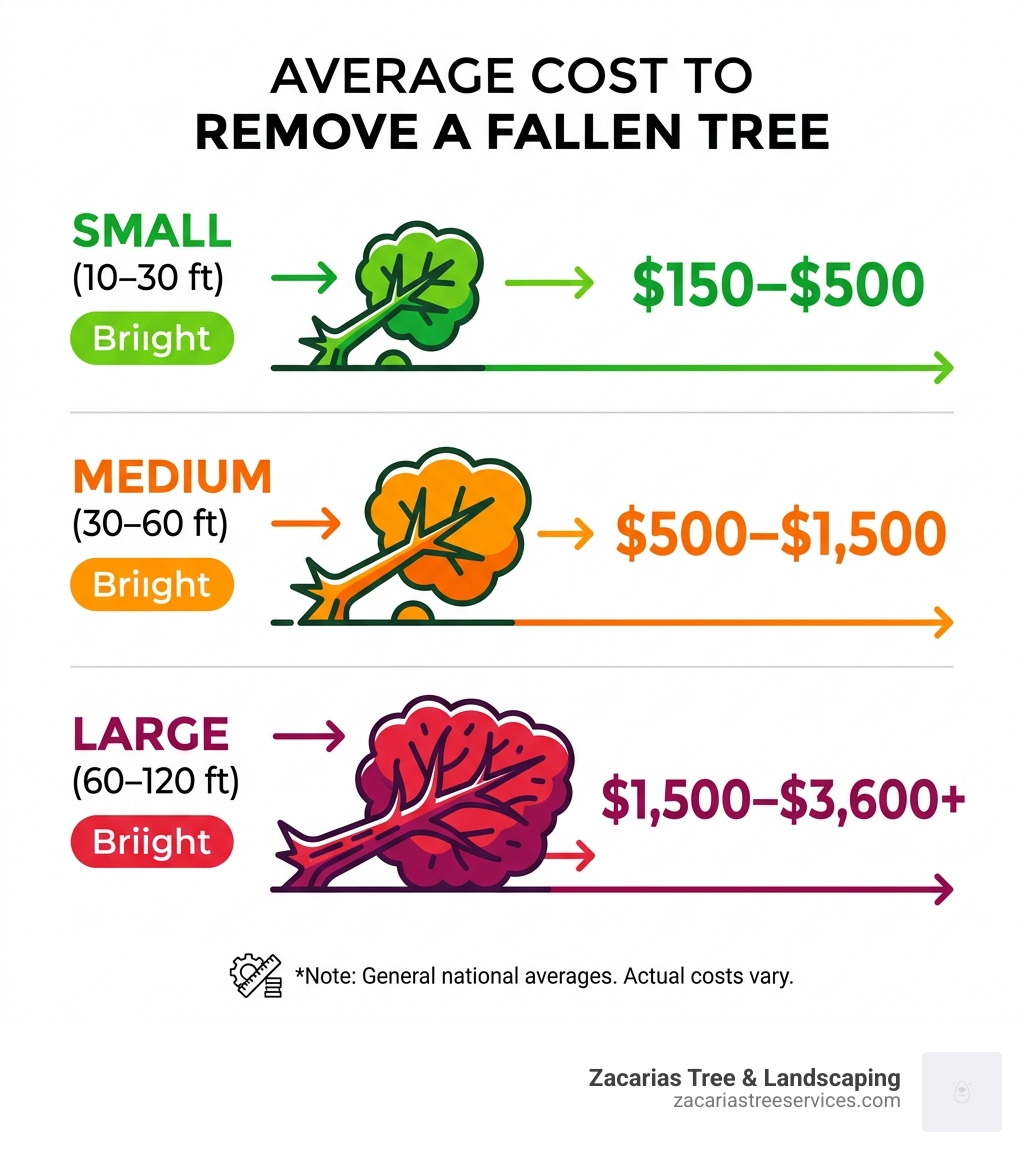
Average cost to remove a fallen tree terms at a glance:
When you wake up after a Nor’easter in Arlington or Concord and find a massive oak sprawled across your lawn, your first question is inevitably about the wallet. Based on general internet research and national data for April 2026, the average cost to remove a fallen tree sits between $350 and $750 for standard jobs, though the full spectrum of projects can range from as little as $100 to over $5,000.
Why such a massive gap? Because no two trees fall the same way. A tree that lands neatly in an open field is a “walk in the park” (literally). A tree that is tangled in power lines or resting on a Victorian roof in Cambridge is a complex engineering puzzle.
According to How Much Does It Cost to Remove a Tree? [2025 Data] , the pricing variability is driven largely by the volume of debris. A tree that is twice as tall and twice as thick doesn’t just have twice the wood—it often has eight times the mass and material to process and haul away.
Size is the primary “anchor” for any estimate we provide. While every property in towns like Lexington or Newton is different, we generally see costs scale with the height and diameter of the trunk.
Living in Massachusetts means dealing with specific economic realities. Labor rates in the Greater Boston area—from Somerville to Framingham—tend to be higher than the national average. Furthermore, Massachusetts has strict regulations regarding wood disposal and debris management.
In towns like Acton or Bedford, you might also face higher disposal fees at local transfer stations. We also see seasonal spikes. If a major ice storm hits the North Shore or the MetroWest area in the winter, demand for crews skyrockets, and emergency rates may apply.
If you are looking for more details on how we handle these specific challenges, check out our Tree Removal services page for a deeper dive into our process.

When we arrive at your property in Woburn or Natick to give you an estimate, we aren’t just looking at the tree. We are looking at the “logistics puzzle” surrounding it. As noted in Tree Removal Cost [2026 Data] | Angi , several variables can push a quote toward the higher end of the range.
Can we get our trucks and chippers close to the tree? If the tree fell in a wide-open front yard in Sudbury, the job is efficient. If it fell in a tiny, fenced-in backyard in Cambridge where we have to carry every branch through a narrow gate by hand, the labor costs will rise.
For those dealing with urgent situations where a tree is blocking a driveway or threatening a structure, you can learn more about our Emergency Tree Service options.
The basic “removal” quote usually covers cutting the tree into manageable sections and chipping the small branches. However, there are often “extras” that homeowners forget to budget for:

It might seem counterintuitive, but a tree falling over can actually save you money—assuming it didn’t land on your Tesla. Removing a standing tree is a high-stakes surgical operation. Removing a fallen tree is more like a construction site cleanup.
When a tree is standing, we have to fight gravity. Our arborists often have to climb the tree, rig branches with ropes, and lower them slowly to avoid damaging your house or the lawn. This takes a massive amount of time and highly specialized skill.
With a fallen tree:
Research suggests that removing a fallen tree can be 20% to 50% cheaper than removing the same tree while it was standing. For a closer look at how we reclaim your yard after a storm, read Getting Your Yard Back With Professional Downed Tree Removal.
There is a major exception to the “fallen is cheaper” rule: Structural Impact.
If a 10-ton oak is resting on your roof in Braintree, it is under incredible tension. Cutting it the wrong way could cause it to shift, potentially collapsing your roof or injuring a worker. These jobs require cranes, specialized rigging, and a much higher level of expertise. In these cases, the cost can easily double or triple compared to a tree on the grass.
Furthermore, “hung up” trees—trees that have snapped but are leaning against another tree—are the most dangerous jobs in the industry. They are essentially giant, loaded springs waiting to snap. These require extreme caution and often more expensive equipment.
One of the most common questions we get in towns like Lynnfield or Winchester is: “Will my insurance pay for this?”
The answer is a classic: It depends.
Generally, homeowners insurance covers tree removal if the tree hit a “covered structure.” If a tree falls on your house, garage, or a permanent fence, your policy will likely cover the cost of removal (minus your deductible) and the repairs to the structure.
However, if a tree falls in the middle of your backyard and doesn’t hit anything, many insurance companies consider that “yard debris” and may not cover the removal at all, or they may offer a very small capped amount (often $500).
For a deep dive into the logistics of insurance and storm damage, check out The Grounded Truth A Guide To Emergency Fallen Tree Removal.
When a massive storm rolls through Massachusetts, every tree service from Lowell to Quincy gets 500 calls at once. During these peak periods, “Emergency Rates” often apply.
Emergency services typically involve:
Expect emergency rates to be 1.5x to 3x higher than a standard scheduled removal. If you find yourself in this situation, our Emergency Tree Removal The Homeowners 24 Hour Survival Guide can help you navigate the chaos. You can also find help quickly via our Need Help Now Your Guide To 24 Hour Emergency Tree Service page.
We know it’s tempting. You have a chainsaw in the garage, and you want to save a few hundred bucks. But fallen trees are deceptive.
We always recommend hiring a professional, especially for trees with a diameter larger than 8 inches. It’s simply not worth the risk to your life or your property. For more on what to do immediately after a tree hits your property, see What To Do When Nature Attacks Your Emergency Tree Service Handbook.
As mentioned, coverage usually only kicks in if the tree damages a covered structure like your home or a shed. If the tree falls “harmlessly” on the lawn, you are likely on the hook for the bill. Always take photos before the crew arrives to document the damage for your adjuster.
If it’s just a single large limb, the cost is significantly lower, usually ranging from $75 to $250. This covers the labor to cut it up and run it through the chipper. However, if that limb is dangling 40 feet in the air (a “widow-maker”), the price will go up because we’ll need a bucket truck or a climber to reach it safely.
Yes, in almost every scenario. Without the need for high-altitude climbing and complex rigging to bring the tree down piece-by-piece, the labor time is cut in half. The only exception is when the tree is resting on a house or power line, which requires specialized equipment and extreme care.
Dealing with a downed tree is never part of the plan, but understanding the average cost to remove a fallen tree helps you make an informed decision when the unexpected happens. Whether you are in Belmont, Salem, or Maynard, the key is to act quickly to prevent further property damage or pest infestations.
At Zacarias Tree & Landscaping, we pride ourselves on our rapid response and quick estimates. We know that a tree in your driveway is an emergency, and we work efficiently to get your life back to normal. Our team is known for thorough cleanup—we don’t just cut the tree; we make sure your yard looks better than it did before the storm.
We serve a wide range of Massachusetts communities, including:
Don’t let a fallen tree sit and rot or create a hazard for your family. Contact us for professional tree removal today, and let us handle the heavy lifting while you enjoy the peace of mind that comes with hiring the pros.
Need a pro? Zacarias Tree & Landscaping provides licensed, insured, and expert care across Lynn, Essex, and Middlesex Counties.
We live by a simple promise: Clear scope. Clear plan. Clean finish.
From emergency removals to seasonal landscaping, we’ve been Lynn’s trusted choice since 2002. Safety-first standards. Total site cleanup. Every time.