When a massive tree fails, the initial shock can cloud your judgment. However, the moments following a fall are the most critical for ensuring the safety of your family and neighbors. Downed tree removal is not just about clearing debris; it is about managing a high-stakes hazard zone.
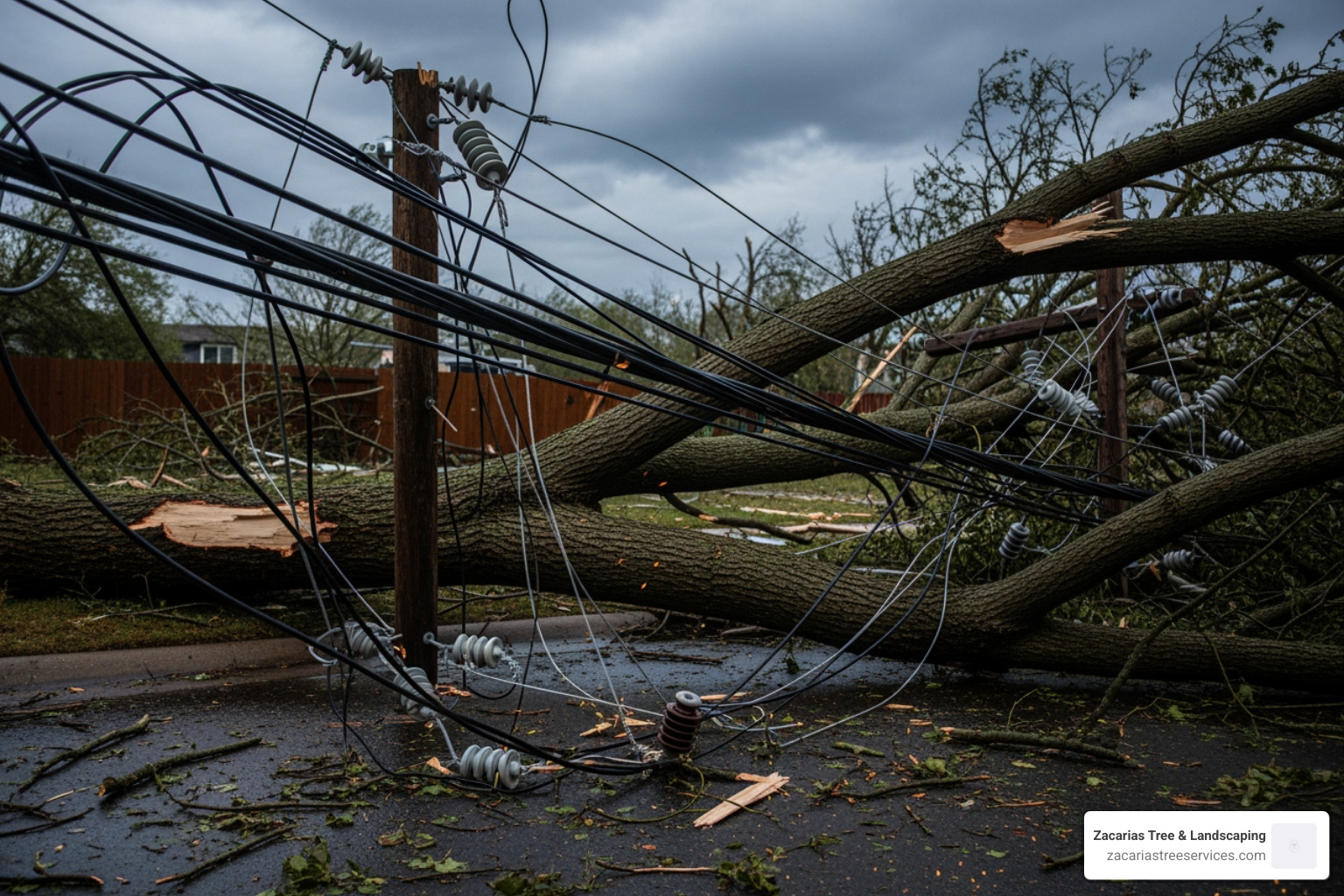
The first rule of post-storm safety is the 10-meter rule: always stay at least 33 feet (10 meters) away from any downed wires or trees touching those wires. Electricity can travel through the ground and the tree itself, creating a lethal “gradient” of voltage. You should always assume that any downed power line is live and dangerous.
If a tree has fallen on your home, evacuate the building immediately. The structural integrity of your roof or walls may be compromised, and the weight of a 50,000-pound oak can cause a secondary collapse hours after the initial impact. For more detailed safety steps, you can review the Safety tips from the Electrical Safety Authority.
Not all hazards are as obvious as a trunk lying in the kitchen. We look for “silent” killers that indicate an emergency situation:
For a deeper dive into managing these high-pressure scenarios, check out our Emergency Tree Removal: The Homeowner’s 24-Hour Survival Guide.
If a tree is interfering with electrical infrastructure, your first call isn’t to a tree service—it’s to the utility company. In Massachusetts, depending on your specific town (whether you are in Arlington, Framingham, or Newton), you may need to contact Eversource, National Grid, or your local municipal light plant.
Utilities like Alectra or Toronto Hydro (for our northern neighbors) emphasize that property owners are responsible for the trees on their private land, but the utility handles anything touching the high-voltage lines. They may need to perform a temporary service disconnection so that our crews can safely perform the downed tree removal. Most utilities maintain 24/7 hotlines specifically for reporting fallen tree hazards.
Once the immediate danger has passed, the “who pays?” question usually crawls to the top of the list. Dealing with insurance adjusters while a tree is still sitting on your car is never fun, but staying organized will save you thousands of dollars.
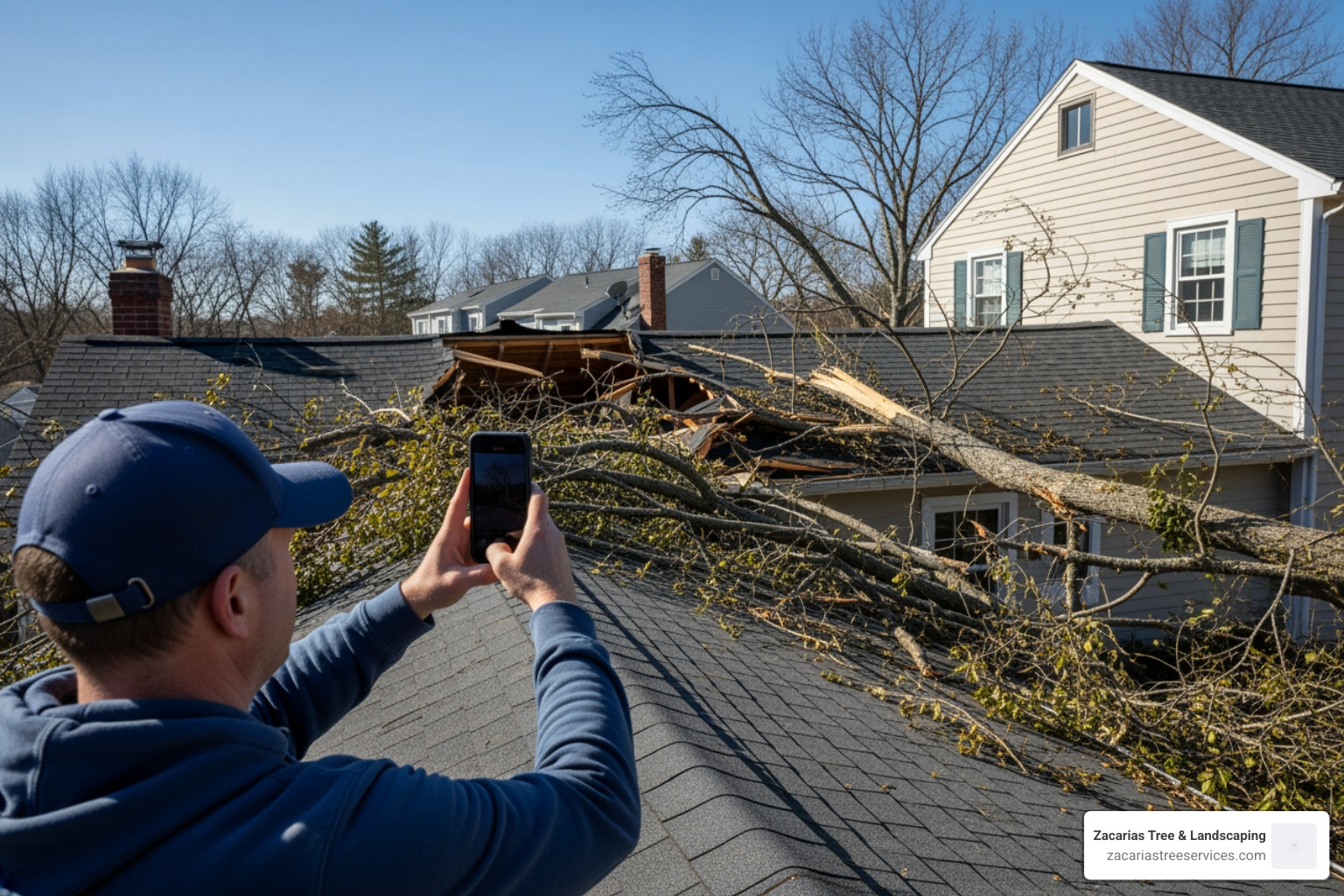
In insurance, a fallen tree is often considered an “Act of God.” Generally, if a tree falls on your property, your homeowners’ insurance covers the damage and removal, regardless of where the tree stood originally.
For more on the legal nuances of these situations, you can read the Consumer Reports on tree fall responsibility.
Before we start the chainsaws, you need evidence.
If you need more information on how we categorize these services for your adjuster, visit our page on Tree Removal.
We’ve seen it too many times: a well-meaning homeowner heads out with a store-bought chainsaw to “clean things up” and ends up in the emergency room. Downed tree removal is arguably the most dangerous task in the landscaping industry.

When a tree falls, it creates a complex web of physics.
Professionals use technical rigging and specialized equipment to neutralize these forces. For the heaviest jobs, we utilize Crane Assisted Tree Removal to lift the tree vertically, preventing further damage to your shingles or lawn.
A certified arborist does more than just cut wood. We provide:
Learn more about our specialized Emergency Tree Service to see how we handle these high-risk scenarios.
Massachusetts has some of the strictest tree protection bylaws in the country. Even if a tree is on the ground, you might still have paperwork to consider.
Once the tree is on the ground and cut into manageable pieces, the “cleanup” phase begins. We don’t just leave a pile of logs in your driveway.
In many Massachusetts towns, trees over a certain diameter (often 30cm or 12 inches) are protected. However, “imminent hazards” are usually exempt from the standard permit process. If a tree has fallen or is about to fall on a public roadway or sidewalk, it becomes a municipal liability issue. In these cases, you should report the obstruction to 311 or the local DPW immediately.
The best way to handle downed tree removal is to prevent the tree from falling in the first place.
Trees usually give us “hints” before they fail. We recommend a professional inspection if you notice:
Regular Tree Trimming and Pruning can thin out the canopy, allowing wind to pass through the tree rather than acting like a sail and blowing it over.
If you’ve lost a tree, the next step is restoration. We help homeowners with “Right Tree, Right Place” planning. This means choosing species that won’t interfere with utility easements or grow too close to the foundation. You can explore our Tree Planting services to start rebuilding your canopy.
In Massachusetts, the owner of the property where the tree landed is generally responsible for the cleanup and damage through their own insurance. This is considered an “Act of God” unless you can prove the neighbor was aware the tree was hazardous and neglected to fix it.
Most local bylaws in the MA service area allow for the immediate removal of trees that pose an “imminent hazard” to life or property without a prior permit. However, we always recommend taking photos and notifying the town arborist or conservation commission shortly after the work is done to maintain a record.
Pricing for downed tree removal varies significantly based on the size of the tree, its location (e.g., on a roof vs. in an open field), and the equipment required (like cranes). Based on general industry research, costs can range anywhere from $500 for a small, accessible tree to $5,000 or more for complex, large-scale emergency removals involving structures. For an accurate figure tailored to your property, it’s best to request a free on-site estimate.
A fallen tree doesn’t have to mean a ruined property. At Zacarias Tree & Landscaping, we specialize in helping Massachusetts homeowners navigate the chaos of storm damage with rapid response, quick estimates, and thorough cleanup. From the historic streets of Salem to the quiet neighborhoods of Boxborough, our crews are ready to help you get your yard back.
If you are facing an emergency or just want to ensure your trees are ready for the next Nor’easter, don’t wait. Get Your Instant Tree Removal Quote Today and let us handle the heavy lifting safely and efficiently.
Need a pro? Zacarias Tree & Landscaping provides licensed, insured, and expert care across Lynn, Essex, and Middlesex Counties.
We live by a simple promise: Clear scope. Clear plan. Clean finish.
From emergency removals to seasonal landscaping, we’ve been Lynn’s trusted choice since 2002. Safety-first standards. Total site cleanup. Every time.