If you need emergency tree service, here’s what to do immediately:
A storm rolls through Massachusetts overnight. By morning, a massive oak is leaning hard toward your roof — roots half out of the ground, soil cracked and heaving beneath it. Every gust makes it shift a little more.
This is not a “wait and see” situation.
Tree emergencies happen fast, and the window to act safely is narrow. A mature oak can weigh up to 50,000 pounds. Once it starts moving, nothing stops it.
The difference between a close call and a catastrophic loss often comes down to one thing: how quickly you get the right help.
This guide walks you through everything — from spotting a real emergency, to what happens when the crew arrives, to how to protect yourself before the next storm hits.
Not every drooping branch requires a midnight phone call, but knowing when a tree has crossed the line into a hazardous tree situation is vital for your family’s safety. In our experience serving Massachusetts, a true emergency is defined by immediate risk. If a tree has already caused structural damage to your home, is leaning precariously over a bedroom, or has made contact with utility lines, you are facing a crisis.
Another major red flag is blocked property access. If a massive trunk is sprawled across your driveway, it isn’t just an inconvenience; it’s a safety hazard that could prevent emergency vehicles from reaching your home. When you see uprooted root systems where the soil is literally lifting out of the garden bed, the tree has lost its anchor. At this point, gravity is the only thing holding it up, and gravity is a fickle friend during a New England windstorm.

Trees often try to tell us they are failing before they actually hit the ground. Keep a sharp eye out for trunk splits or deep vertical cracks that look like the tree is trying to unzip itself. A sudden lean—especially one that happened overnight or during a storm—is a clear cry for help.
Watch the ground as much as the sky. Ground heaving (where the earth around the base of the tree is rising) or “mounding” is a sign the roots are snapping. Also, look for fungal growth or “shelf mushrooms” at the base; this often indicates internal rot, which leads to uncontrolled tree falls because the structural heart of the tree has turned to mush.
While any tree can fall under the right conditions, certain species are more “drama-prone” than others. Cottonwood Trees and Willow trees are notorious for having brittle wood and shallow root systems. They grow incredibly fast, but that speed comes at a price: they lack the structural density of a slow-growing hardwood.
Silver Maples are another common culprit in Massachusetts yards. They tend to develop multiple trunks and brittle branches that snap like matchsticks when coated in ice or buffeted by high winds. If you have these fast-growing species near your home, they require much more frequent inspections to ensure they don’t become an emergency tree service headline.
We get it—you have a chainsaw in the garage and a “can-do” attitude. But Tree Removal is one of the most dangerous jobs in America for a reason. As we mentioned, a mature oak can weigh 50,000 pounds. To put that in perspective, that’s about the weight of four or five school buses. When that much weight starts to shift, it doesn’t just fall; it crushes everything in its path.
Chainsaw safety risks are only the beginning. There’s also the “spring pole” effect, where a branch under tension snaps back with enough force to be lethal, and the unpredictable way a storm-damaged tree shifts its weight once you start cutting. Attempting a DIY removal on a hazardous tree is a recipe for property damage, severe injury, or even legal liability if the tree ends up in your neighbor’s living room. This is why we always emphasize that Tree Services should be left to licensed professionals who carry the right insurance and expertise.
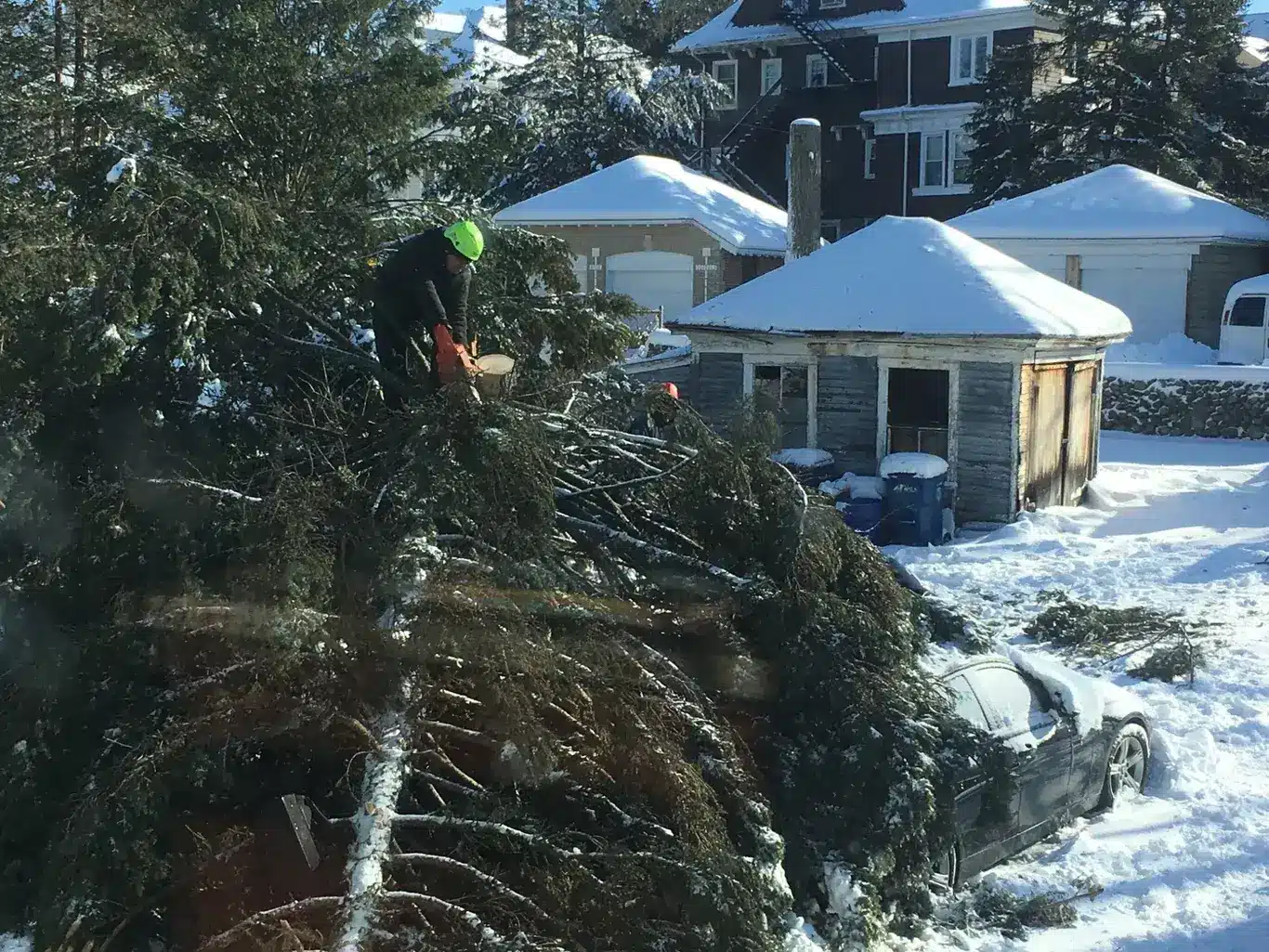
When our team arrives for an emergency tree service call, we don’t just start hacking away. We begin with a site safety assessment to identify “kill zones” and electrical hazards. For complex jobs where a tree is leaning over a structure, we utilize Crane Assisted Tree Removal. This allows us to lift the tree vertically piece by piece, rather than letting it fall, which protects your roof and landscape.
Our process involves:
Standard gardening tools won’t cut it in a crisis. Professional crews use bucket trucks to reach heights of 60 feet or more and heavy-duty wood chippers that can turn a massive limb into mulch in seconds. For night operations—which are common during Massachusetts winter storms—we deploy portable generators and high-intensity floodlights to ensure our crew can see every tension point and hazard. We also use location tracking for our fleet, allowing us to dispatch the closest team to your location in towns like Framingham, Natick, or Newton for the fastest possible response.
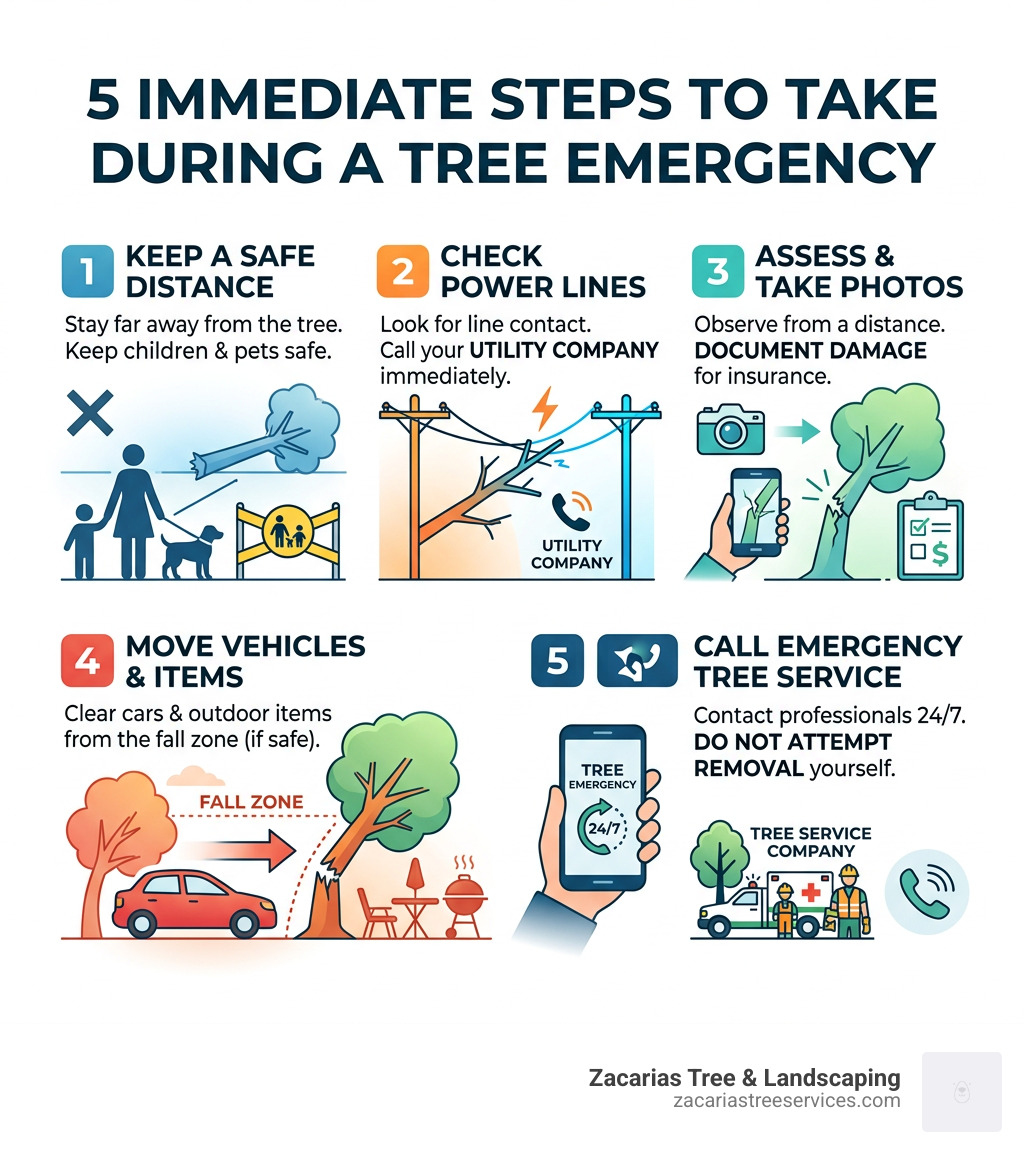
If a tree has fallen or is about to, your first job is “Chief Safety Officer.” Establish a safety perimeter—basically, if the tree is 50 feet tall, stay at least 100 feet away from it in every direction. If the tree is touching your house and you hear creaking or see structural shifts, follow evacuation protocols immediately.
If the tree has tangled with power lines, do not touch anything—not even the ground near the tree. Call your utility company immediately. While you wait for us to arrive, you can refer to our Emergency Tree Removal: The Homeowner’s 24-Hour Survival Guide for more detailed safety tips. One of the most helpful things you can do is document the scene.
We know that “how much is this going to cost?” is the first question on every homeowner’s mind. Based on general internet research and national averages, emergency tree removal can vary wildly. A simple limb removal might start around $300, while a massive, complex removal involving cranes and structural stabilization can range from $2,000 to over $7,000.
Factors that affect the price include:
Most homeowners find that their insurance covers a significant portion of the cost if the tree fell due to a “peril” like wind or lightning and struck a covered structure. You will likely only be responsible for your deductible. Because every situation is unique, we encourage you to Contact Us for an on-site estimate to get an accurate picture for your specific property.
The best emergency tree service is the one you never have to call. Learn more about professional tree care to understand how regular maintenance can save you thousands in the long run. Proper Tree Trimming & Pruning involves canopy thinning, which allows wind to blow through the tree rather than hitting it like a solid sail.
If you are looking to add to your landscape, consider Tree Planting species that are known for strength, like White Oaks or Sugar Maples, which handle New England winters beautifully. If a tree was planted too close to a foundation, Tree Transplanting it while it’s still young can prevent a future structural emergency.
| Service Type | Estimated Cost Range (General Averages) | Potential Emergency Cost Avoided |
|---|---|---|
| Routine Pruning | $250 – $1,200 | $2,000 – $7,000+ |
| Professional Inspection | $150 – $500 | $10,000+ (Roof Repair) |
| Cabling & Bracing | $500 – $1,500 | $5,000+ (Total Removal) |
| Disease Treatment | $200 – $800 | $3,000+ (Dead Tree Removal) |
Our certified arborists recommend a professional inspection at least once a year, preferably before the heavy snows of winter or the hurricane season. In our Service Areas across Massachusetts, we look for structural weaknesses that can be fixed with cabling and bracing systems. These systems act like “braces” for your tree, providing extra support to weak crotches or heavy limbs. Managing disease early also prevents the internal rot that leads to sudden, catastrophic failures.
Generally, yes—but with conditions. If a healthy tree falls due to a storm and hits your house, garage, or fence, insurance usually covers the removal and the repairs. However, if the tree was dead or diseased for years and you ignored it, the insurance company might deny the claim based on “negligence.” Always document the condition of your trees before storm season!
In urgent situations where a tree is blocking a road or crushing a roof, we aim for the fastest possible deployment. While response times can vary during major regional storms when everyone is affected, reputable local services often maintain a response time of under two hours for the most critical emergencies. We prioritize jobs based on the level of immediate danger to life and property.
Stay back! A tree touching a power line can energize the entire tree and even the ground around it. Call your local utility company (like National Grid or Eversource) immediately. Do not attempt to clear any branches, even if they aren’t touching the wires directly. Professional tree crews will coordinate with the utility to ensure the power is cut before any work begins.
When nature attacks, you don’t have to face the aftermath alone. At Zacarias Tree & Landscaping, we pride ourselves on our rapid response and our deep expertise in handling the unique challenges of Massachusetts weather. Whether you are in Acton, Cambridge, or Worcester, our goal is to restore safety to your property with efficient work and a thorough cleanup that leaves your yard looking better than before the storm.
Don’t wait for the “crack” in the middle of the night. If you see a warning sign or are currently facing a fallen giant, we are here to help. About Us—we are a team dedicated to professionalism and property protection.
Need a pro? Zacarias Tree & Landscaping provides licensed, insured, and expert care across Lynn, Essex, and Middlesex Counties.
We live by a simple promise: Clear scope. Clear plan. Clean finish.
From emergency removals to seasonal landscaping, we’ve been Lynn’s trusted choice since 2002. Safety-first standards. Total site cleanup. Every time.