For most North Shore homeowners, selling trees to a lumber company will not pay for clearing land. Sawmills and loggers want large volumes of straight, defect-free trunks of valuable species that a log truck can reach, and a handful of yard trees rarely meets that bar. The honest plan is to budget for removal as a normal service and use the wood in ways that save money, like keeping it as firewood.
We are Zacarias Tree & Landscaping, a family-run tree and landscape company in Lynn since 2002. The timber question tends to come up right after someone sees a removal estimate, so this guide explains what buyers look for and why house-lot trees usually fall short.
What timber buyers actually look for
A timber buyer is paying for sawlogs: sections of trunk that can be milled into boards. Value depends on several things at once.
- Species. In New England, buyers are most interested in hardwoods such as red oak, white oak, sugar maple, and black cherry. White pine has value in volume. Norway maple, birch, and ornamental trees usually have little or none.
- Trunk quality. The valuable part is the straight lower trunk free of large branches, rot, cracks, and wide forks. A tree that grew in the open with low limbs, like most yard trees, has a short, knotty trunk.
- Size. The trunk has to be big enough in diameter and long enough to produce usable boards.
- Volume. Moving a crew, skidder, and log truck costs the same whether they cut one tree or fifty. Buyers need enough good wood in one place to make the trip worthwhile.
- Access. Logging equipment needs a wide, firm route to the trees and room to load a truck. Backyards between houses almost never offer that.
Why yard trees usually are not worth selling
Metal hidden in the wood
Trees that grew near homes collect nails, fence staples, clothesline hooks, wire, and old tree-house bolts. Over the years the wood grows around them. A single hidden nail can damage an expensive saw blade, so many mills avoid residential trees entirely or pay very little for them.
Removal method changes the wood
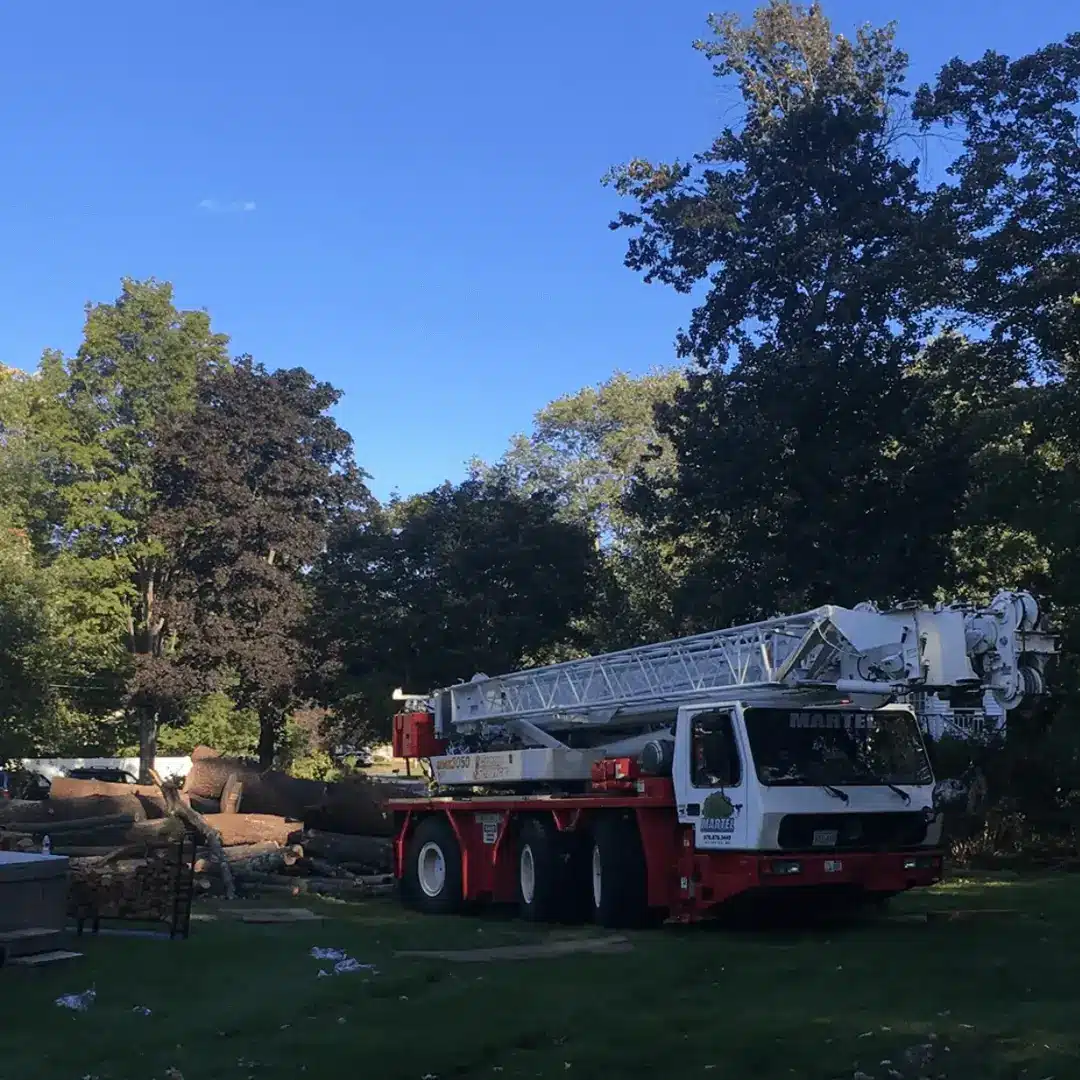
A tree in the open can be felled in one piece, leaving a long log. A tree next to a house usually has to be taken down in short sections, rigged and lowered or lifted out by crane. Short rounds suit firewood, not the long logs a mill wants.
The numbers rarely work
Even when a yard tree has some value, the payment to the owner (called stumpage) is usually small, while the cost of safely removing that tree near a house can be significant. The safety work is the expensive part, and a timber sale does not reduce it.
When a timber sale can make sense
If you own actual woodland, a timber sale can be a legitimate option. That usually means several acres of forest with good-quality hardwood or pine, road access, and no buildings in the way. In that case:
- Talk to a licensed consulting forester who works for you, not the buyer, and can mark trees and put the sale out to bid.
- Know that larger commercial harvests in Massachusetts fall under the state's Forest Cutting Practices Act, which is administered by the Department of Conservation and Recreation. DCR can explain whether a cutting plan is required for your land.
- Check with your town's conservation commission if the land is near wetlands or water.
That kind of forestry work is outside what we do. Our focus is residential tree removal, pruning, and landscaping on home lots.
Better ways to get value from your trees
| Option | Best for | What it saves |
|---|---|---|
| Keep the firewood | Oak, maple, and other hardwoods if you have a wood stove or fire pit | Hauling and disposal on the removal quote |
| Keep the wood chips | Mulching beds and paths | Buying mulch, plus chip disposal |
| Save a log or slab | A garden bench, edging, or a woodworking project | Nothing on the quote, but keeps a piece of the tree |
| Offer rounds to neighbors | Large amounts of firewood you cannot use | Storage space, and some goodwill |
Firewood can be left on request, cut to rounds for you to split. Hardwoods such as oak and maple make the best firewood once they have seasoned. White pine burns fast and is better suited to outdoor fires than to a wood stove.
Lowering the cost of clearing trees without a timber sale
- Group removals. Taking down several trees in one visit spreads the cost of equipment and crew.
- Keep healthy trees at the edges. Remove only what the project needs.
- Handle stumps to fit the plan. Grind only the stumps that sit where lawn, beds, or a patio will go.
- Get one clear scope. Our guide to clearing trees and brush from part of a lot walks through what drives that price.
Frequently asked questions
Will a lumber company pay me for one big oak in my yard?
Rarely. A single oak, even a large one, is usually not enough volume to bring in logging equipment, and yard trees often contain metal. If the oak needs to come down, plan on paying for removal and keep the wood as firewood if you can use it.
Is my white pine worth anything as timber?
Pine is valued by volume, so a few trees on a house lot seldom interest a buyer. Tall pines near homes also tend to come down in short sections, which lowers any value further.
Do I need a permit to cut trees for timber in Massachusetts?
Larger commercial harvests fall under state forestry rules administered by DCR, and wetland areas involve the local conservation commission. For removing trees on a house lot, check your town's rules first.
Can you leave all the wood for me?
Yes. Ask when you get your estimate. Leaving the wood on site usually lowers the price because there is less to haul.
Get a straight answer on your trees
If you are weighing whether trees on your property are worth anything, we will tell you honestly and give you a clear price for removing the ones that need to go. Our ISA-Certified Arborists can also point out which trees are healthy enough to keep. See our tree removal and arborist services, or request a free estimate anywhere in Lynn, the North Shore, and Essex and Middlesex Counties.