A long tree cutter — also called a pole pruner or telescopic tree pruner — is a long-handled tool designed to trim or saw branches high above your head without using a ladder.
Quick answer: What is a long tree cutter?
After a storm rolls through a Massachusetts backyard, it’s common to find broken or hanging branches just out of arm’s reach. Not quite high enough to justify calling a crew — but too high to safely grab with a standard pair of loppers. That’s exactly where a long tree cutter earns its keep.
These tools range from simple rope-pull pole pruners to powerful gas-driven saws extending over 12 feet. The right choice depends on your branch height, branch thickness, and how much overhead work you’re willing to take on safely.
This guide walks you through every option — so you can make a smart, safe decision for your yard.
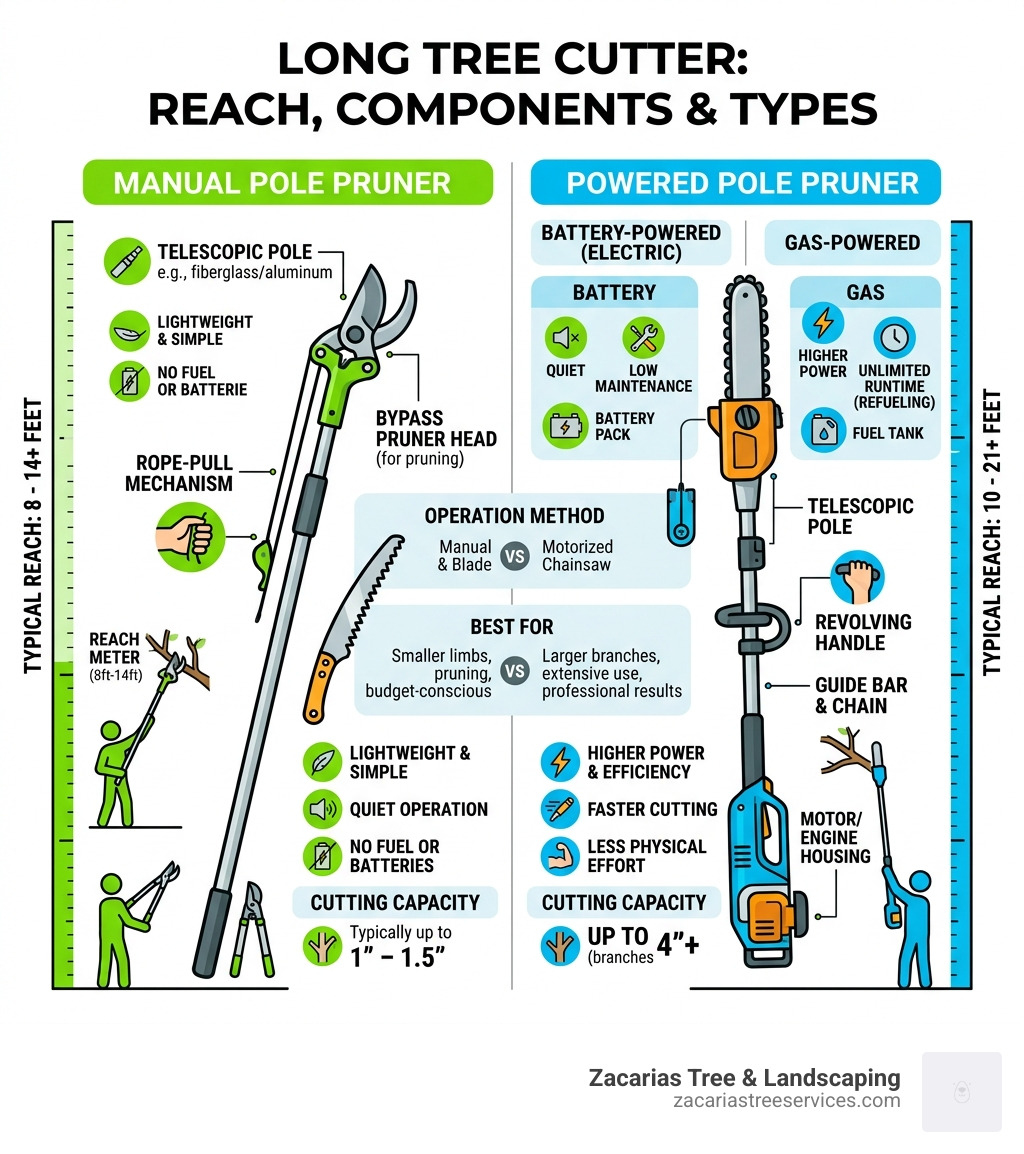
When we talk about a long tree cutter, we are really looking at a diverse family of tools. At its simplest, it is a “chainsaw on a stick” or a pair of “scissors on a pole.” For many homeowners in towns like Acton or Concord, keeping these tools in the garage is the first line of defense against overgrown maples or oaks that threaten the driveway.
Before you buy, you need to understand the two main cutting heads: Bypass blades and Anvil mechanisms.
Choosing the right tool also depends on your budget and how much work you want to do yourself. If you are curious about the broader financial picture of tree maintenance, you might want to check out our guide on How Much Does It Cost to Have Trees Trimmed?
| Feature | Manual Pole Pruner | Electric (Cordless) Pole Saw | Gas-Powered Pole Saw |
|---|---|---|---|
| Power Source | Your Muscles | 20V/40V Battery | 2-Cycle Fuel Mix |
| Max Cutting Capacity | 1″ to 1.5″ | 6″ to 10″ (Sawing) | 8″ to 12″+ (Sawing) |
| Weight | Lightweight (3-6 lbs) | Medium (10-15 lbs) | Heavy (15-20 lbs) |
| Best For | Light pruning, fruit trees | Residential maintenance | Heavy clearing, large estates |
| Price Range | $40 – $200 | $150 – $400 | $400 – $800+ |
Manual pruners are the “old reliable” of the gardening world. They typically feature a telescoping pole made of fiberglass or aluminum. To operate the clipper, you pull a rope that activates a pulley system. Some modern versions, like the Fiskars Pruning Stik, use an internal pull-cord system to prevent the rope from getting tangled in the branches — a feature we highly recommend for anyone who has ever spent twenty minutes trying to “un-snag” their tool from a dense oak.
Manual tools often include a detachable saw blade. For example, the BOONE Telescoping Long Reach Pruner offers a 3-in-1 system that includes “grabbers” for fruit picking, a standard pruner, and a saw attachment.
If you have a lot of ground to cover in a place like Framingham or Sudbury, your shoulders will thank you for choosing a powered option.
Not all long tree cutters are created equal. If you buy a cheap, flimsy model, you’ll likely find the pole flexing like a wet noodle the moment you try to cut a branch 15 feet up. When we evaluate tools for professional use or recommend them to clients, we look at three main pillars: capacity, material, and ergonomics.
For those looking into the economics of larger projects, it’s worth reading about Trimming the Fat: What Large Tree Pruning Really Costs.
“Reach” is a tricky term in marketing. If a tool says it has a “21-foot reach,” that usually means the tool is 18 feet long and they are assuming you are 6 feet tall with your arms raised. For example, the Sharpex 3 Stage Telescopic Long Cutter extends to 18 feet, which is impressive but requires significant upper body strength to stabilize.
When selecting reach, look for:
The “business end” of the long tree cutter needs to stay sharp. We recommend high-carbon steel blades, often labeled as SK5 steel. Many Japanese-made tools, such as those from Silky or Boone, use chrome-plated or specially hardened steel that resists rust and sap.
Another feature to look for is a rotating head. Some pruners allow you to pivot the cutting head up to 230 degrees. This is a lifesaver when you need to reach a branch that is growing at an awkward angle or tucked behind a trunk.
Working with a long tree cutter is inherently more dangerous than standard gardening. You are standing directly underneath the things you are trying to cut. Gravity is very consistent, and it will bring that branch down toward your head.

This is the most important rule: Never use a long tree cutter near power lines. Even if your pole is made of fiberglass, moisture, sap, or dirt on the pole can conduct electricity. In many cases, you don’t even have to touch the line; electricity can “arc” to your tool. If a branch is within 10 feet of a utility line, put the tool away and call a professional. For residents in the Amesbury or Andover areas, utility companies often have specific regulations about line clearance that only certified arborists should handle.
For more on managing costs while staying safe, see our article on Cutting Back Without Breaking the Bank on Branch Removal.
If you choose a powered model, maintenance is key to safety.
To keep your long tree cutter in top shape for years of service in the Massachusetts climate:
While a long tree cutter is a fantastic DIY tool, it has its limits. We often see homeowners get into trouble when they try to “over-reach.” If you find yourself standing on your tiptoes on the top rung of a ladder while holding a 14-foot pole, please stop. You are essentially creating a giant lever that can easily pull you off balance.
You should call a professional service if:
If you’re curious about the costs of these more complex jobs, check out The Price of Pruning: Large Oak Tree Trimming Costs.
Note: Pricing is based on general national averages and varies significantly based on property access, tree health, and site complexity. Professional estimates typically range from $200 to over $2,000 depending on the scope of work.
For example, a quick “safety prune” of a few low-hanging limbs might be on the lower end, while a full canopy thinning of a 60-foot Oak in Lexington or Concord will be on the higher end. We always recommend getting a free on-site estimate rather than relying on “ballpark” figures you find online. Also, be wary of “topping” trees; it’s a harmful practice. Learn more here: The High Price of Topping Trees and Better Alternatives.
Most consumer-grade manual pruners, like those from Fiskars or Husky, extend to about 12 or 14 feet. Professional models, such as the Sharpex or Silky Longboy, can reach 18 to 21 feet. The longer the pole, the heavier it feels. An 18-foot pole acts like a giant lever; even a 3-pound cutting head will feel like it weighs 30 pounds when fully extended.
Absolutely not. This is the most common cause of serious accidents in the tree care industry. Even “non-conductive” fiberglass poles can conduct electricity if they are dirty or wet. If a branch is near a line, contact your local utility company or a certified arborist who has the training and equipment (like bucket trucks) to handle “line clearance” safely.
Most bypass pruner heads (the scissor part) are rated for branches between 1 inch and 1.25 inches. If the branch is thicker than your thumb, you should switch to the saw attachment. Trying to force a pruner through a thick branch can snap the internal pull-cables or bend the pole. For anything over 4 inches, even a manual saw becomes difficult to use overhead, and a powered pole saw or professional help is recommended.
Finding the perfect long tree cutter is about balancing your needs with your physical comfort. For light maintenance in your backyard in Beverly or Billerica, a manual 12-foot Fiskars or Corona pruner is often all you need. If you have a larger property in Boxford or Georgetown with thicker limbs, a battery-powered pole saw will save you hours of labor.
However, these tools are designed for maintenance, not major surgery. When the branches get too high, too heavy, or too close to your home, the safest tool you can use is your phone to call in the experts.
At Zacarias Tree & Landscaping, we pride ourselves on rapid response and thorough cleanup. We serve over 100 communities across Massachusetts, from Acton to Woburn, ensuring that your trees stay healthy and your property stays safe. Whether you need a quick estimate or a full-scale tree removal, our team has the professional-grade equipment and expertise to get the job done right.
Request a professional tree trimming and pruning consultation
Need a pro? Zacarias Tree & Landscaping provides licensed, insured, and expert care across Lynn, Essex, and Middlesex Counties.
We live by a simple promise: Clear scope. Clear plan. Clean finish.
From emergency removals to seasonal landscaping, we’ve been Lynn’s trusted choice since 2002. Safety-first standards. Total site cleanup. Every time.