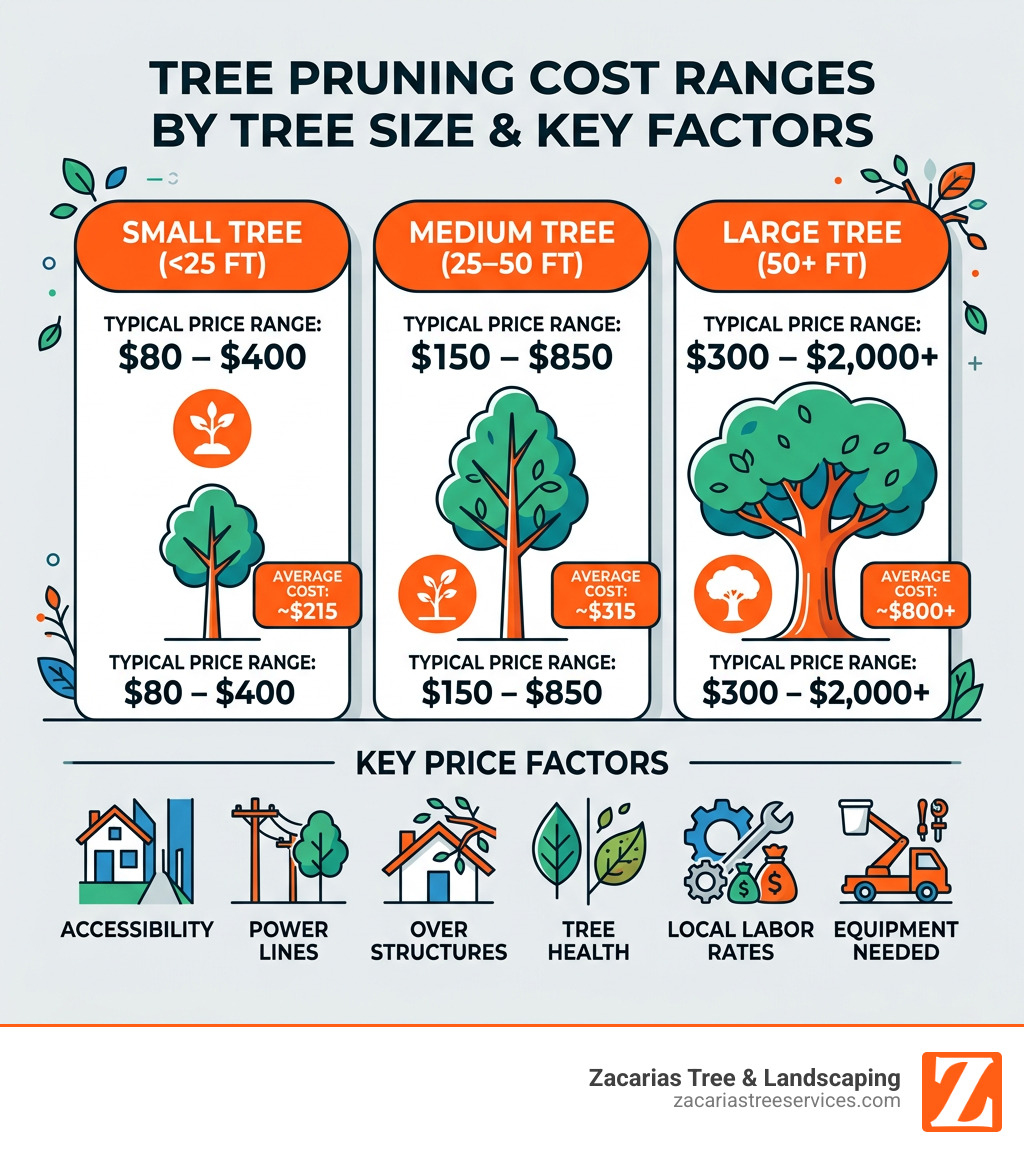
The average price to prune a tree typically falls between $200 and $800 for most homeowners — but the full range runs from as little as $75 for a small tree to over $2,000 for a large, hard-to-reach one. Here’s a quick snapshot based on general national pricing data:
| Tree Size | Typical Price Range | Average Cost |
|---|---|---|
| Small (under 25 ft) | $80 – $400 | ~$215 |
| Medium (25–50 ft) | $150 – $850 | ~$315 |
| Large (50+ ft) | $300 – $2,000+ | ~$800+ |
Note: These figures reflect general national averages from public research. Actual costs vary based on your property’s conditions, access, tree health, and local labor rates. Always get an on-site estimate for accurate pricing.
If you’ve just dealt with a storm, or you’re looking at a large oak leaning toward your roof, you already know that not all pruning jobs are created equal. A healthy 20-foot maple is a very different project from a 70-foot storm-damaged pine tangled in power lines.
This guide breaks down what drives pruning costs up or down — so you can compare rates confidently and know what questions to ask before anyone picks up a chainsaw.
When we talk about the average price to prune a tree, we are looking at a “blended” rate that covers labor, specialized equipment, insurance, and the disposal of all that heavy wood. While national data suggests a median of around $460 per tree, the reality on the ground in Massachusetts can be quite different.
Several variables dictate where your project falls on the spectrum. For instance, a “low-difficulty” job usually involves a healthy, short tree with plenty of open space around it. On the other end of the scale, a “high-difficulty” job involves a massive, diseased tree standing precariously over a sunroom or power lines.
To help you budget, here is a comparison of how complexity shifts the price:
| Complexity Level | Description | Estimated Range |
|---|---|---|
| Low | Small trees, easy ground access, no obstacles. | $75 – $350 |
| Moderate | Medium height (30ft), some dead branches, near a structure. | $350 – $900 |
| High | Tall trees (60ft+), diseased, near power lines or tight quarters. | $900 – $2,000+ |
Size is the most significant factor in any estimate we provide. As trees grow taller, they don’t just get bigger—they get exponentially more dangerous and difficult to manage.
Living in the Northeast, particularly in areas like Cambridge, Lexington, or Concord, means dealing with specific market factors. Labor rates in Massachusetts are generally higher than the national average due to the high cost of living and the rigorous insurance requirements for tree surgeons.
Urban access is another big one. If you live in a densely packed neighborhood in Somerville or Salem, getting a bucket truck or a chipper into a tight backyard adds time and complexity. Furthermore, consultation advised with neighbors is often necessary if a tree hangs over a property line, as local regulations generally hold the property owner responsible for the limbs on their side of the fence.
Beyond just the height of the tree, there are several “invisible” factors that can make a quote fluctuate. When we walk onto a property in Andover or Newton, we aren’t just looking at the leaves; we’re looking at the logistics.

One of the most critical factors is power line proximity. Working near high-voltage lines requires extreme caution and specialized training. In some cases, your local utility company may offer to trim branches that are directly interfering with lines for free, but they typically only do “clearance” trimming, which isn’t always the most aesthetic choice for your tree’s health.
Not all wood is created equal. Hardwood trees like Maples and Oaks are much denser and tougher on equipment than softwoods like Pine.
A healthy tree is a predictable tree. A diseased one is a wildcard. If we spot a disease in the branches like rot or fungal growth, we have to be significantly more cautious. Brittle wood can snap without warning, making it dangerous for climbers.
Pests, such as the emerald ash borer, can also weaken a tree’s internal structure, often requiring us to perform soil tests or apply pest treatments before or during the pruning process.
Then there is the “emergency” factor. If you are calling us after a storm because a limb is dangling over your driveway in Haverhill or Framingham, the cost may be higher due to the urgent nature of the work and the increased danger of “widow-makers” (loose branches caught high in the canopy).
Pruning isn’t just about “cutting things off.” It’s a surgical process designed to improve the tree’s health and your property’s safety. We offer several specialized Tree Trimming & Pruning techniques:
It might seem counterintuitive, but spending money on pruning now saves you a fortune later. Regular Tree Services ensure that your trees grow with a strong structural foundation.
A tree that is pruned every 3 to 5 years is much less likely to split during an ice storm or drop a heavy limb on your roof. When you consider that a full tree removal can cost between $400 and $3,000, and repairing a crushed roof can cost tens of thousands, a $500 pruning visit is a bargain. Plus, well-maintained trees significantly boost your home’s curb appeal and property value.
We get it—when you see a quote for $600, it’s tempting to head to the hardware store, buy a chainsaw, and do it yourself. However, before you climb that ladder, consider the math.
A decent chainsaw, safety gear, and a tall ladder can easily cost you $500 to $600 right off the bat. Then there is the risk. Tree trimming is consistently ranked as one of the most dangerous jobs in the country. One wrong cut can send a 200-pound limb swinging toward your house—or worse, toward you.
When you hire a professional team like ours, you aren’t just paying for the cut; you’re paying for peace of mind. Professional tree services carry:
If you are dealing with branches that require a ladder or any work near power lines, the “savings” of DIY simply aren’t worth the life-changing risks.
While people use the terms interchangeably, there are key differences. Trimming is usually about aesthetics—shaping a hedge or tidying up a tree’s appearance. Pruning is about health and safety—removing diseased wood and structural thinning to ensure the tree lives a long, healthy life.
It depends on the age and species:
Yes! The best time for most trees is the dormant season (late fall through early spring). Not only is it easier for us to see the tree’s structure without leaves, but the tree also heals faster and is less prone to disease. Booking during the “off-peak” winter months can sometimes result in more flexible scheduling and competitive rates.
Determining the average price to prune a tree involves looking at everything from the height of the canopy to the health of the roots. Whether you are in Acton, Billerica, or Weymouth, your trees are a vital part of your property’s value and safety.
At Zacarias Tree & Landscaping, we pride ourselves on our rapid response and efficient work. We don’t just cut branches; we provide thorough cleanup and expert care to ensure your landscape remains beautiful for years to come. Don’t wait for the next big storm to find out if your trees are top-heavy.
Request a free on-site estimate for accurate project pricing and let us help you keep your property safe and stunning.
Need a pro? Zacarias Tree & Landscaping provides licensed, insured, and expert care across Lynn, Essex, and Middlesex Counties.
We live by a simple promise: Clear scope. Clear plan. Clean finish.
From emergency removals to seasonal landscaping, we’ve been Lynn’s trusted choice since 2002. Safety-first standards. Total site cleanup. Every time.