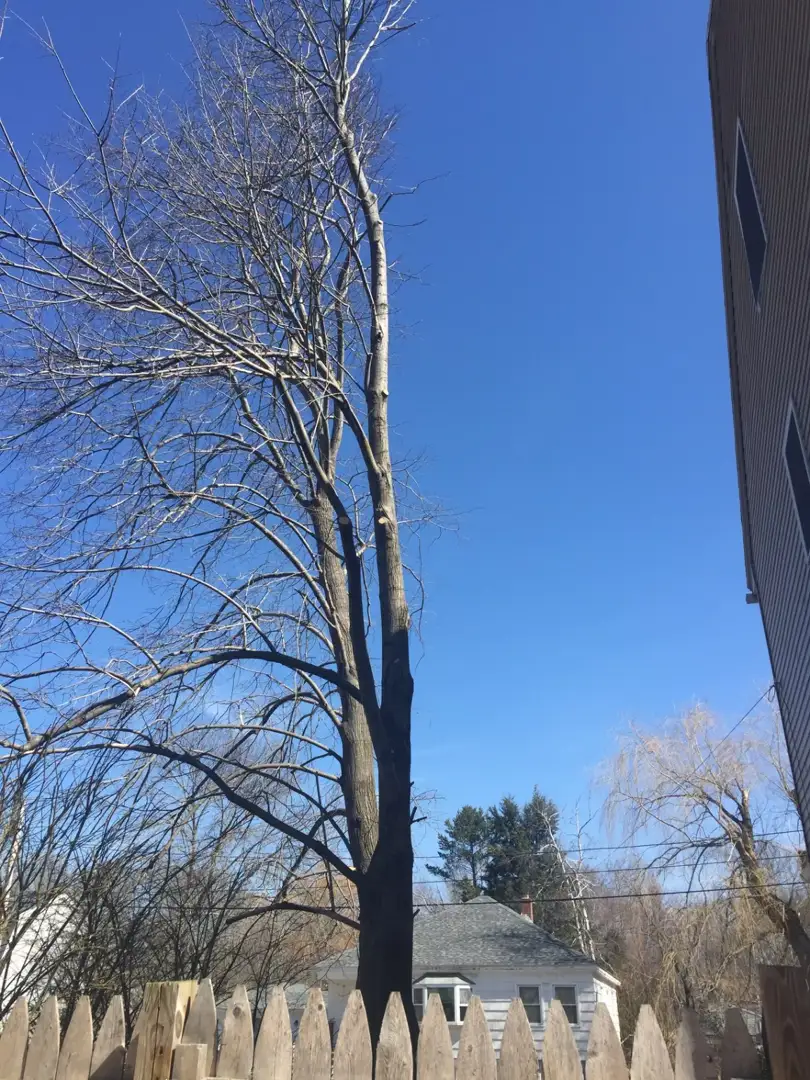
The cost to top a tree is often similar to the price of proper pruning on the day of the work, but topping is the most expensive way to make a tree shorter over time. Cutting the main limbs back to stubs triggers fast, weakly attached regrowth and decay in the cut ends, so within a few years the tree needs more work, becomes riskier in storms, or has to come down. Crown reduction, thinning, or replacing the tree with one that fits the space gets you what you wanted without the damage.
We are Zacarias Tree & Landscaping, a family-run tree and landscape company in Lynn, with ISA-Certified Arborists who assess trees across the North Shore. People usually ask about topping because they are worried about a tall tree near the house, and that worry is reasonable. This article explains why topping makes that risk worse and what actually helps.
What topping is, and what it is not
Topping means cutting the main stems and large limbs back to stubs, or to a chosen height, without regard to where the tree's branches naturally divide. You may also hear it called heading, hat-racking, or rounding over. The giveaway is a row of blunt, thick cuts across the top of the canopy.
Crown reduction is different. An arborist shortens a limb by cutting it back to a side branch big enough to take over as the new end of that limb. The tree keeps its natural shape, fewer and smaller wounds are made, and the remaining branches stay well attached.
What topping does to a tree
- It starves the tree. Leaves make the tree's food. Removing a large part of the leafy crown at once forces it to burn stored energy just to survive.
- It creates decay. Big stub cuts cannot seal properly. Rot starts in the stubs and can move down into the main limbs and trunk.
- It produces weak regrowth. The tree answers with dense clusters of fast shoots, called water sprouts, growing from just below each cut. They attach only in the outer layers of wood and break easily.
- It raises storm risk. Within a few years those sprouts become heavy limbs sitting on decaying stubs. Wet snow, ice, and nor'easter winds are exactly the loads they handle worst.
- It exposes bark to sun. Suddenly shaded bark can scald and crack once the canopy above it is gone.
- It spoils the tree's form. A topped tree rarely regains a natural shape. Conifers like white pine can lose their single leader and grow several competing tops.
The real cost of topping over time
| Stage | Topped tree | Properly reduced tree |
|---|---|---|
| Day of work | Similar price to pruning | Similar price, more skilled cuts |
| First few years | Dense sprouting; repeat cutting needed sooner | Normal growth; routine care on a regular cycle |
| Storm season | Sprouts break; cleanup and damage risk | Well-attached limbs with less wind load |
| Long term | Decay spreads; removal often follows | Tree stays healthy and keeps its value |
Add up repeated cuts, storm cleanups, possible property damage, and an eventual removal, and topping rarely saves anything. You keep paying for a tree that only gets worse.
Better alternatives
Crown reduction
Reduces the height or spread of a tree with cuts made back to healthy side branches. It is the right tool when a tree has grown too close to a roof or a view has closed in.
Crown thinning
Removes selected live branches throughout the canopy so wind and light pass through. It lowers the weight a tree carries in a storm without shortening it.
Crown raising
Removes lower limbs to clear a driveway, walkway, or roofline, often the real problem when people ask for topping.
Remove and replace
Some trees simply outgrow their spot, such as a white pine planted too close to the house. Removing it and planting a species that fits at full size is often the honest answer. Our tree planting team can help choose one.
For a comparison of what these pruning types involve and cost on big trees, see our guide to large tree trimming costs.
If the real worry is the tree falling
Topping does not make a tree safer; it trades a risk you can see for a set of hidden ones. If you are concerned a tree could hit your house, the right first step is an assessment of its structure, roots, and decay. An arborist assessment tells you whether the tree needs reduction, support pruning, or removal. When comparing companies, check credentials through the International Society of Arboriculture, and be cautious of anyone who offers to "take the top out."
Frequently asked questions
How much does it cost to top a tree?
Up front, topping is usually priced like other pruning of the same size tree, based on height, access, and cleanup. The real cost comes later in repeat cutting, storm damage, and often removal. An on-site estimate for crown reduction is usually a better investment.
Is topping ever acceptable?
Pollarding, a traditional practice that starts on young trees and is maintained every year or two, is a different technique. Utility line clearance sometimes requires unusual cuts. For a normal yard tree, topping is not a recommended practice.
Can a topped tree be fixed?
Sometimes. An arborist can select the strongest sprouts to become new limbs and remove the rest over several years. It takes time and regular visits, and badly decayed trees may still need removal.
Does topping make a tree less likely to fall?
Not over time. The sprouts that grow back are weakly attached and sit on decaying stubs, which often makes the tree more likely to drop limbs in storms.
Make a tree smaller the right way
Zacarias provides tree trimming and pruning, including crown reduction and thinning, across Lynn and Essex and Middlesex Counties. We are licensed, bonded, and fully insured, and every estimate is free with no obligation. Request a free estimate and we will show you what can be done without topping.