Land clearing prices per acre vary widely — but here’s a quick breakdown based on national averages so you can estimate your project before reading further.
| Vegetation Type | Typical Cost Per Acre |
|---|---|
| Light brush / grassland | $700 – $2,500 |
| Moderate growth / lightly wooded | $2,500 – $4,000 |
| Heavy forest / large trees | $4,000 – $12,000+ |
Note: These figures are based on general national averages from internet research. Actual costs vary depending on your property’s conditions, access, terrain, and scope. Always get an on-site estimate for accurate pricing.
So what makes the range so wide? A lot. Two neighboring lots on the same street can carry completely different price tags depending on what’s growing there. A half-acre of overgrown scrub brush is a very different job from a half-acre of mature hardwoods with deep root systems.
For Massachusetts homeowners — especially those dealing with storm damage, overgrown parcels, or land they want to build on — understanding these numbers upfront saves a lot of frustration later.
This guide breaks down costs by acreage, vegetation type, clearing method, and regional factors specific to the Northeast.
Land clearing prices per acre further reading:
When we talk about land clearing prices per acre, we aren’t just talking about a quick mow. We’re talking about transforming a wild, untamed piece of Massachusetts earth into a “blank slate” ready for a foundation, a pasture, or a beautiful new landscape. Based on national data and industry trends for 2025 and 2026, the average homeowner might spend anywhere from $1,200 to $6,000 for standard clearing, but those numbers can climb significantly for “heavy” projects.
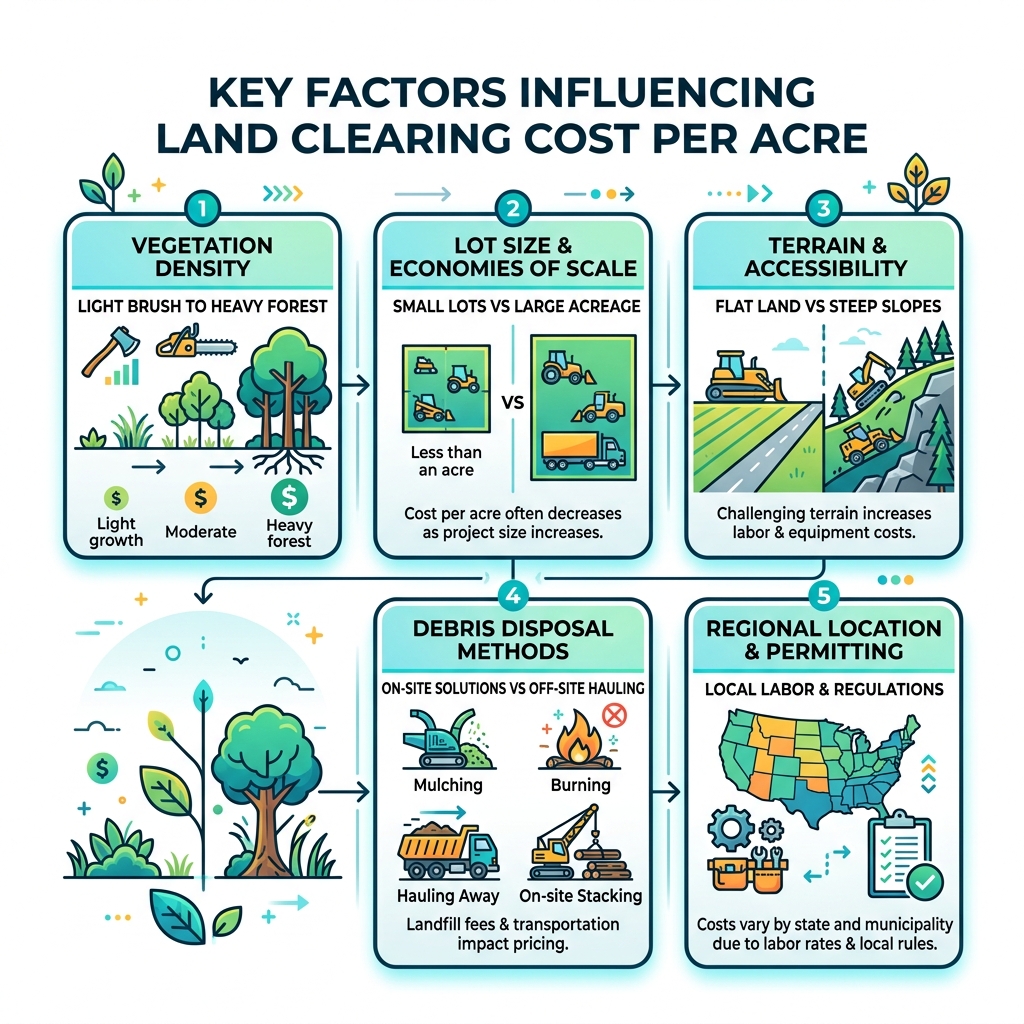
The first thing we look at is vegetation density. If you’re in a town like Andover or Framingham and your lot is mostly tall grass and small shrubs, you’re looking at the lower end of the spectrum. However, if you’re dealing with a dense thicket of old-growth oaks and maples in a more wooded area like Boxford or Groton, the labor and equipment requirements skyrocket.
According to the Average Cost to Clear an Acre of Land 2026, the complexity of the property is the biggest driver. This includes:
Wooded lots are the most common project type we see in the Northeast. A “wooded” acre isn’t a monolith. We categorize these by the type of trees and the density of the underbrush.
Pine forests often clear faster than hardwood stands. Pines tend to have shallower root systems and softer wood, making them easier to fell and process. Hardwoods like Oak, Hickory, and Maple—which are staples in Massachusetts—are much denser. They require more fuel, sharper teeth on our mulchers, and more time to process. If you have a heavily forested acre, you might see quotes ranging from $3,395 to $6,155 per acre on the low end, with some complex projects reaching $12,000 or more if full stump removal and hauling are required.
Beyond the trees themselves, we have to consider the “ladder fuels”—the small trees and shrubs that grow beneath the canopy. Clearing this underbrush is essential for fire safety and for seeing the actual lay of the land. For more specialized info, check out our guide on Tree Removal.
There is a bit of “bulk pricing” logic in land clearing, but it works differently than buying paper towels at Costco.
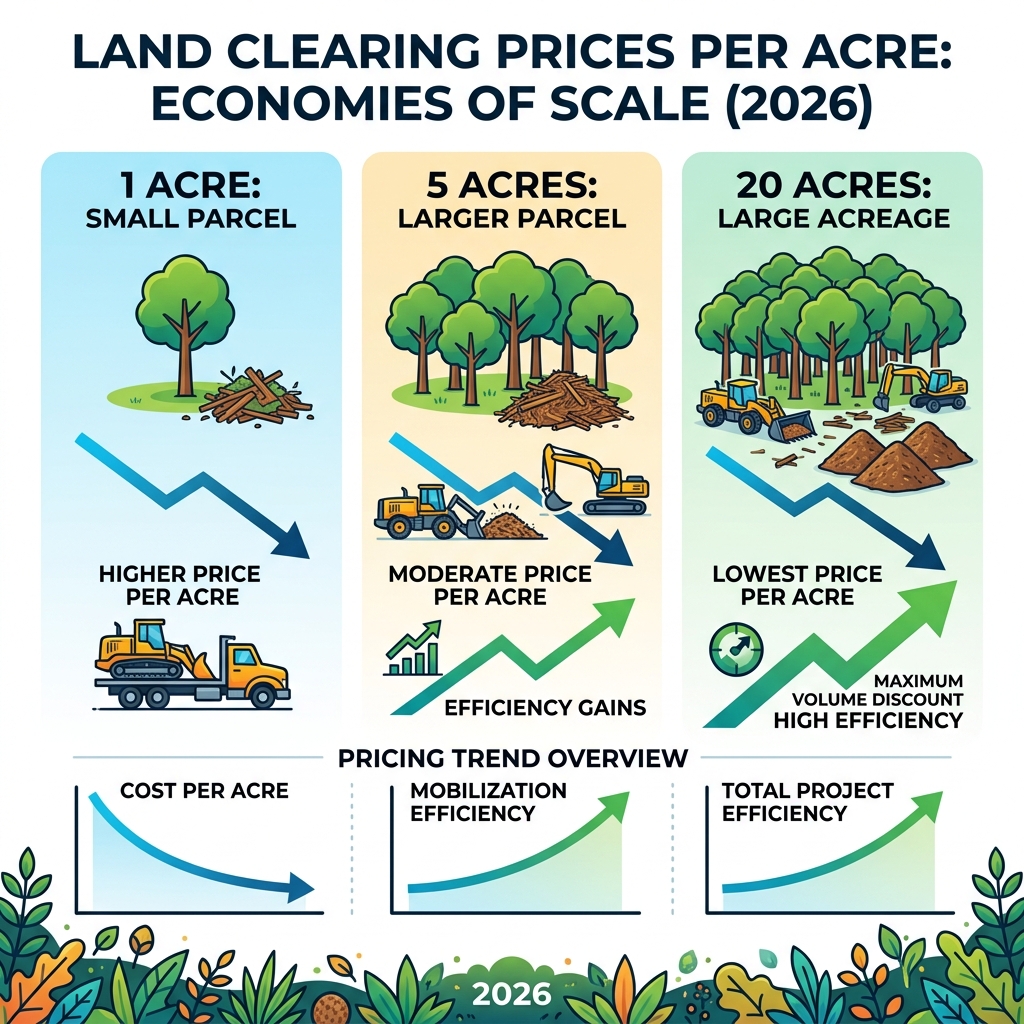
For small residential lots (1/4 to 1/2 acre), the cost per acre is actually higher. This is because of “mobilization fees.” It costs the same amount of money and time to put a massive forestry mulcher on a trailer and drive it to a site in Lexington whether we are clearing 5,000 square feet or 5 acres. For a 1/4 acre lot, you might pay $1,200 to $4,500 total, which technically puts the “per acre” rate quite high.
On larger parcels—let’s say 5 to 20 acres—the price per acre often drops. Once the equipment is on-site and the crew is in a rhythm, the efficiency increases. You might see a 10-20% volume discount on these larger projects. If you’re curious about individual tree impacts on these costs, see How Much Does It Cost to Cut Down a Tree.
How we clear the land is just as important as what we are clearing. There are two main schools of thought: the “Slash and Burn” (Traditional) method and the “Grind it Down” (Forestry Mulching) method.
Traditional Clearing involves bulldozers and excavators. The machines knock trees over, pull stumps out of the ground, and pile everything up. This leaves the soil disturbed and creates massive “burn piles” or debris piles that must be hauled away. While effective for construction sites where you need to dig a basement anyway, it is often more expensive due to the hauling fees.
Forestry Mulching is the modern favorite. Using a high-flow skid steer or a dedicated mulching machine, we grind trees and brush exactly where they stand. This creates a carpet of nutrient-rich mulch that prevents erosion and suppresses weeds. According to the Land Clearing Cost Per Acre: A Complete Guide, mulching can cost anywhere from $500 to $4,000 per acre depending on density, but it saves you a fortune on debris disposal.
The “tools of the trade” dictate the daily rate.
When we are dealing with massive specimens, the costs change. For example, Scaling the Costs of 60-Foot Tree Removal explains how height and complexity add to the equipment needs.
This is the “hidden” cost that catches many Massachusetts landowners off guard. If you clear an acre of heavy forest, you aren’t just looking at a few twigs. You are looking at potentially 50 to 60 dump truck loads of debris.
Hauling fees can easily double the cost of a project. In some cases, a quote might be $11,500 to clear the land but jump to $19,000 once you add “hauling and disposal.” To avoid this, we often recommend on-site chipping or mulching whenever possible. If you do need hauling, make sure your Step-by-Step Guide to Tree Removal Quotes includes a clear line item for disposal fees.
Clearing land in the Northeast is a different beast than clearing a flat lot in Texas or Georgia. We have strict environmental regulations, higher labor costs, and—let’s be honest—some of the most stubborn rocks in the country.
In Massachusetts, you can expect to pay a “Northeast Premium” of about 20% to 40% above national averages. This is due to the cost of living and the rigorous safety and insurance standards we maintain. However, there is a silver lining: Winter Discounts. Many companies offer 15-25% off during the late fall and winter months. The frozen ground is actually better for heavy machinery as it prevents the equipment from sinking into the mud and damaging the soil structure. For more on local nuances, check out The Root of the Problem: Navigating Tree Removal in Newton, MA.
Before we even start the engines, we have to deal with the paperwork.
Understanding these administrative costs is just as important as the physical clearing. We cover more of this in our guide on how to Don’t Get Stumped by Tree Arborist Cost Estimates.
Once the trees are gone, you aren’t necessarily ready to build. “Clearing” just means the vertical stuff is gone. You still have to deal with what’s underground.
For a look at how specific tree species might affect these finishing costs, see our How Much to Chop the Oak: A Price Guide.
It’s tempting to head to the local rental yard, grab a chainsaw and a bobcat, and spend your weekends playing “lumberjack.” We get it—it looks fun. But for anything larger than a small patch of light brush, DIY land clearing is rarely the bargain it seems to be.
First, there’s the equipment cost. Renting a professional-grade mulcher or excavator costs $400 to $800 per day. If you don’t know how to operate it efficiently, you might spend four days doing what a pro crew does in four hours. Then there’s the fuel, the insurance, and the risk of damage.
More importantly, there is the safety risk. Tree work is consistently ranked as one of the most dangerous jobs in America. Felling a 60-foot pine in a tight residential neighborhood like Somerville or Cambridge requires precision that only comes with years of experience. One wrong cut can lead to thousands of dollars in property damage—or worse.
When you hire a professional, you aren’t just paying for the machine; you’re paying for the liability insurance, the expertise to spot a “widowmaker” branch, and the peace of mind that the job will be done right. If you’re unsure about the health of the trees on your lot before you clear them, it might be worth getting a Professional Inspection.
For a professional crew with the right equipment:
In most cases, yes, if you are clearing more than a small residential garden area. Most towns require a “Plot Plan” or a “Tree Removal Permit.” If you are within 100 feet of a wetland or 200 feet of a river, you will definitely need to file with the Conservation Commission. Always check with your local town hall in places like Concord, Lexington, or Billerica before starting.
Forestry mulching is generally the most cost-effective method because it eliminates the need for hauling, burning, and extensive erosion control. Other tips include:
Clearing land is the essential first step to any major property transformation. Whether you are preparing a site for a new home in Newton or reclaiming an overgrown pasture in Stow, understanding the land clearing prices per acre helps you build a realistic budget.
At Zacarias Tree & Landscaping, we pride ourselves on being the rapid-response experts for the Massachusetts area. From Acton to Weymouth and everywhere in between, we bring the heavy-duty equipment and the local expertise needed to handle New England’s toughest terrain. We don’t just knock things over; we provide a thorough cleanup, ensuring your land is ready for its next chapter.
Ready to see what your specific project will cost? Don’t rely on national averages alone. Every lot in Massachusetts is unique. Contact us today for a free, no-obligation on-site estimate. We’ll walk the property with you, identify any potential hurdles, and provide a clear, honest quote to help you clear the way.
Explore our full range of Tree Services and let’s get to work!
Need a pro? Zacarias Tree & Landscaping provides licensed, insured, and expert care across Lynn, Essex, and Middlesex Counties.
We live by a simple promise: Clear scope. Clear plan. Clean finish.
From emergency removals to seasonal landscaping, we’ve been Lynn’s trusted choice since 2002. Safety-first standards. Total site cleanup. Every time.