The average cost to cut down a tree in the U.S. is around $850, but what you’ll actually pay can range quite a bit depending on your specific situation.
Here’s a quick snapshot to answer your question right away:
| Tree Size | Estimated Cost Range |
|---|---|
| Small (under 30 ft) | $150 – $500 |
| Medium (30–60 ft) | $500 – $1,500 |
| Large (60–80 ft) | $850 – $2,000 |
| Extra-large (over 80 ft) | $1,200 – $3,000+ |
| Emergency removal | $500 – $5,000 |
| Fallen tree removal | $75 – $150 |
Note: These figures are based on national averages from general internet research. Actual costs vary based on your property’s conditions, site access, tree species, and scope of work. Always request a free on-site estimate for accurate pricing.
Most homeowners pay somewhere between $385 and $1,070 for a standard removal. But if your tree is large, storm-damaged, close to your home, or hard to access — costs can climb fast.
If you’ve got a storm-damaged tree in your backyard right now, you’re not just dealing with the removal itself. You may also need stump grinding, debris hauling, and possibly an insurance claim — all of which add to the total.
This guide breaks it all down so you know exactly what to expect before you call anyone.
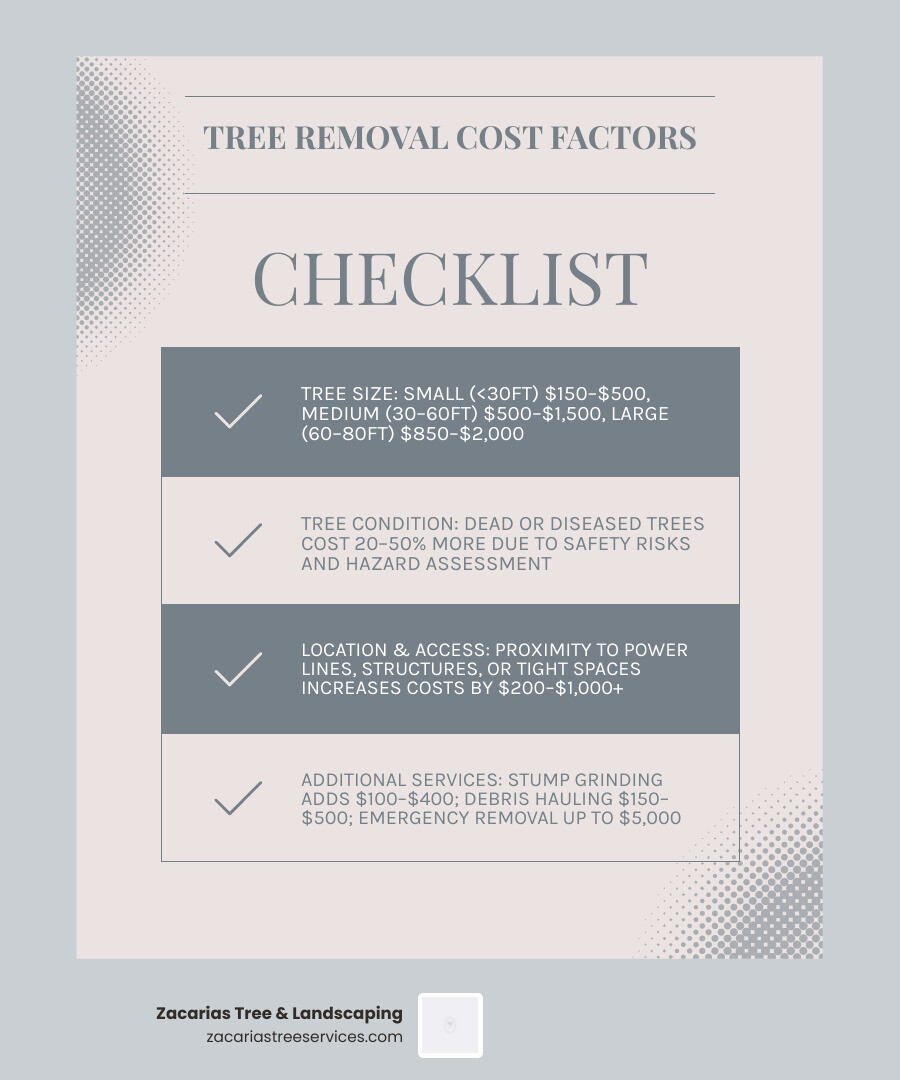
Average cost to cut down a tree word guide:
When we talk about the average cost to cut down a tree, we are looking at a national median. However, here in Massachusetts—from the historic streets of Cambridge to the wooded lots of Concord—prices can fluctuate based on local labor markets and the specific challenges of our New England landscape.
While the national average sits around $850, the typical price range most homeowners encounter is between $385 and $1,070. If you are dealing with a massive, century-old oak or a tree wedged between two houses in Somerville, the price will naturally reflect that complexity. According to the International Society of Arboriculture (ISA) pricing reference, the primary drivers of cost are height, diameter, and the amount of risk involved for the crew.
To get the most accurate picture for your property, we recommend checking out our Step-by-Step Guide to Tree Removal Quotes. This helps you understand what to look for when a professional walks your property.
Size is the single most significant factor in determining your bill. The taller the tree, the more equipment, time, and safety measures are required.
On average, you might see a cost per foot ranging from $9.50 to $14.50. For more detailed safety and care standards, the International Society of Arboriculture (ISA) — Consumer Information portal offers excellent resources on why height increases risk.
Not all wood is created equal. The type of tree matters because wood density and branch structure affect how much work is required to dismantle it.

Beyond just the “what” and “how big,” we have to look at the “where.” A tree standing in the middle of a five-acre field in Ashby is much cheaper to remove than the same tree hanging over a power line in Newton.
One of the most critical measurements we use is DBH (Diameter at Breast Height). A tree with a massive trunk requires more chainsaw work, more hauling, and more time. Furthermore, proximity to utilities is a major cost driver. If a tree is within 10 feet of a power line, it often requires specialized “hazard-trained” crews.
In some cases, we must bring in heavy machinery. According to OSHA 29 CFR 1910.180 crane safety standards, operating a crane adds significant overhead—often $500 to $1,500 just for the rental—but it is sometimes the only way to safely lift heavy logs over a house. You can learn more about this specialized process on our Crane Assisted Tree Removal page.
You might think a dead tree would be cheaper to remove because it’s “already halfway there,” but the opposite is often true. Dead or diseased trees are brittle and unpredictable. They are dangerous for arborists to climb because the branches can snap without warning.
If your tree is showing signs of rot, fungal growth, or structural instability, it becomes a “hazard removal.” This requires more cautious rigging and potentially more expensive equipment. If you aren’t sure if your tree needs to go, it’s worth checking out: Is Your Tree Sick? Here is the Cost for a Professional Inspection.
We often joke that we are part-arborist, part-Tetris masters. Accessibility challenges can add 25% to 50% to the final price. Common obstacles include:
All professional operations must follow the ANSI Z133 Safety Requirements for Arboricultural Operations to ensure the safety of both the workers and your property.
The quote for the “removal” usually covers felling the tree and getting it to the ground. But what happens to the wood and the hole in the ground?
To avoid surprises, read our guide on how to Don’t Get Stumped by Tree Arborist Cost Estimates.
When a Nor’easter hits towns like Andover or Gloucester, trees don’t always fall politely. Emergency removals—those that need to happen now because a tree is on a roof or blocking a driveway—carry a premium. You can expect to pay 20% to 50% more, with some emergency projects reaching up to $5,000.
Fallen trees are actually cheaper to remove ($75 to $300) if they haven’t hit anything, simply because no climbing is required. However, if they are entangled in wires or structures, the complexity spikes. Crews must follow strict OSHA 29 CFR 1910.266 — Logging Operations standards during these high-risk cleanups.
Many Massachusetts municipalities, like Lexington or Cambridge, have strict tree ordinances. You may need a permit to remove a tree over a certain diameter. Permit fees usually range from $60 to $150, and some towns require a formal arborist report.
For larger projects, such as clearing a lot for a new home in Billerica, we often charge by the acre.
The US Forest Service Urban and Community Forestry Program provides great context on why these local regulations exist to protect our urban canopy.
We get it—saving a few hundred dollars by grabbing a chainsaw sounds tempting. However, tree removal is one of the most dangerous jobs in America.
The risks of DIY include:
Professional crews come with liability insurance and workers’ compensation. When we handle a Tree Removal, we take the risk so you don’t have to.
The “dormant season”—late winter and early spring—is typically the best time for your wallet. Because the ground is often frozen (which protects your lawn from heavy equipment) and the trees have no leaves (making them lighter and easier to handle), many companies offer better rates. Plus, our schedules are usually more flexible before the spring landscaping rush hits. If you’re looking to save, check out the cost to have trees trimmed during the off-season as well.
Usually, insurance only covers tree removal if the tree falls due to a “covered peril” (like a storm) and damages a “covered structure” (like your house or garage). They typically won’t pay to remove a tree that fell in the middle of your yard without hitting anything, nor will they pay for “preventative” removal of a rotting tree. For more on this, see our breakdown of The Price of Pruning: Large Oak Tree Trimming Costs.
Determining the average cost to cut down a tree involves balancing many variables, from the height of the branches to the complexity of the surrounding property. Whether you are in a tight urban lot in Medford or have a sprawling backyard in Sudbury, understanding these factors helps you budget effectively and keep your property safe.
At Zacarias Tree & Landscaping, we pride ourselves on our rapid response and efficient work across our extensive Massachusetts service area. We don’t just cut down the tree; we ensure a thorough cleanup so your yard looks better than when we arrived.
Ready to get a clear price for your project? We offer free on-site estimates to give you an accurate, no-obligation quote. Explore our full range of Tree Services today and let us take the hard work off your hands.
Need a pro? Zacarias Tree & Landscaping provides licensed, insured, and expert care across Lynn, Essex, and Middlesex Counties.
We live by a simple promise: Clear scope. Clear plan. Clean finish.
From emergency removals to seasonal landscaping, we’ve been Lynn’s trusted choice since 2002. Safety-first standards. Total site cleanup. Every time.