
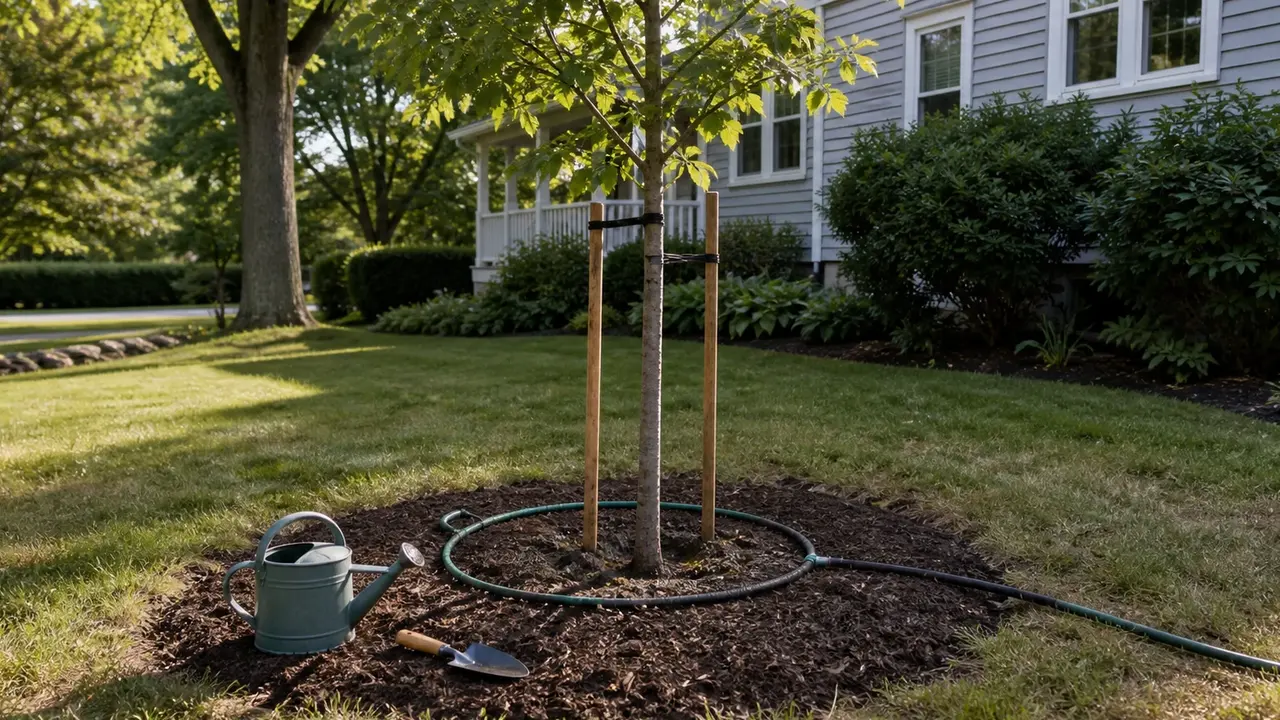
Knowing how to care for a transplanted tree comes down to a few habits: keep the root ball steadily moist but never soggy through the first full year, cover the root area with a wide, shallow mulch ring, stake it only if it cannot stand on its own, and leave pruning and fertilizer alone. Expect some wilting or early leaf color the first season. That is normal transplant shock, and it usually fades as new roots grow.
Zacarias Tree & Landscaping, based in Lynn since 2002, plants and relocates trees across the North Shore and Essex and Middlesex Counties. This is the aftercare routine for a tree that has just been moved or newly planted in a Massachusetts yard.
Why a moved tree needs extra help
Moving a tree cuts off a large share of its roots, including most of the fine feeder roots that take up water. The canopy still loses water through its leaves at the same rate, so for the first season or more the tree is trying to drink through a much smaller straw. A common rule of thumb among arborists is that a tree needs about a year to re-establish for every inch of trunk diameter, so a larger tree needs a longer stretch of careful watering.
A first-year watering schedule
UMass Extension's guidance on watering new plantings gives practical numbers. About ten gallons applied twice a week will wet a 20 to 24 inch root ball, roughly the same as an inch of rain. If less than an inch of rain has fallen in five to seven days, the tree needs water.
| Stage | What to do | What to watch |
|---|---|---|
| Planting day | Soak the root ball and surrounding soil slowly | Water should soak in, not run off |
| First two to three weeks | Check every few days and water when the root ball is drying | Afternoon wilting that does not recover by morning |
| Rest of the first growing season | Roughly ten gallons twice a week when rain falls short | Heat waves and windy stretches raise the need |
| Fall | Keep watering weekly, as needed, until the ground freezes | Dry falls are common; do not stop early |
| Second and third summers | Deep watering during dry spells | Larger trees need this longer |
Three details make the schedule work:
- Measure your hose. Time how long a slow-running hose takes to fill a bucket of known size, then use that to deliver ten gallons each time.
- Check the root ball itself. The original root ball dries faster than the looser soil around it. Probe gently with a trowel or your fingers down several inches right at the ball; UMass suggests checking moisture to about 12 inches.
- Slow and deep beats light and often. A daily sprinkle wets the surface and encourages shallow roots. Too much water is just as harmful, since roots need air. If the soil stays soggy or smells sour, back off.
A soaker hose or a drip line with emitters around the root ball takes most of the guesswork out of this. Our guide to drip systems for trees covers how to set one up.
Mulch: a wide ring, not a volcano
Spread 2 to 3 inches of shredded bark or wood chip mulch over the root area, out to at least a few feet from the trunk and wider for bigger trees. Pull it back a few inches from the bark so the root flare stays visible. Mulch piled against the trunk holds moisture on the bark, invites rot and rodents, and can lead to roots circling the stem over time. A good ring also keeps mowers and string trimmers away from the trunk.
Staking: only when needed, and not for long
Many transplanted trees stand fine on their own, and a little movement in the wind actually helps build a stronger trunk. Stake only if the tree leans, sits in a very windy spot, or has a top-heavy canopy on a small root ball. When you do:
- Use two or three stakes outside the root ball, not driven through it.
- Attach with wide, flexible straps, not wire or rope against the bark.
- Leave some slack so the trunk can sway.
- Check the ties after storms and heavy snow, and remove the stakes after one growing season in most cases.
Transplant shock versus real trouble
Some stress is expected. Normal signs of transplant shock include leaves that wilt in the afternoon heat, browning at leaf edges, yellowing, fall color that shows up early, and smaller or sparser leaves the following spring. A few dead twig tips are also common. These usually improve as roots grow.
Call for a closer look if you see:
- The whole canopy turning brown within days
- Bark cracking, peeling, or oozing near the base
- A new lean, or soil lifting on one side of the root ball
- Soil that stays waterlogged and smells sour
- Dieback that keeps spreading into the second season
An arborist can tell the difference between a slow start and a failing root system; our arborist assessments start with a free visit.
What not to do in the first year
- Do not fertilize heavily. A burst of nitrogen pushes leaves the damaged roots cannot support. Let the tree settle first.
- Do not prune for shape. Only remove dead, broken, or rubbing branches. The tree needs every healthy leaf to feed new roots.
- Do not add soil over the root ball. Burying the flare deeper cuts off oxygen to the roots.
- Do not park, pile, or dig in the root area. Compaction in wet soil is hard to undo.
Getting through the first New England winter
Keep up the watering until the ground freezes; a tree that goes into winter well hydrated handles drying wind far better. Evergreens are especially prone to winter burn in their first year, so keep them out of road salt spray and consider a burlap screen on the windward side in exposed coastal spots. Brush heavy wet snow off small trees gently, and check stakes and ties after each storm.
If the tree has not gone in yet, our guide to the best time to plant trees in Massachusetts explains how the planting season changes this routine.
Frequently asked questions
How often should I water a newly transplanted tree?
Check the root ball every few days for the first few weeks, then plan on about ten gallons twice a week whenever less than an inch of rain falls in five to seven days. Adjust for heat, wind, and soil type.
How long does transplant shock last?
Mild shock often eases within the first season, but a tree can take a year or more per inch of trunk diameter to fully re-establish. Some slow growth the next spring is normal.
Should I fertilize a transplanted tree?
Not in the first year in most cases. Focus on water and mulch, and let the roots recover before pushing new growth.
When should stakes come off a transplanted tree?
Usually after one growing season. Leaving them on longer can weaken the trunk or let ties cut into the bark.
Moving a tree on your property?
Our tree transplanting service handles the dig, the move, and replanting at the new spot, with aftercare guidance for your specific tree. Request a free estimate and we will come out, usually the same day, anywhere in Lynn and the North Shore.