
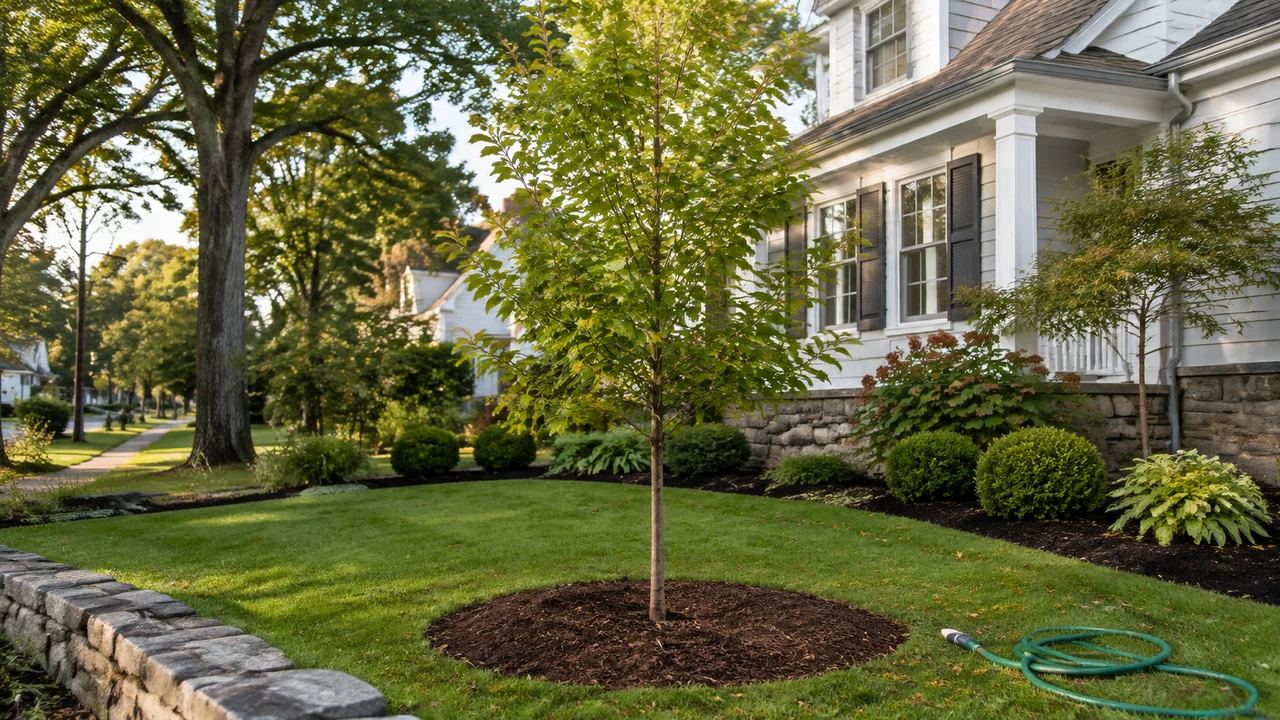
The best time to plant trees in Massachusetts is early fall, roughly mid-August to mid-October, for most deciduous trees, and spring, once the soil has thawed and dried enough to work, for evergreens and trees that are slow to root. Both windows work on the North Shore. The deciding factors are the species, how much time roots get before the ground freezes or summer heat arrives, and whether someone can water the tree through its first year.
At Zacarias Tree & Landscaping, a family-run company in Lynn since 2002, our crews plant and transplant trees across Essex and Middlesex Counties. This guide explains how to pick the right window for your tree and what to do after it goes in.
Why early fall works so well
From late summer into mid-fall, the air cools but the soil stays warm and damp. Roots keep growing in warm soil even while the top of the tree slows down, so a fall-planted tree gets a head start underground before winter. The next spring it wakes up with roots already reaching into the surrounding soil instead of sitting in a pot-shaped ball.
UMass Extension's fall planting fact sheet puts the useful window at mid-August to mid-October and advises allowing at least six weeks of root growth before the ground freezes. Its rule of thumb is to have fall planting done by mid-October.
Which trees to plant in fall, and which to hold for spring
| Tree type | Better window | Notes |
|---|---|---|
| Maples, linden, honeylocust, hackberry, elm, sycamore | Early fall | UMass lists these among trees that establish easily in fall |
| Crabapple, redbud, hawthorn | Early fall | Also on the UMass easy fall list; spring works too |
| Pine and spruce | Fall, but by the end of September | UMass advises planting while the soil is still warm |
| Broadleaf evergreens such as rhododendron | Spring | UMass recommends waiting until spring |
| Yew and similar narrow-leaved evergreens | Spring | Same UMass guidance as broadleaf evergreens |
| Trees many nurseries treat as slow to root, such as birch and magnolia | Often spring | Ask the nursery about the specific tree |
One local note: the UMass list also names ash as easy to establish, but with emerald ash borer now across Massachusetts, we would not plant a new ash tree. Infested ash trees decline and turn brittle quickly.
Planting in spring
Spring planting starts when the ground has thawed and is no longer soggy. A handful of soil should crumble, not smear. On the North Shore that is often somewhere in April, earlier on sandy, sunny sites and later on heavy clay or low ground. Planting before the tree leafs out, or as soon as possible after, gives roots the longest run before summer.
The tradeoff is summer. A spring-planted tree faces July and August heat with a small root system, so the first summer is its real test. Spring is still the right choice for the evergreens above, for trees that arrive bare-root, and for any site that was too wet to dig in fall.
Summer and late fall planting
Container-grown trees can go in during summer, but they need close attention to watering through every hot, dry stretch, and it is the hardest season for a new tree. Late fall, after mid-October, is a gamble. It varies year to year, and ground near the coast often stays workable longer than inland, but a tree planted in November may not grow enough roots before freeze-up to replace the moisture it loses to winter wind. If a tree arrives late, keeping it in its container in a sheltered spot and planting in spring is often the safer choice.
Before you dig
- Call Dig Safe first. Dig Safe marks underground gas, electric, and other lines for free before you dig. Do this a few days ahead.
- Check the mature size. Measure the spot against the tree's full height and spread, not its nursery size, and look up for wires.
- Look at drainage. Avoid spots where water stands after rain, and note where roof and driveway runoff goes.
- Find the root flare. Plant with the flare at or an inch or two above the surrounding soil, in a hole two to three times wider than the root ball but no deeper than it.
Plan the first year of watering by season
When you plant changes when the watering work falls. UMass Extension advises watering whenever less than an inch of rain has fallen in five to seven days, and notes that fall is one of the most critical times to keep up with it.
- Fall-planted trees: water weekly, as needed, right up until the ground freezes. Dry, windy Octobers are common, and a tree that goes into winter dry is the one that browns out in spring. Plan on another full season of attention the following summer.
- Spring-planted trees: the heavy lifting comes in July and August. Budget time for deep watering through every dry spell, and consider a soaker hose or drip line so it does not depend on remembering.
For the week-by-week routine, how much water to give, and how to spot stress, see our guide on how to care for a transplanted tree. If you would rather not drag hoses around, our irrigation systems team can add a zone for new plantings.
Frequently asked questions
Is October too late to plant trees in Massachusetts?
Early October is usually fine for most deciduous trees. UMass advises finishing by mid-October so roots get about six weeks before the ground freezes. Evergreens like pine and spruce should be in by the end of September.
Is it better to plant trees in spring or fall in New England?
For most deciduous trees, early fall gives roots a head start and less heat stress. For broadleaf evergreens, yews, and trees that are slow to root, spring is safer.
Can you plant trees in the summer?
Container-grown trees can be planted in summer, but they need steady, deep watering through every dry spell. It is the most demanding season for a new tree.
When does the ground freeze on the North Shore?
It varies by year and by site, and coastal ground often stays workable into late fall. Rather than betting on a late freeze, use the mid-October cutoff as your planning date.
Plan your planting
If you want help choosing the right tree for the spot and the season, our tree planting service covers selection, installation, and first-year care guidance. Request a free estimate and we will visit, usually the same day.