The cost of tree trimming typically ranges from $75 to $1,800+ per tree, depending on size, species, and job complexity. Here’s a quick breakdown based on national averages:
| Tree Size | Height | Typical Cost Range |
|---|---|---|
| Small | Under 30 ft | $75 – $550 |
| Medium | 30 – 60 ft | $150 – $900 |
| Large | Over 60 ft | $200 – $1,800+ |
The national average sits around $460 per tree, though most homeowners pay somewhere between $270 and $1,800 depending on their situation.
Note: These figures are based on national averages from general internet research. Actual costs vary based on your property, tree condition, access, and local market. Always get an on-site estimate for accurate pricing.
A storm rolls through overnight. By morning, you’re standing in your backyard staring at a massive limb hanging over your roof — or worse, already through it. Suddenly, tree trimming isn’t a someday task. It’s an emergency.
Even without storm damage, overgrown trees create real risks: falling branches, blocked light, damage to structures, and liability concerns. The problem most homeowners run into isn’t deciding to trim their trees — it’s not knowing what it should cost before calling someone.
Prices vary a lot. A small ornamental tree might run under $100 to clean up. A large oak leaning over your driveway? That’s a very different conversation.
This guide breaks down what drives those numbers, so you can get a fair estimate and avoid overpaying.
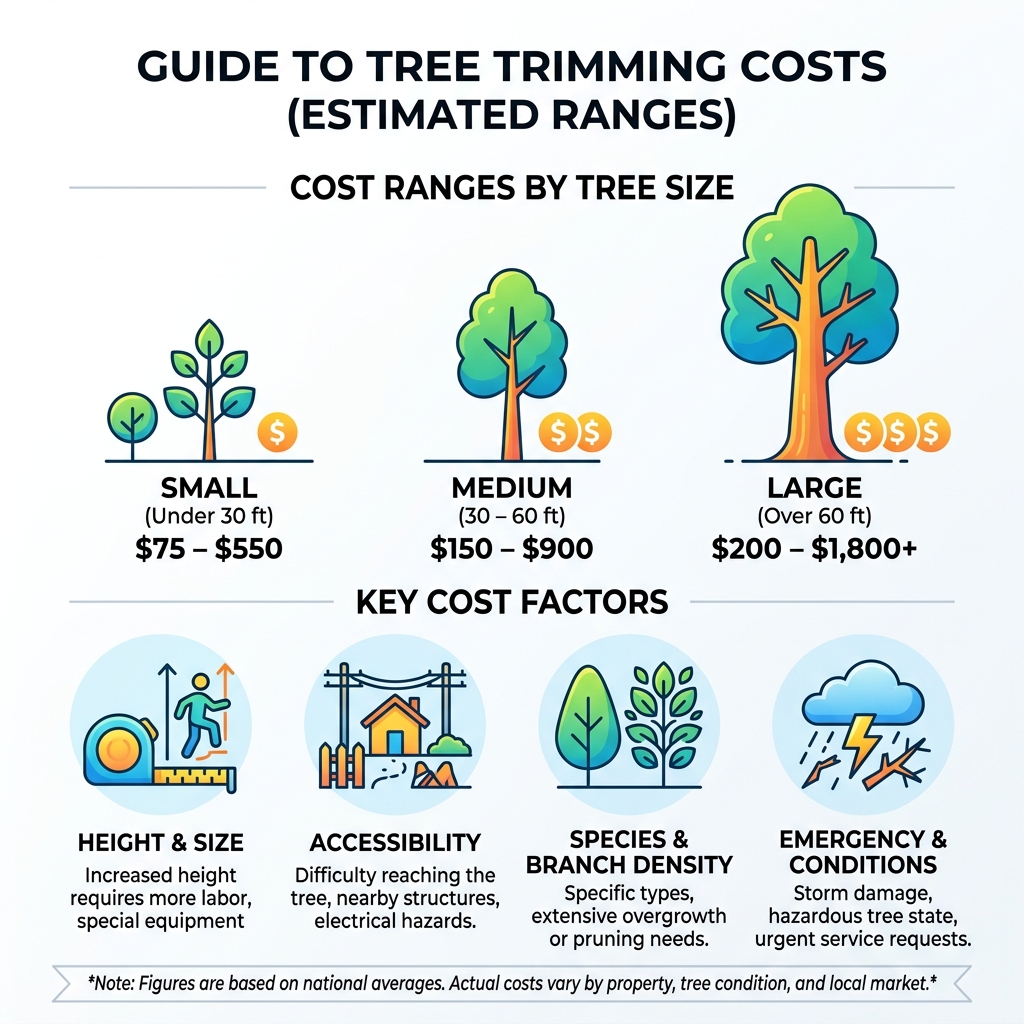
Simple guide to cost of tree trimming:
When we talk about the cost of tree trimming, it is important to remember that no two trees are exactly alike. However, looking at national data provides a solid baseline for residential budgeting. According to How Much Does Tree Trimming Cost? – NerdWallet, the typical range for a professional job falls between $200 and $760, with an overall average of $460.
In the Massachusetts market, particularly in areas like Lexington, Concord, and Newton, costs can skew slightly higher due to the density of mature hardwoods and regional labor rates. We often see homeowners balancing the need for aesthetic “curb appeal” with the practical necessity of safety.
The most significant driver of price is verticality. The higher a crew has to climb or reach, the more equipment and safety protocols are required.
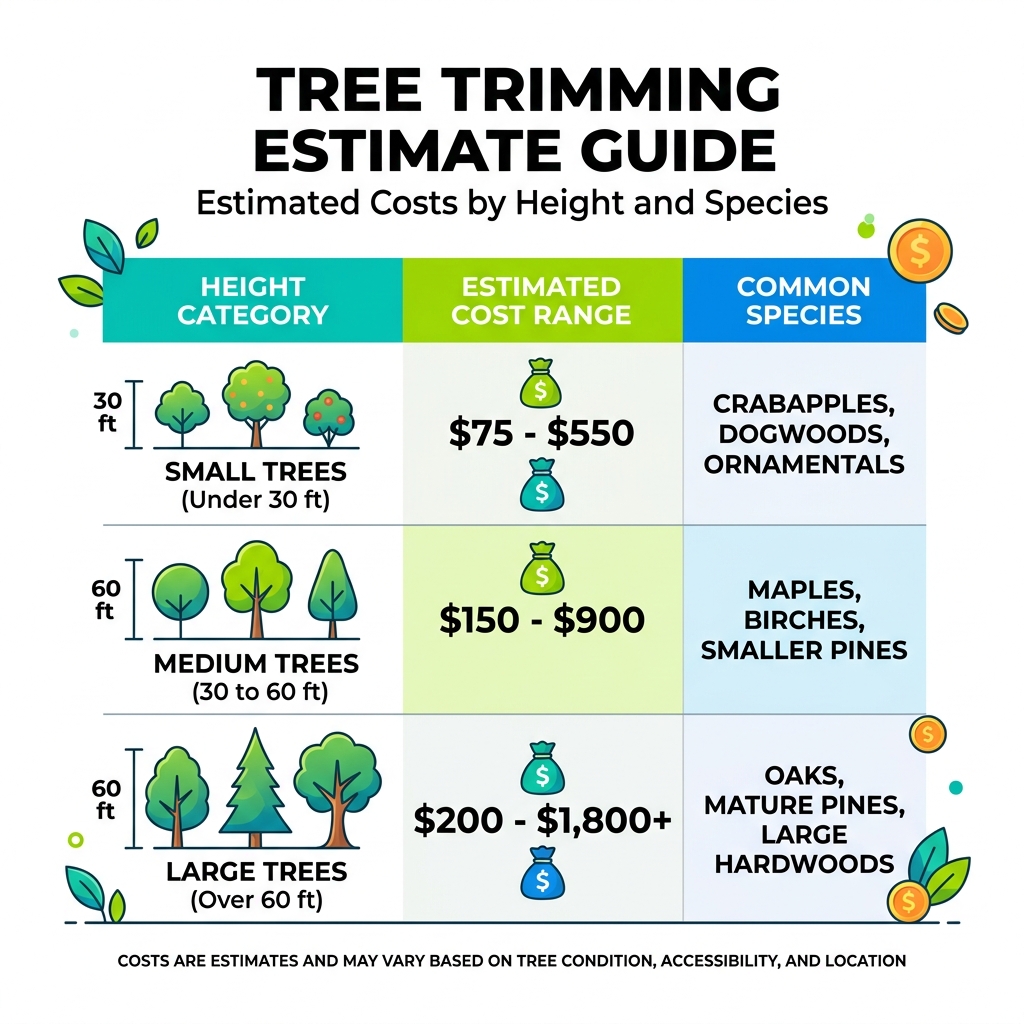
When we arrive at a property in Arlington or Belmont to provide a quote, we aren’t just looking at the tree’s height. Several “invisible” factors play into the final number.
If a tree is sitting in the middle of a wide-open field, the job is straightforward. However, if it is squeezed between a swimming pool and a delicate fence, or hanging directly over your sunroom, the complexity rises. Difficulty in getting equipment like a bucket truck or chipper close to the tree will increase labor hours.
One of the most serious factors is the presence of utility lines. According to Overhead Line Work: Line-Clearance Tree Trimming Operations, working near power lines requires specialized training and extreme caution. If branches are interfering with main utility lines, you should actually contact your local utility company first, as they may handle the clearance for free. For secondary lines leading to your house, a professional service is mandatory for safety.
For a deeper dive into how these variables interact, you can check out more info about trimming costs to see how specific site conditions change the math.
The type of tree in your yard dictates how it needs to be cut and how much effort it takes to do so. Different species have different growth patterns and wood densities.
We always tell our clients in places like Waltham and Billerica that tree care is an investment, not just an expense. If you neglect a tree for ten years, a simple $400 trim can easily turn into a $1,500 “rehabilitation” job—or worse, a full removal.
For more info about tree services, it’s helpful to understand that frequency matters:
Regular maintenance ensures that we catch pests or structural weaknesses before they become costly roof repair issues.
While many people use these terms interchangeably, they serve different purposes and can sometimes carry different price tags.
Understanding the more info about trimming and pruning distinction helps you communicate better with your service provider. Pruning often requires more expert knowledge of tree biology to ensure the cuts are made at the right spots (the “branch collar”) so the tree can heal properly.
Sometimes, the cost of tree trimming is just the starting point. Depending on the state of your property, you might need “add-on” services that can change your final bill.
It can be tempting to grab a chainsaw and a ladder from the local hardware store to save a few hundred dollars. However, tree work is consistently ranked as one of the most dangerous professions in the country.
Hiring a professional ensures that the job is done safely and that the company carries the necessary insurance to protect your property. If a tree is beyond saving, you may need to look into more info about tree removal instead. Professionals understand why to hire an arborist—they have the technical expertise to diagnose whether a tree needs a haircut or a permanent exit.
For most species in Massachusetts, the dormant season (late fall through late winter) is ideal. Without leaves, it is easier for us to see the tree’s structure and identify problem areas. Furthermore, trees are less susceptible to pests and diseases when the sap isn’t flowing. However, emergency trimming should be done immediately, regardless of the season.
Most mature trees benefit from a professional inspection and trim every 3 to 5 years. Fast-growing species or those near power lines and structures may need attention every 2 years. Regular inspections help you avoid the much higher costs associated with storm damage or total tree death.
In many Massachusetts towns, you do not need a permit for standard maintenance trimming on your own property. However, some municipalities have “Heritage Tree” ordinances or protections for trees in public rights-of-way or wetlands. If you are in a historic district or dealing with a protected species, it is always best to check with your local town hall first.
Navigating the cost of tree trimming doesn’t have to be a guessing game. By understanding that size, species, and accessibility are the primary drivers of price, you can better prepare your home maintenance budget. The goal of trimming isn’t just to make the tree look “neat”—it’s to ensure the safety of your family and the longevity of your landscape.
At Zacarias Tree & Landscaping, we pride ourselves on providing rapid responses and quick, honest estimates for homeowners across Massachusetts—from Acton and Arlington to Worcester and Woburn. We don’t just cut branches; we provide a thorough cleanup so your property looks better than when we arrived.
Don’t wait for the next big storm to find out your trees are a hazard. Get a free estimate for tree removal and trimming from our team today, and let us help you keep your property safe and beautiful.
Need a pro? Zacarias Tree & Landscaping provides licensed, insured, and expert care across Lynn, Essex, and Middlesex Counties.
We live by a simple promise: Clear scope. Clear plan. Clean finish.
From emergency removals to seasonal landscaping, we’ve been Lynn’s trusted choice since 2002. Safety-first standards. Total site cleanup. Every time.