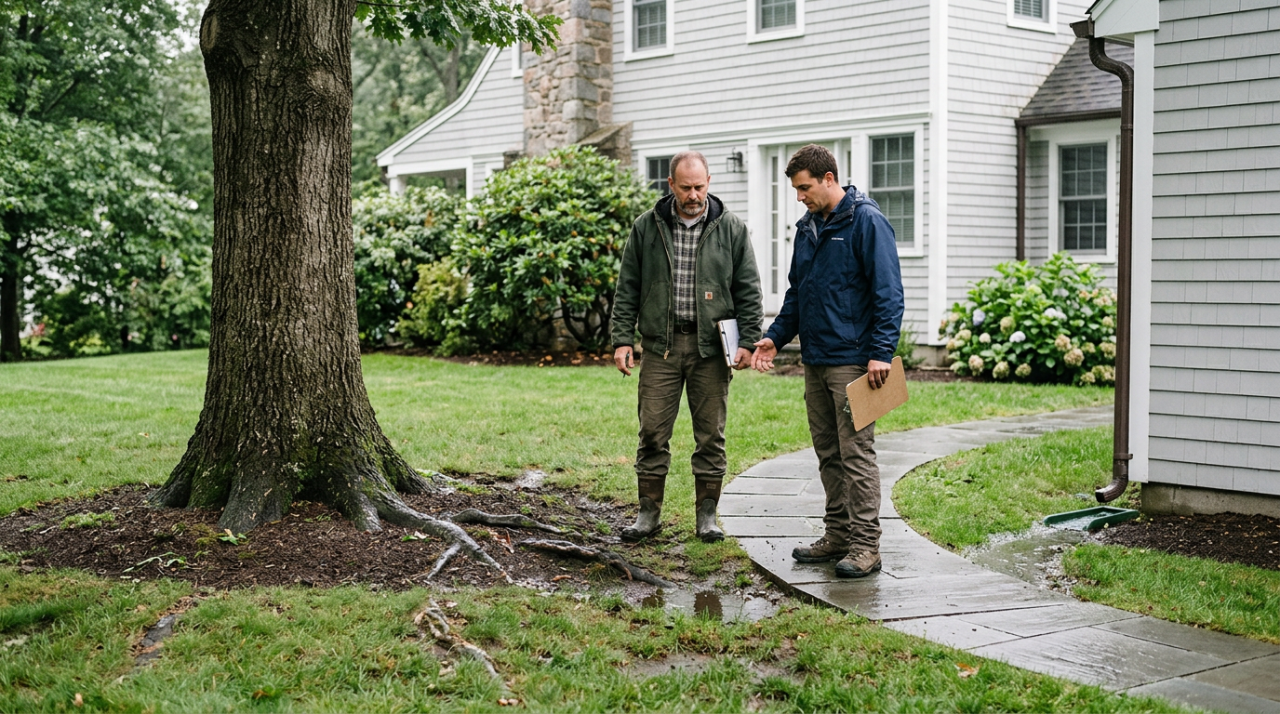
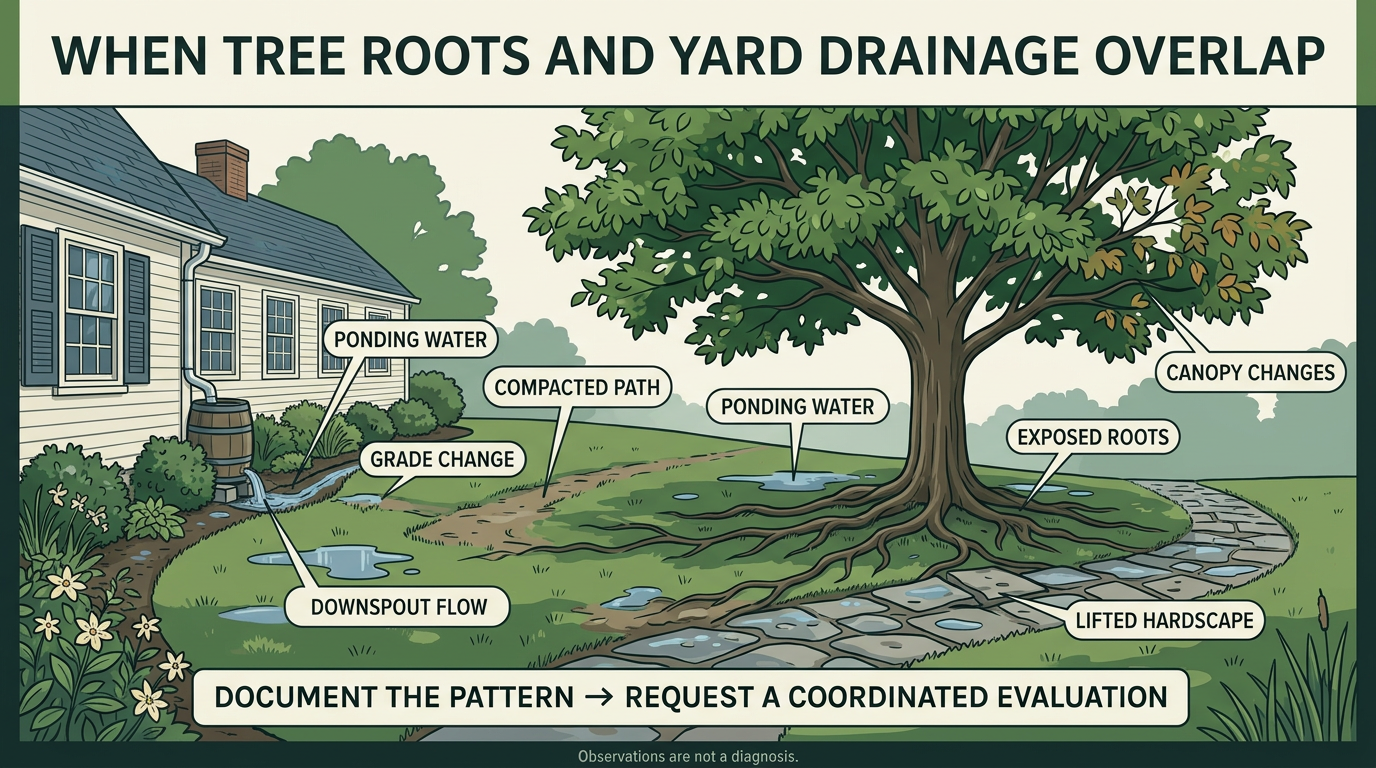
Tree and drainage conditions should be evaluated together when water, soil, grading, hardscape, or construction has changed within a tree’s rooting area. Recurring ponding, compacted soil, new fill, exposed roots, lifted pavement, erosion, canopy decline, or a recent trench are observations to document—not proof that roots caused the drainage problem or that drainage caused the tree symptoms.
Why the two systems overlap
Roots need both water and oxygen. Saturated or compacted soil can reduce air movement and root growth, while excavation, added soil, or grade changes can disturb existing roots and redirect water. University of Minnesota Extension explains that compaction reduces pore space, infiltration, and drainage. Its tree guidance also identifies saturated and compacted soils among site conditions associated with tree instability or stress.
Build an observation record before changing the yard
| Observation | Record | Do not assume |
|---|---|---|
| Ponding or runoff | Rain amount, start/stop time, depth area, duration, flow direction | Visible roots are blocking underground drainage |
| Soil and grade | Recent fill, ruts, equipment traffic, erosion, new low/high points | Adding topsoil or gravel will correct the cause |
| Tree condition | Lean change, soil lifting, cracks, dead/hanging limbs, foliage change | One symptom identifies disease or risk |
| Hardscape and utilities | Lifted edges, settled areas, downspouts, drains, trenches, repairs | Cutting roots or changing pitch is a safe first step |
Map recent property changes
List additions, patios, driveways, utilities, fences, grading, drainage work, stump removal, irrigation, soil stockpiles, and repeated equipment routes. Add dates if known. Even work outside the canopy can affect roots or water pathways. UMass Amherst notes that buildings, pavement, underground utilities, traffic, and compaction substantially modify suburban planting sites; see its tree and shrub site guidance.
Know when the observation becomes urgent
Keep people away and seek prompt professional or utility help when a tree has a sudden or increasing lean, soil heaving near the base, a split trunk, large hanging or cracked limbs, partial uprooting, or contact with electrical lines. Do not enter a fall zone to take better photographs. The International Society of Arboriculture’s storm-related tree damage guidance advises staying clear of damaged trees and involving emergency services, utilities, or an arborist when hazards are present.
Avoid quick fixes that destroy evidence
- Do not cut major roots, trench, drill, or excavate near a tree without an evaluated plan.
- Do not bury roots or the trunk flare with added soil or mulch.
- Do not drive heavy equipment through saturated root-zone soil.
- Do not redirect downspouts or drains toward a neighbor or another vulnerable area.
- Do not diagnose stability from photographs alone.
Massachusetts excavation can trigger Dig Safe obligations, and public markings may not identify all private drainage or irrigation lines. Review the state’s Dig Safe guidance before any approved excavation.
What a coordinated site review should answer
- What is the likely source and path of surface or subsurface water?
- Which trees and root areas may be affected by present conditions or proposed work?
- What additional information—survey, soil evaluation, drainage testing, utility locating, or arborist assessment—is needed?
- Can the design avoid excavation, compaction, or grade change in sensitive areas?
- How will construction access, drainage outlets, hardscape, and planting work together?
Questions property owners ask
Do roots always cause lifted walkways?
No. Roots, base conditions, frost, drainage, settlement, and material details can interact. The repair plan should evaluate both the tree and the hardscape.
Can a French drain be installed beside a tree?
Possibly, but trench location, depth, roots, outlet, utilities, soil, and the actual drainage cause must be evaluated first. A generic trench detail is not a site plan.
Will improving drainage save a declining tree?
Not automatically. Tree response depends on species, duration and severity of stress, roots, pests/disease, construction history, and other conditions. A qualified assessment is needed.
Zacarias Tree & Landscaping can coordinate the landscape side through its landscaping services and evaluate tree-related concerns through its tree services across the North Shore and Greater Boston area.