
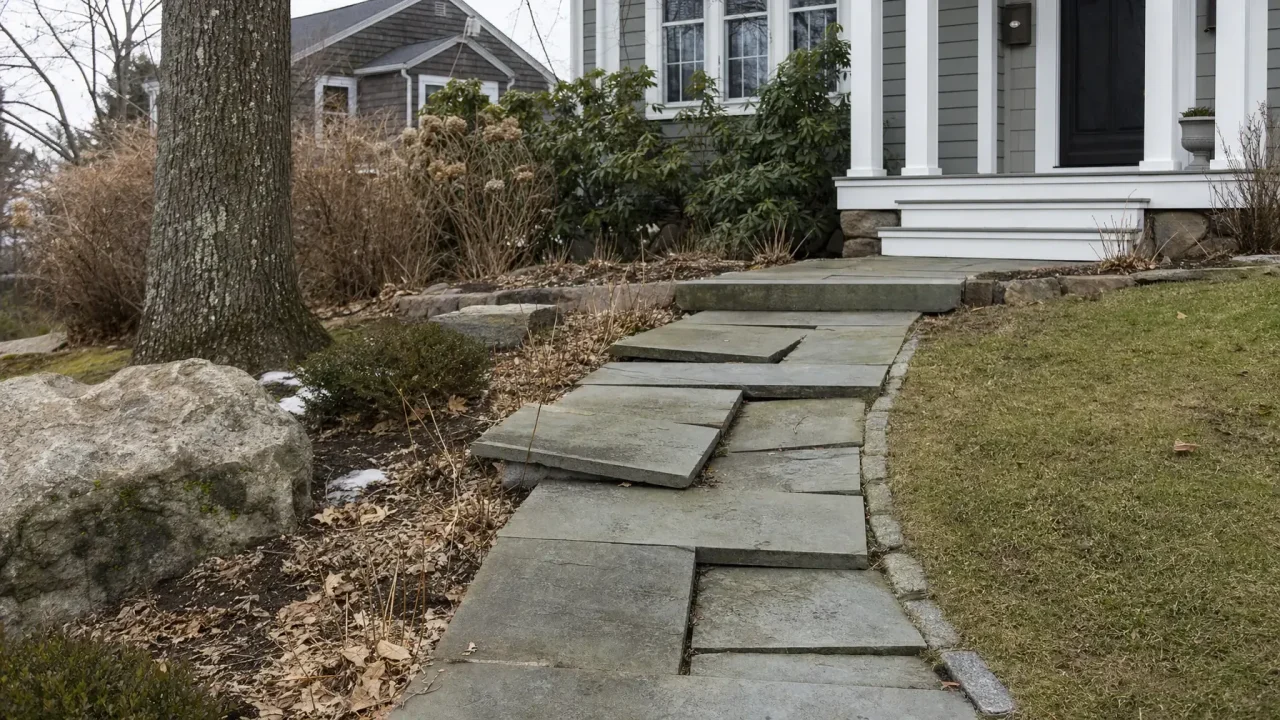
An uneven walkway does not automatically need complete replacement. A localized repair assessment may make sense when the concern is confined to a limited area and the rest of the route still works for your household. Replacement deserves discussion when unevenness is widespread, problems return after previous work, or the path no longer provides suitable access.
The deciding question is not simply whether the surface can be made to look level again. It is whether the proposed work addresses the conditions behind the problem, and leaves you with a useful route. Visible symptoms help frame that discussion, but they cannot establish the cause or the right repair method without an on-site assessment.
Separate immediate access from the permanent decision
A raised edge, loose-looking surface, or deteriorated section deserves attention even before you decide between repair and replacement. Avoid the affected section where possible and tell household members and visitors about it. If another usable entrance is available, consider using it while arranging an assessment.
Compare isolated defects with widespread or recurring problems
- A localized repair assessment is worth requesting when the concern appears confined, surrounding sections remain usable, and the current layout still meets your needs. Ask whether the affected area can be addressed without leaving related problems outside the work limits.
- A broader replacement discussion is worth having when unevenness or deterioration extends along the route, multiple sections need attention, or correcting a limited area would leave other access concerns unresolved.
- Recurring movement calls for investigation before another surface correction. Share what was done previously, where the problem returned, and any records you have. Recurrence does not prove replacement is necessary, but it makes the reason for the earlier result important.
Material condition and the scope of reconstruction are separate questions. Some existing pieces may be candidates for reuse even if a larger section needs rebuilding. Conversely, usable-looking surface material does not establish that the support beneath it can remain.
Include water and nearby trees without guessing at the cause
Record where water collects, where runoff reaches the walk, and whether water appears to travel toward the house. Existing photographs taken during or after rain can help explain the pattern. Do not enter a slippery or unstable area just to collect more detail.
Puddling is an observation, not proof of a particular drainage failure. Likewise, an uneven section beside a tree does not by itself prove root damage. Ask the assessor what needs to be checked about surface slope, supporting layers, surrounding ground, and nearby roots before recommending a scope.
Where trees and wet areas overlap the proposed work, a coordinated assessment can help keep the walkway decision from being made in isolation. The guide to evaluating tree roots and yard drainage together explains what to bring into that conversation. Do not cut roots, dig beside the path, or redirect runoff as a way to test a theory.
Ask whether the existing route still works
Repairing the current surface may leave the current layout unchanged. Before choosing that scope, consider whether the walkway connects the places people actually need to reach and accommodates how your household uses it now.
- Does the route provide practical access between the driveway, entrance, and yard, or do people regularly avoid it?
- Is there adequate room for household members using mobility aids, carrying items, or helping someone beside them?
- Are turns, transitions, and the approach to the door part of the difficulty rather than just the uneven section?
- Can the route be maintained and cleared of snow without leaving the same access problem unresolved?
If those needs have changed, replacement may be worth discussing even when some material remains usable. For the installation side of that conversation, see the walkway installation overview. Keep the decision focused on what the route must do, rather than choosing a new finish before resolving access.
Compare proposals by what they retain, investigate, and restore
Labels such as repair and replacement can hide very different scopes. Ask for clear work limits and an explanation of what remains in place. A limited proposal and a full reconstruction proposal are not directly comparable if they address different conditions.
- Retained materials: Which surface pieces and underlying areas would remain? Is reuse conditional on their condition after removal?
- Removal and disposal: What would be removed, what would be set aside for reuse, and what haul-away is included?
- Underlying conditions: What can be assessed before work begins, and what may remain unknown until the surface is opened? How would a change in scope be documented and approved?
- Water and trees: What drainage evaluation is included, and does nearby tree involvement require an arborist’s input?
- Connections and restoration: How will the finished work meet retained sections, entrances, or adjacent surfaces? What lawn, planting-bed, or landscape restoration is included?
- Access during work: Where will people enter the home, and how will work areas and material staging affect the property?
Leave the assessment with a reasoned recommendation
Before choosing, ask what supports a localized approach, what would make broader reconstruction necessary, and what concerns each option would leave unresolved. If replacement is recommended, ask why retaining more of the walkway would not meet the project’s goals. If repair is recommended, ask how the proposal accounts for recurrence and adjacent conditions.
Zacarias Tree & Landscaping includes walkways among its hardscaping services for properties in Lynn and across Essex and Middlesex Counties. When requesting a visit, describe the existing condition and ask which assessment or project options are available for your walkway; do not assume every repair method is offered.
The useful outcome is a defined scope tied to observed conditions and household needs, not a repair or replacement label chosen from appearance alone.