
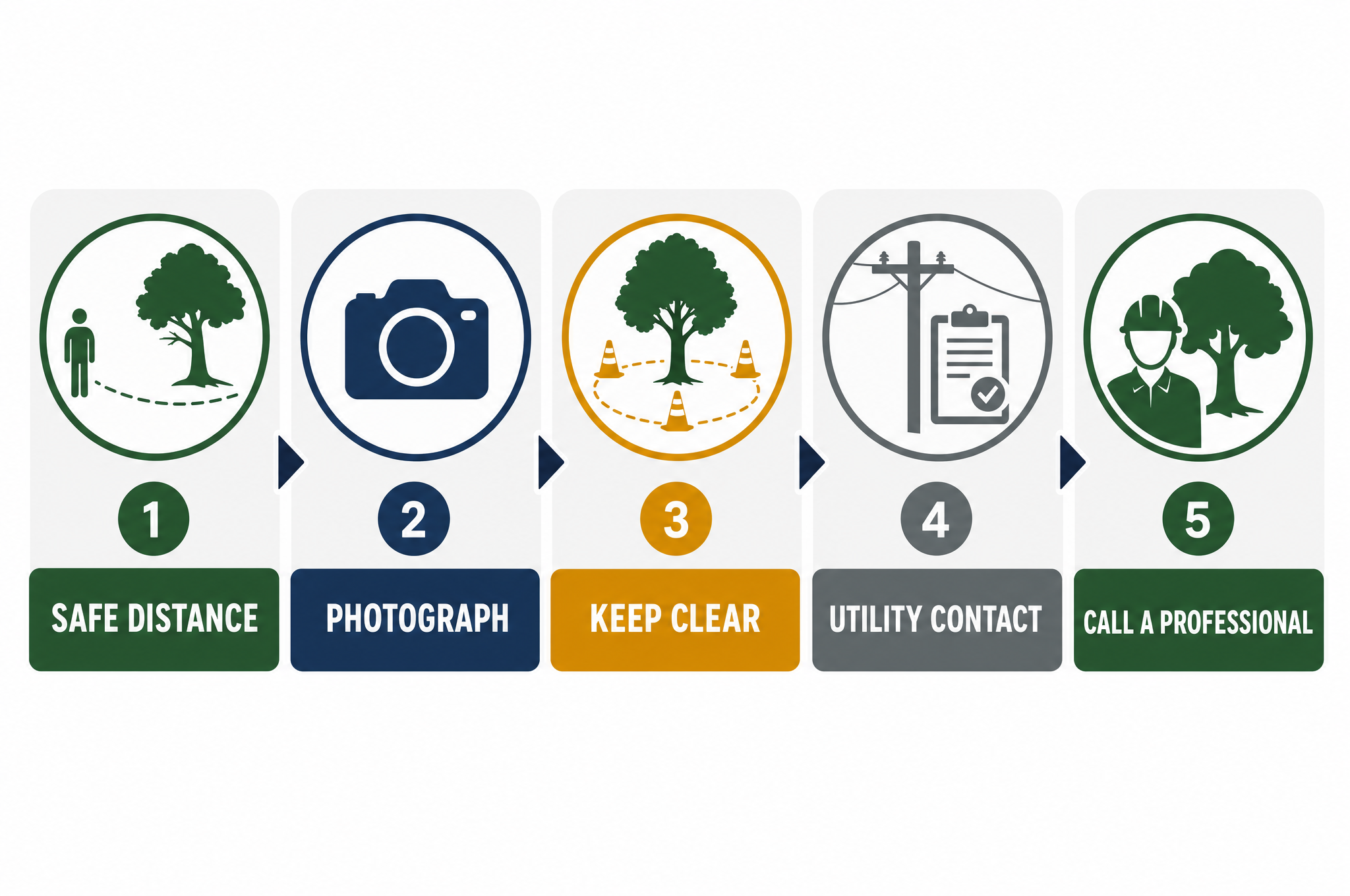
During a tree emergency, protect people first: stay clear of the tree and anything it touches, keep others out, call 911 for an immediate threat to life, and contact the electric utility for any tree or limb involving wires. Only take photographs from a safe location. A tree-service dispatcher needs the address, hazard, people/structures involved, wire status, access, and a callback number more than a close-up image.
Use the right first call
- Call 911 for fire, injury, a trapped person, blocked emergency access, gas odor, or another immediate threat to life or public safety.
- Call the electric utility when a tree or branch touches, hangs over, or has brought down electrical lines. Treat every wire as energized.
- Call a qualified tree service for storm-damaged, fallen, cracked, uprooted, or hanging tree parts once people are clear and utility hazards are being handled.
Do not approach a line to determine whether it is electric, communications, or inactive. Do not drive over or move a wire or a branch touching one.
Information to give the dispatcher
| Tell us | Useful detail | Do not do |
|---|---|---|
| Exact location | Street address, side/rear yard, nearest entrance, gate | Enter the fall zone to mark the trunk |
| What happened | Whole tree or limb, uprooted/leaning/hanging, when it changed | Diagnose stability or cut a tensioned limb |
| What is affected | People, house, vehicle, road, neighboring property, wires | Move a damaged vehicle beneath the tree |
| Access | Gate width, driveway, overhead wires, septic, soft ground | Promise equipment access you have not checked |
Take only safe, useful photographs
From outside the potential fall and roll zone, take a wide view showing the entire tree and surroundings, a second view from another safe angle, and a view of access from the street or driveway. Use zoom for cracks, hanging limbs, root-plate movement, or wire involvement. Stop if wind, rain, darkness, traffic, unstable ground, or changing movement makes observation unsafe.
The International Society of Arboriculture warns that hanging limbs, uprooted trees resting on structures, tensioned wood, and electrical contact can move unexpectedly; its storm-damage guidance recommends staying clear and using professional arborists for assessment and cleanup.
Keep the work area clear without entering it
- Keep children, pets, tenants, neighbors, and onlookers away.
- Move vehicles only when they are outside the hazard zone and can be moved safely.
- Unlock an alternate gate or identify another approach without walking under damaged limbs.
- Tell responders about septic systems, wells, irrigation, propane/oil, weak pavement, or locked areas.
- Do not start chainsaw work, climb, pull with a vehicle, or use a ladder.
- Do not remove debris that may be supporting another limb or hiding a wire.
OSHA’s storm tree-trimming guidance describes the hazards professional crews manage during debris removal. A homeowner’s useful role is communication and access—not dangerous cleanup.
Prepare property and insurance information
Record the event time, weather, visible damage, utility/911 call numbers if provided, and safe before/after photos. Notify the property insurer when a structure, vehicle, or covered property is involved and ask what documentation it requires. Do not delay emergency action needed to protect life, and do not make coverage promises based on a blog post.
Emergency-call questions
Can I cut a small hanging limb?
Not if it is overhead, tensioned, supported unpredictably, near wires, or requires climbing/ladder work. Size alone does not make storm damage safe.
Should I tarp the roof?
Stay out of the tree and roof hazard zone. Discuss temporary weather protection with qualified responders or roofing professionals after the tree and electrical hazards are controlled.
What if the tree is from a neighboring property?
Protect people, report utility/public hazards, contact the tree service and insurers, and document conditions from your own safe area. Property responsibility can be fact- and jurisdiction-specific.
For urgent tree conditions on the North Shore or in Greater Boston, use Zacarias Tree & Landscaping’s tree services. For non-emergency site restoration and drainage coordination after hazards are controlled, review its landscaping services.