
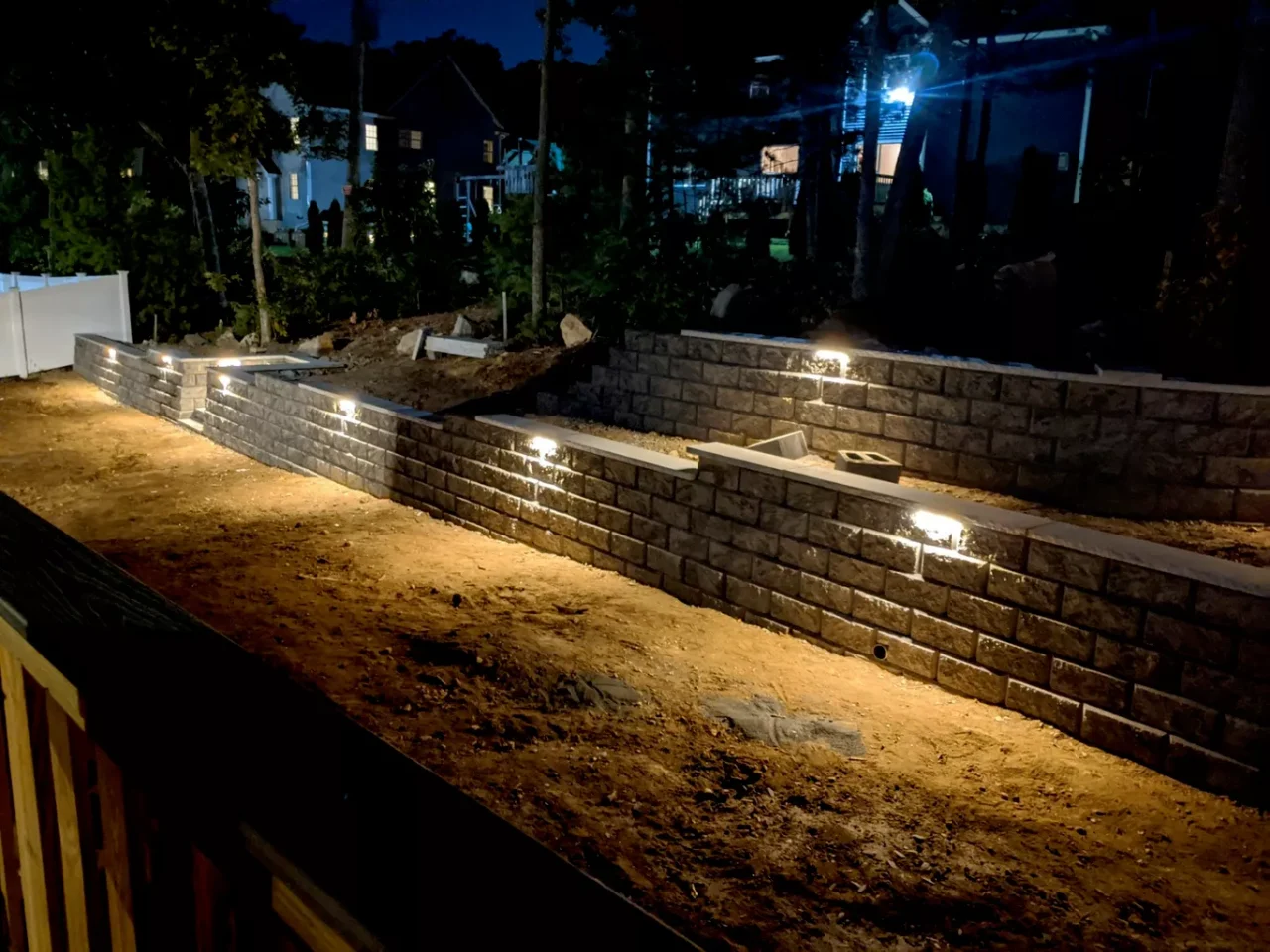
The most useful low voltage landscape lighting tips come down to three decisions: light where people actually walk, hide the glare so light lands on the ground and not in anyone's eyes, and size the transformer and wiring so every fixture gets full power. Paths, steps, patio edges, and the front entry come first; accent lighting on trees and walls comes second. Plan it that way and the yard feels safe and comfortable after dark without looking like a runway.
Zacarias Tree & Landscaping designs and installs outdoor lighting alongside our patios, walkways, and walls for homes in Lynn and across the North Shore. This guide covers the basics of how these systems work, placement for each area, and a simple maintenance routine.
Low voltage landscape lighting basics
A low voltage system has three main parts:
- A transformer that plugs into a weatherproof, GFCI-protected outdoor outlet and steps household current down to about 12 volts.
- Direct-burial cable that runs just below the surface from the transformer to the fixtures.
- Fixtures, now almost always LED, such as path lights, step lights, spotlights, downlights, and wall lights.
Because the voltage is low, the cable does not need the deep trenches and conduit that full household wiring does, which makes these systems safer and more flexible for yards. The outlet and transformer location still need to meet electrical code.
Start with where people walk
Before choosing fixtures, walk the property at night with a flashlight. Mark every place where someone could trip, miss a step, or hesitate: the driveway to the front door, side gates, back steps, patio edges, and the route to the trash cans. Those points get lit first. Everything else is decoration.
Paths and walkways
Path lights should light the walking surface, not the sky. Choose fixtures with a hood or shade so the bulb is hidden from view. A few practical points:
- Spacing: a common starting point is 6 to 10 feet apart, adjusted to the fixture's spread so pools of light just meet. Too close looks like an airport runway; too far leaves dark gaps.
- Stagger them: alternating sides of the path usually looks more natural than lining both edges.
- Set them back: place fixtures a little off the edge so they are not kicked, shoveled, or hit by a snowblower.
- Light the turns: put a fixture where the path changes direction or meets steps.
If you are building or rebuilding a path, run the cable before the surface goes in. See our walkways page.
Steps and grade changes
Steps cause more nighttime falls than flat paths. Lights set into the riser or tucked under the tread lip show each edge clearly without glare. On retaining walls, lights under the cap can wash both the wall and the ground below. Our retaining wall ideas guide shows how walls and lighting can be planned together.
Patios
- Light the edges and any step down so people can find them.
- Use downlights mounted in a nearby tree or on the house for soft, even light over a seating area. Mounting in a tree should use hardware that will not girdle the branch as it grows.
- Keep bright fixtures out of seated eye level.
- Add a separate zone for the patio so it can be brighter when you are outside and dimmer or off the rest of the time.
Learn more about our patio work.
Entryways
The front door needs even light on the walking surface, the steps, the lock, and the house number. Two fixtures, one on each side, avoid harsh shadows. Keep them shielded so arriving guests are not looking into a bright point. For planting and walkway ideas that pair with entry lighting, read our guide to entrance landscape design.
Controlling glare and color
- Pick shielded fixtures and aim spotlights away from windows, the street, and neighbors.
- Warm white light, commonly around 2700K to 3000K, flatters stone, plants, and brick more than cool white.
- Less is usually more. A few well-placed fixtures read as calm; too many makes the yard look busy and wastes power.
Timers and controls
A photocell turns lights on at dusk. An astronomical timer adjusts on/off times through the seasons automatically. Many newer transformers also allow app control and separate zones, so paths can stay on all evening while accent lights shut off at bedtime. Whatever you choose, check the settings after power outages and clock changes.
Wiring that keeps every light bright
- Size the transformer with headroom. A common rule is to keep the total fixture wattage under about 80 percent of the transformer's rating.
- Watch voltage drop. Long runs lose voltage, so the last fixture on a long cable can be dim. Heavier cable, shorter runs, or a hub layout that feeds fixtures from a central point keeps brightness even.
- Use sealed connectors. Cheap pinch connectors let moisture in and corrode, which causes flickering.
- Locate utilities. Even shallow trenching counts as digging. Call Dig Safe first.
How to maintain low voltage landscape lighting
New England winters are hard on outdoor lighting. Frost heave tilts fixtures, plows and shovels clip them, and salt corrodes cheaper metals near driveways and the coast. A quick routine each spring and fall keeps the system working:
- Straighten and re-seat fixtures pushed over by frost or snow.
- Clean lenses and remove leaves, dirt, and mulch from around fixtures.
- Trim plants that have grown over path lights or into spotlight beams.
- Look for exposed or damaged cable, especially along bed edges.
- Check the timer or photocell and adjust aim where plants have grown.
- Note any dim or dead fixtures; the cause is often a bad connection rather than a failed LED.
Near the coast or salted driveways, solid brass or copper fixtures hold up better than painted aluminum.
Frequently asked questions
How far apart should path lights be?
A common starting point is 6 to 10 feet, adjusted so the pools of light just touch. Test with a few fixtures before burying cable.
Why are some of my landscape lights dimmer than others?
Usually voltage drop on a long cable run, an overloaded transformer, or a corroded connection. Fixing the layout or connectors normally solves it.
Can I install low voltage lighting myself?
Many homeowners handle a small path light kit. Larger systems with multiple zones, long runs, or lights in trees and walls benefit from a professional layout.
Do LED landscape lights need much maintenance?
LEDs last a long time, but fixtures still need cleaning, straightening, and connection checks, especially after winter.
Plan your lighting
Our outdoor lighting team can design a system around your paths, patio, and entry, or check an existing one that keeps failing. Request a free on-site estimate anywhere in Lynn, the North Shore, and Essex and Middlesex Counties.